Germany, Hawaiian sugar, San Diego, and civic philanthropy.
We’re just back from Hawaii, where we learned about the 19th century sugar plantations, and the US businessmen who were key to overthrowing the Hawaiian monarchy and establishing the republic that would eventually become the United States’ 50th state. On previous travels throughout the US we learned about German immigration in the mid 1800s, and how many of those immigrants became influential landowners and industrialists.
Now here we are in San Diego, where those two things have come together.
Claus Spreckels was born in the Kingdom of Hanover before the unification of multiple kingdoms into what is now Germany. He came to South Carolina – legend has it with a single coin in his pocket – in 1846, at just 18 years old. He opened a grocery store, then moved to New York City, then shortly afterward to San Francisco where he opened a brewery. Things must have gone well, because within a few years he got involved in sugar refining, quickly expanding to become the California Sugar Refinery, the dominant refiner of Hawaiian sugar. He lived much of his life in Hawaii, and there is even a town on Maui named after him: Spreckelsville. In Southern California he built a resort hotel, invested in the Santa Cruz Railroad, and established the largest beet sugar factory in the US: Spreckels Sugar Company (which just makes me think of sugar sprinkles).
So where does San Diego fit in?
Claus’ eldest son, John D. Spreckels, was no less successful than his father. Using his father’s capital, he grew the sugar refining industry and invested in the control of two large fleets of ships that operated between Hawaii and the US mainland, and all the way to Australia and New Zealand. His transportation and real estate empire in San Diego included the San Diego and Arizona Railway, and the famous Hotel del Coronado. He is credited with turning an economically challenged village into a cosmopolitan city: today’s San Diego. When reading about him, I was amazed at all the iconic San Diego buildings and businesses he owned. He even founded San Diego’s light rail transit system!
John Spreckels was apparently very proud of his city, and was a big supporter of the Panama-California Exposition. He and his brother Adolph donated the organ and the pavilion that bear the Spreckels name, at an equivalent in today’s dollars of $2.9 million USD. John also paid for the services of a renowned organist for the 2 year run of the exhibition, and extended the organist’s contract beyond that so that San Diegans could continue to enjoy the music.
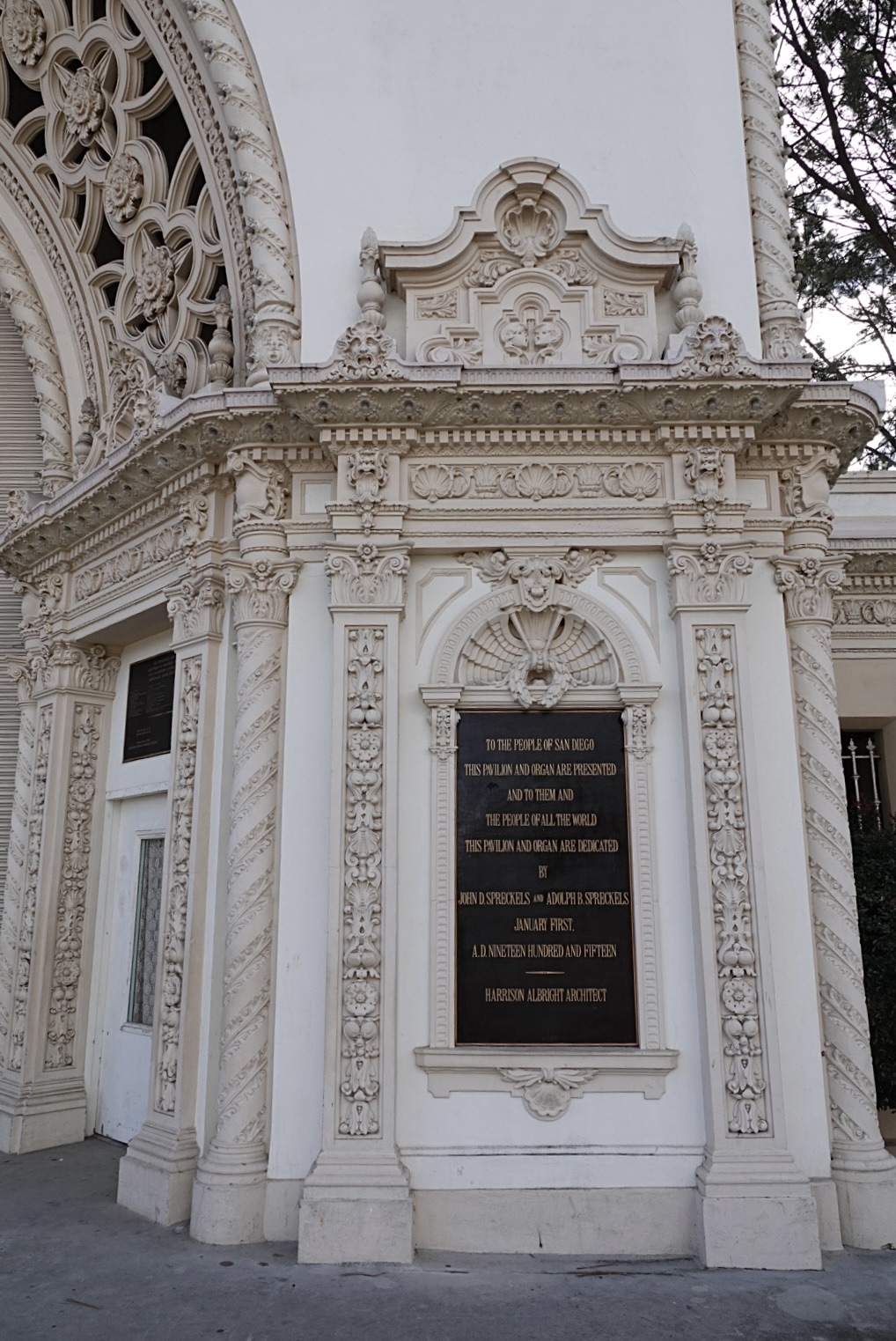
TO THE PEOPLE OF SAN DIEGO
THIS PAVILION AND ORGAN ARE PRESENTED
AND TO THEM AND
THE PEOPLE OF ALL THE WORLD
THIS PAVILION AND ORGAN ARE DEDICATED
BY
JOHN D SPRECKELS and ADOLPH B SPRECKELS
JANUARY FIRST.
A.D. NINETEEN HUNDRED AND FIFTEEN
HARRISON ALBRECHT ARCHITECT
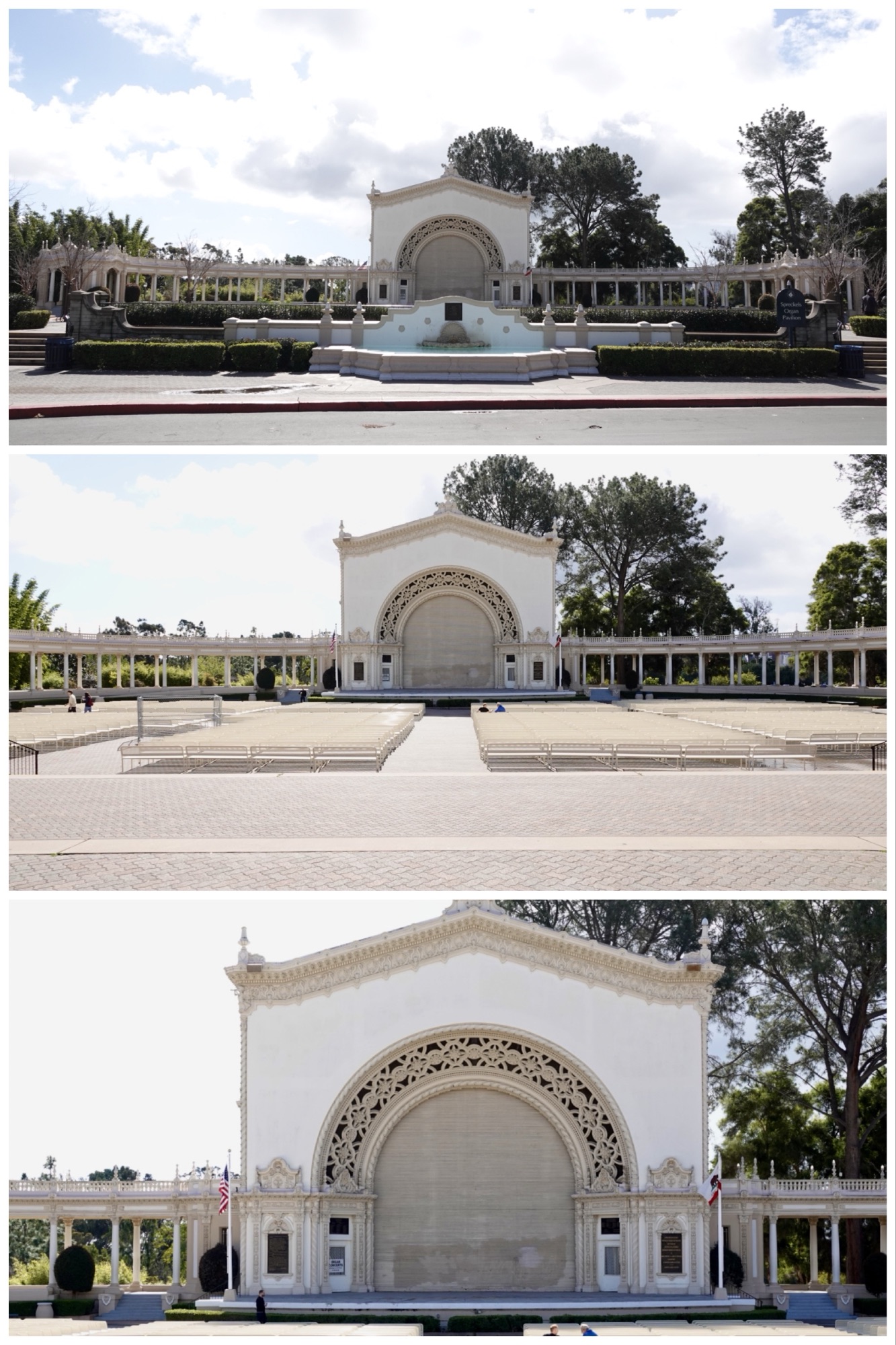
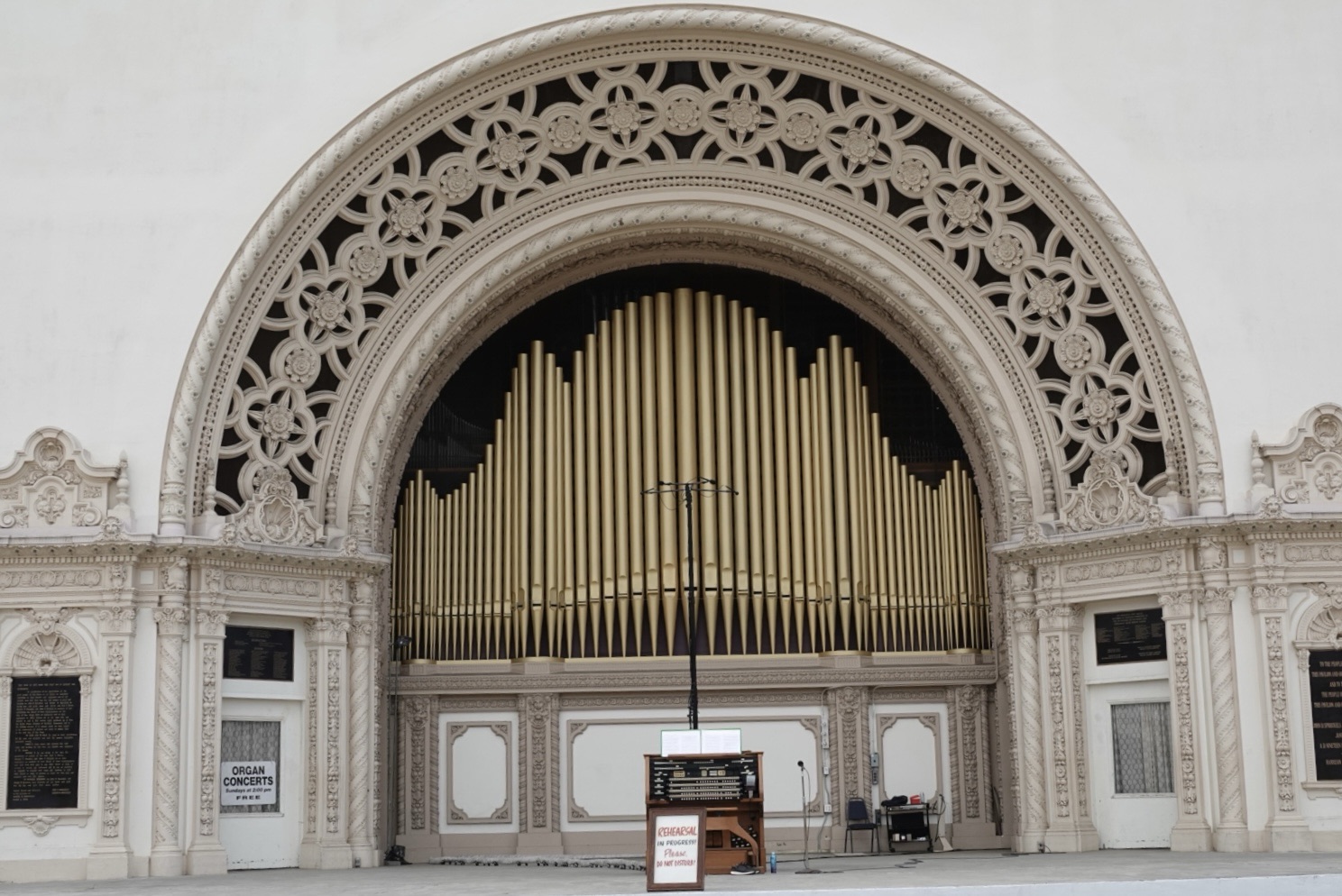

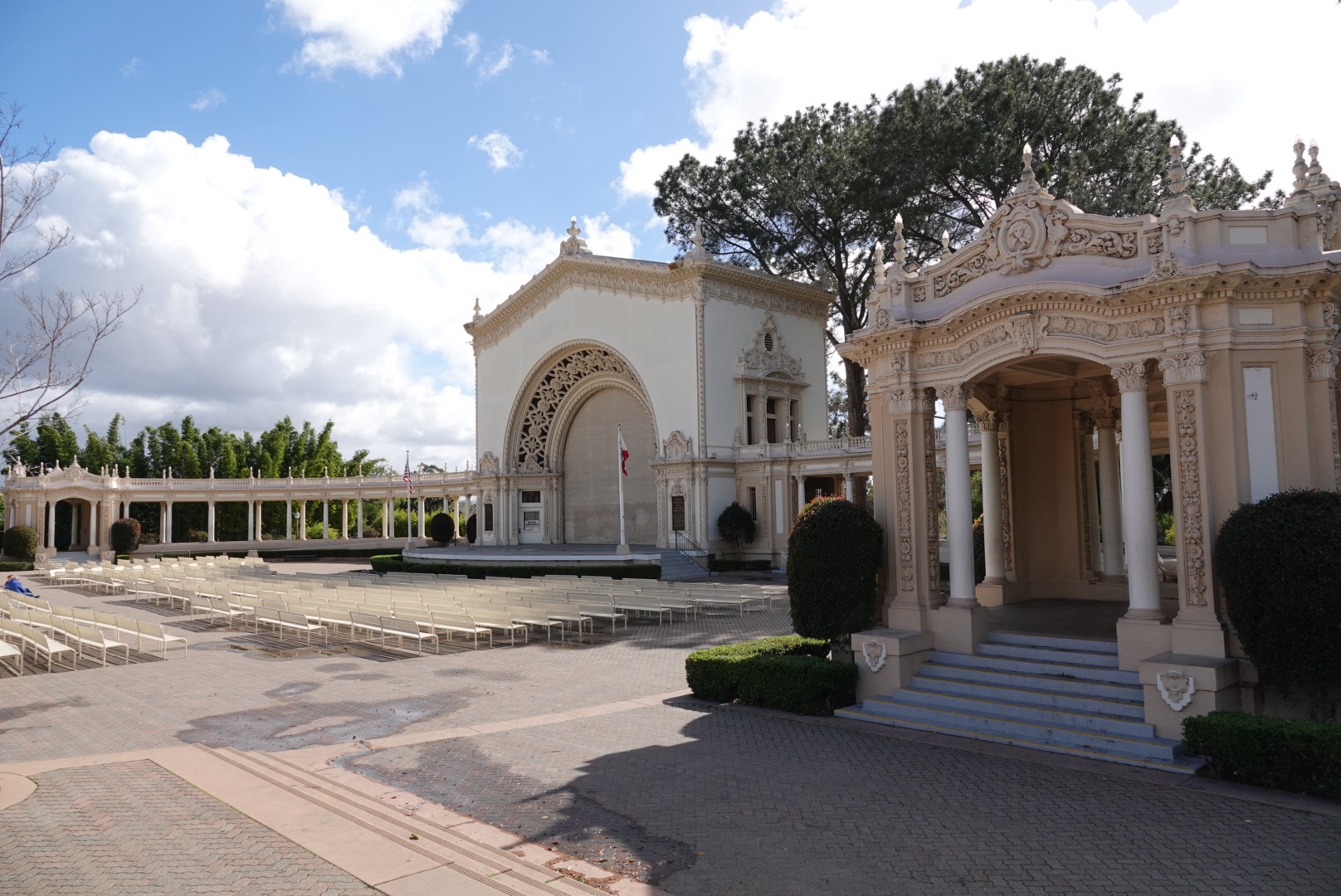
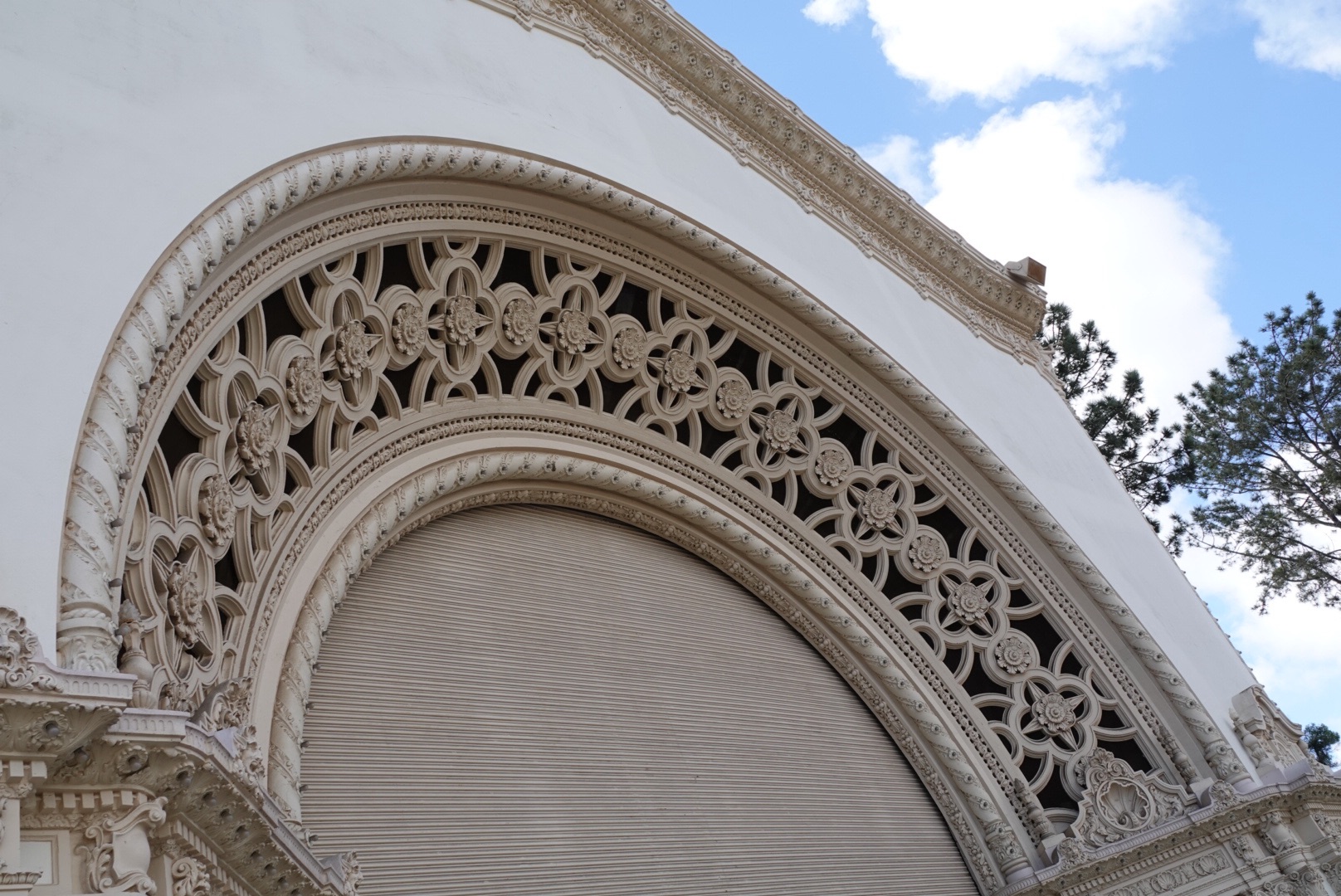
I read that as part of the organ’s inaugural concert,on New Year’s Eve leading into 1915, selections from Haydn’s oratorio Die Schöpfung (The Creation) were performed. That’s the oratorio that Ted and I heard at the opening night of the Salzburg Music Festival in 2016 (attending that was a bucket list item for me), so I can just imagine the magnificent organ and a chorus of 250.
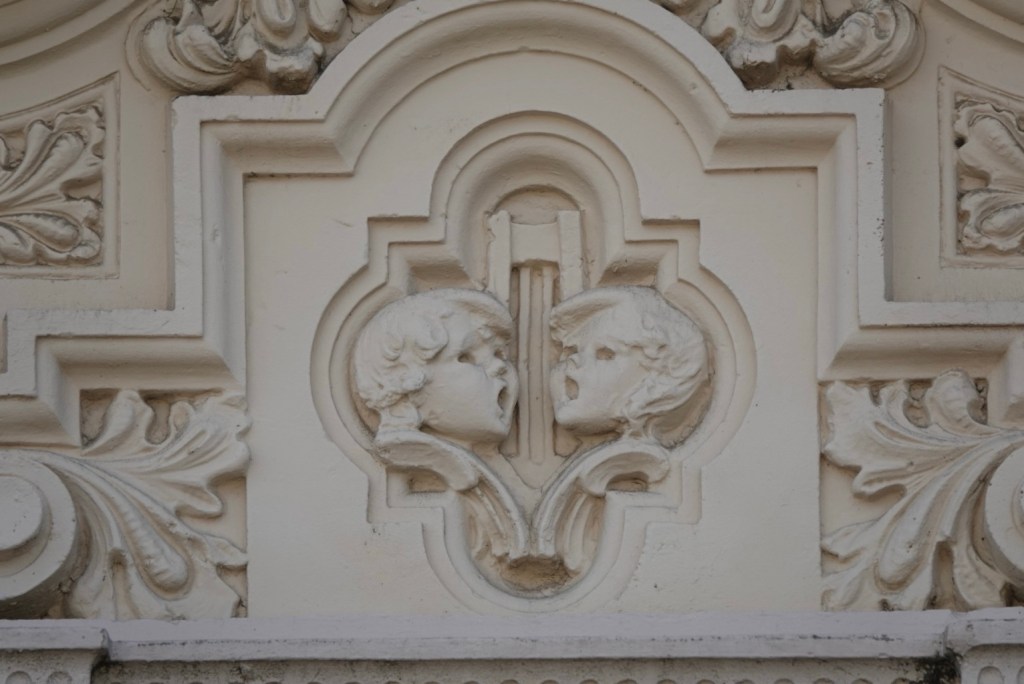
The organ was silent during the war years when Balboa Park was used as naval barracks. By the 1980s, the organ and pavilion were in need of so much repair that they would have been demolished if not for a million dollar repair, funded mostly by a non-profit organization.
Presently, there are free Sunday afternoon concerts, summer evening events, and a summer organ festival.

Here’s the program for the concert we attended:

We noticed that virtually every piece had either been transcribed or arranged by organist Raúl Prieto Ramírez, which only added to his allure. He was incredibly talented, entertaining, FUNNY, (and handsome!). He introduced each musical selection by telling us a bit about its composer, and the reason for its composition. In the case of Beethoven’s Scherzo, he explained that it had been composed to be played once each hour on a mechanical clock located in a wealthy man’s mausoleum, and lamented the foolishness of writing beautiful music for a corpse’s entertainment. Pragmatism won the day though; Raúl’s final comment before playing the lovely piece was “Beethoven needed the money. I hope he was paid well.”
In the video below the photos of the pipes, Raúl talks about the fact that the Spreckels Organ is the world’s largest pipe organ in a fully outdoor venue. It has 5098 pipes, ranging from the largest at almost 34 feet long (so long it had to be “bent” to fit into the pavilion) to the smallest which is the size of a pencil. The second largest outdoor organ is the Heroes’ organ in Austria’s Kufstein Fortress with 4,948 pipes. Guess what is now on my travel wish list.

But wait for it: after Raúl’s explanation, Bernstein’s West Side Story medley is here too.
The pieces chosen for the Sunday performances are a combination of audience favourites, and the organist’s favourites that often also show off all the sounds this organ can make – as well as his playing skills. For instance, in the Bach Prelude and Fugue, Raúl’s right hand played violin, his left played viola, and his feet played the cello part!
Before playing the final selection, Raúl told us about the percussion sounds we’d been hearing, since he was playing unaccompanied. In addition to the 5098 pipes, there are also an actual xylophone, a glockenspiel, a set of chimes, a snare drum, and cymbals in the pavilion. Those instruments are located behind the pipes, and operated by keys on the organ. (Not, as he teased, by “volunteer” San Diegans attached by ball and chain to each instrument and locked into the pipe area where they watch him for their cues.)
This one of Ted’s videos is probably the best demonstration of everything the organ can do, even though the music itself wasmy least favourite.
The organ can certainly be loud, but it can also be delicate and sweet, as in Raúl’s arrangement of Debussy’s Clair de Lune
We have one more Spreckels-related thing to do: drinks at the iconic Hotel del Coronado. That’s something we did in 2010, but at that time it was the Hollywood glamour that drew me, as opposed to the Spreckels connection, so on this visit I’m also going to book the behind-the-scenes guided tour – unless the heavy rains predicted for this week scupper my plans.
 Rose and Ted’s Excellent Adventure
I’m a few days behind in reading your blog, but so glad you wrote this about the Spreckels organ and the family history and connections. I’m thinking now about a long weekend trip to SD, just to hear a concert and experience Balboa Park per your earlier posts. We have been to the zoo there before, but didn’t have time for all the rest. My favorite part of our Viking Grand European River cruise was the organ concert in Passau. Glorious!
LikeLiked by 1 person
It was the organ concert in Passau on our first Viking river cruise in 2013 that inspired us to look for more everywhere travel. The pipe organ in the Kelvingrove Art Gallery and Museum in Glasgow is another one not to miss!
LikeLiked by 1 person
So… When is Austria??? Hope you get to The Coronado. “Rain, rain, go away; Rose and Ted just want to play!”
LikeLiked by 1 person
Spreckel’s always seemed like a perfect sugar name — I never realized it was a family name until well into my teens. Thanks, Ted, for the recordings. That was pure fun. I hope the rain doesn’t spoil your Coronado plans…
LikeLiked by 1 person
ROSE:
<
div>Amazing! Was not even aware of the Spreckel’s organ. The second West Side Story selecti
LikeLiked by 1 person