#MyVikingStory
Are we REALLY in France? Because it feels exactly like being in Germany.
Strasbourg is the capital city of the Grand Est region, formerly Alsace Lorraine, in northeastern France near the German border. Its culture and architecture blend German and French influences.
After the Romans left, the Holy “Roman” Empire of German states remained, and Strasbourg was German until Louis XIV’s reign . Then Alsace–Lorraine (Elsaß-Lothringen in German) was established in 1871 by the German Empire after it had won the region back from France in the Franco-Prussian War with the Treaty of Frankfurt. It was reoccupied by France in 1920 as part of the Treaty of Versailles following Germany’s defeat in World War 1, although it was already annexed by France in 1918. Despite being officially French for over a century, and French and German both being taught in schools, much of the population still speaks a Germanic dialect called Alsatian. Borders are such an arbitrary thing.
Our included 4 hour morning excursion in Strasbourg: Admire the scenery of the Rhine region during a panoramic drive and visit historic Strasbourg’s Christmas market. Meet your guide and embark on a scenic ride by motor coach as your guide explains the history of the French city that has retained its German heritage and flair. Upon arrival, you will set off on foot to explore the city’s historic center. Pause to take in the grandeur of the 15th century Notre Dame Cathedral, a Gothic masterpiece. Continue through the different districts of Strasbourg, including picturesque La Petite France, a charming quarter known for its classic cobblestone streets and picturesque canals. Head to the main square and delight in the festive ambiance of the Christmas market, with more than 300 wooden chalets located among the city’s Old Town squares. Thousands of shimmering lights and decorations make it one the most famous Christmas markets in Europe.
But before we start our day: breakfast. What I love most about Viking breakfasts are their wonderful fish. The smoked salmon is gorgeous, and when served with dill, lemon, capers, and cream cheese, with fresh seeded rye bread, it’s heavenly. But even better (for me) is the herring available on their ocean ships, so today I decided to ask the chef whether it was available on the river too. His answer? “Just ask your server!” Apparently they don’t set it out since the predominantly US travellers don’t eat it, but it’s on board for Europeans who request it. Guess what my breakfast tomorrow will include!
Today, fortified with strong coffee and a good breakfast, we headed back into the old city.
One thing we noticed yesterday that differentiated France from Germany (or Strasbourg from Freiburg at any rate) was the large heavily armed police presence in France. We wondered why the Christmas market required police and military “guards”, and it felt a bit odd. Our guide today, Jacqueline, explained that the heightened security presence was due to two factors: last week the Council of Europe, which meets one week out of each month at their headquarters here, was sitting; and December 11th was the 5th anniversary of the Charlie Hebdo terrorist attacks.
Our panoramic tour of Strasbourg really highlighted the city’s cultural mix by demonstrating it through architecture. Especially in the area now called the Ville Nouveau/Neustadt (formerly the German Imperial Quarter under Kaiser Wilhelm), the buildings are large impressively decorated stone structures. Ted couldn’t get many photos from the bus as we travelled the ring road, but they reminded us of the buildings in the Museum Island in Berlin, which makes sense since their construction dates to the same period.

Still on the bus, passed by the very beautiful Strasbourg synagogue. The original which was built during Kaiser Wilhelm’s reign was destroyed by the Nazis. Our guide consciously made the distinction in her tour between “German” and “Nazi”. Certainly Strasbourg understands the difference better than most.
We also drove by the massive building that is home to the Council of Europe , the continent’s human rights organization, created in 1949, when Winston Churchill recommended that it be located in Strasbourg in part to represent the reconciliation of France with Germany. The Council of Europe is distinct from the European Council, the political organization of the EU.
Once off the bus, we walked along the Ill River, between whose arms Strasbourg is located, ending in the district called Petit France, which was once populated by tanneries and mills. The half-timbered houses here are a stark contrast to imposing stone – much like comparing Berlin to Rothenburg.
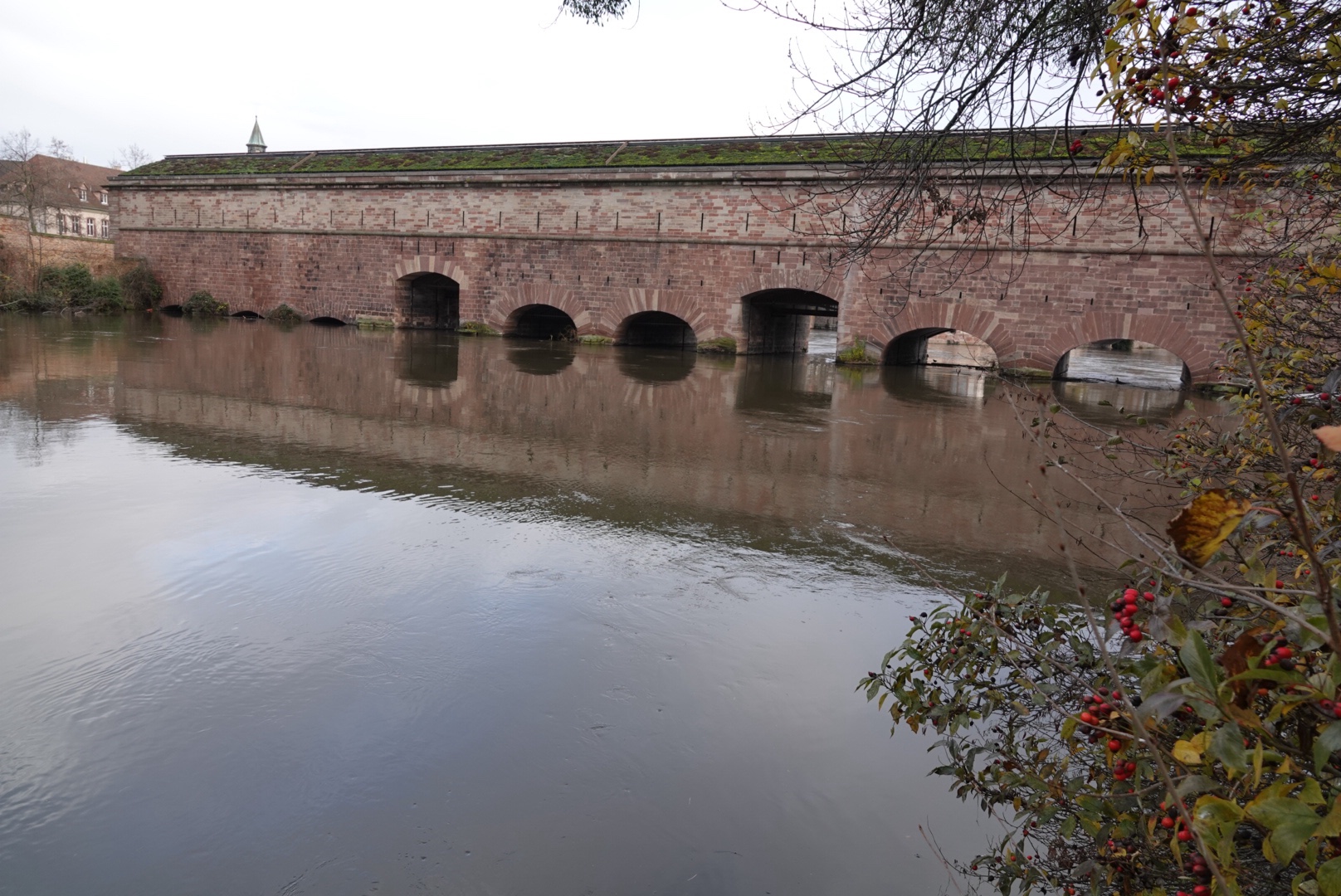
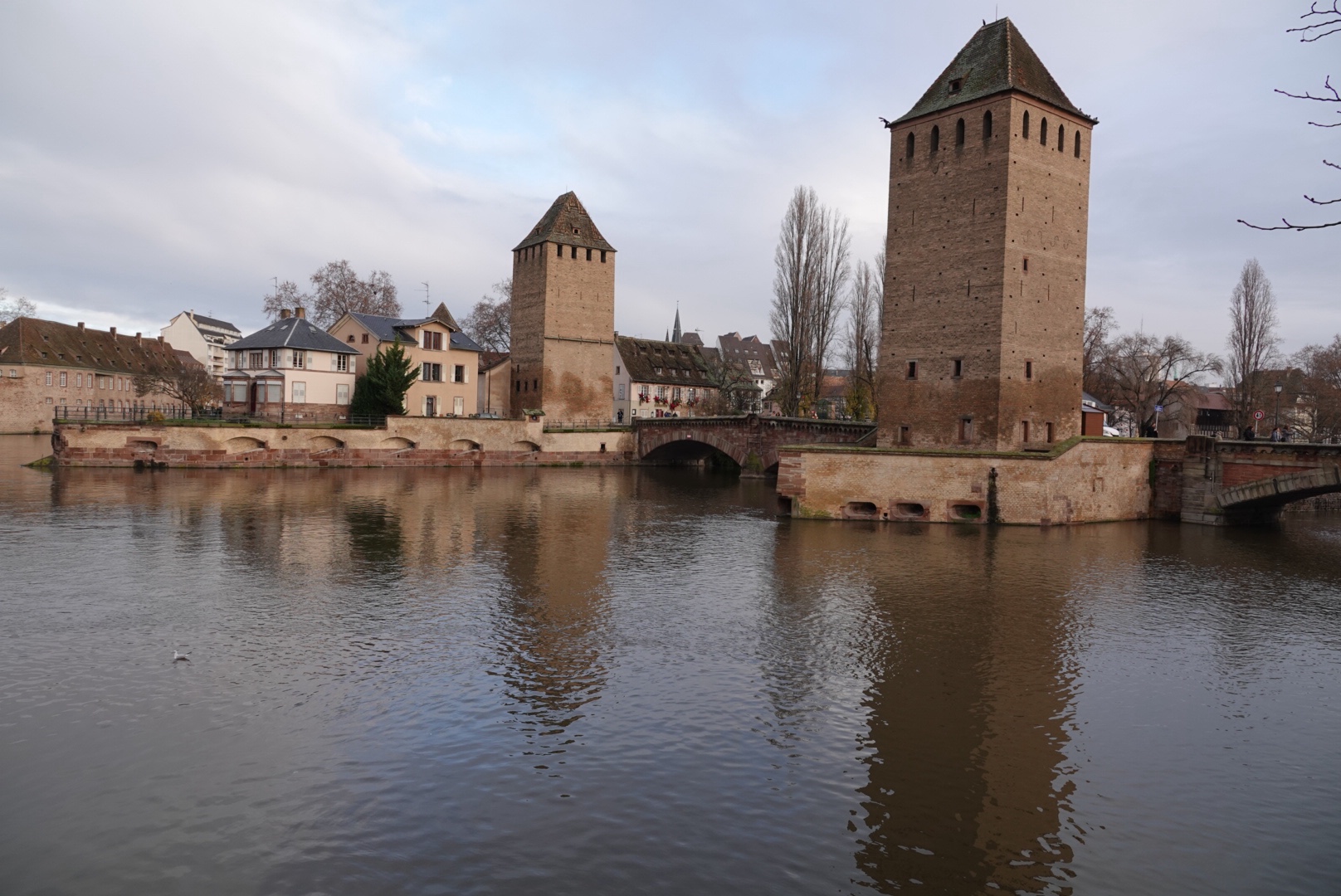


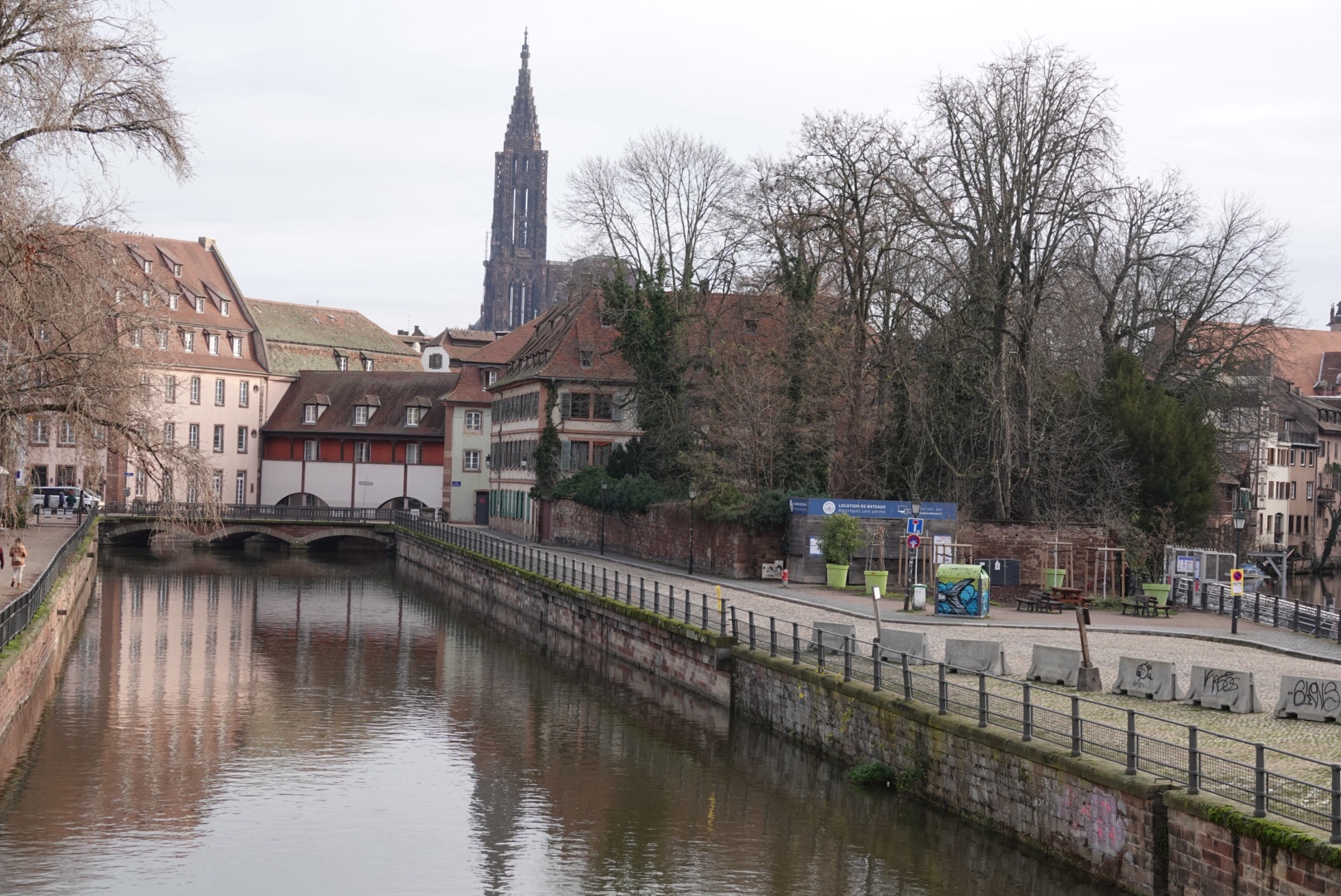


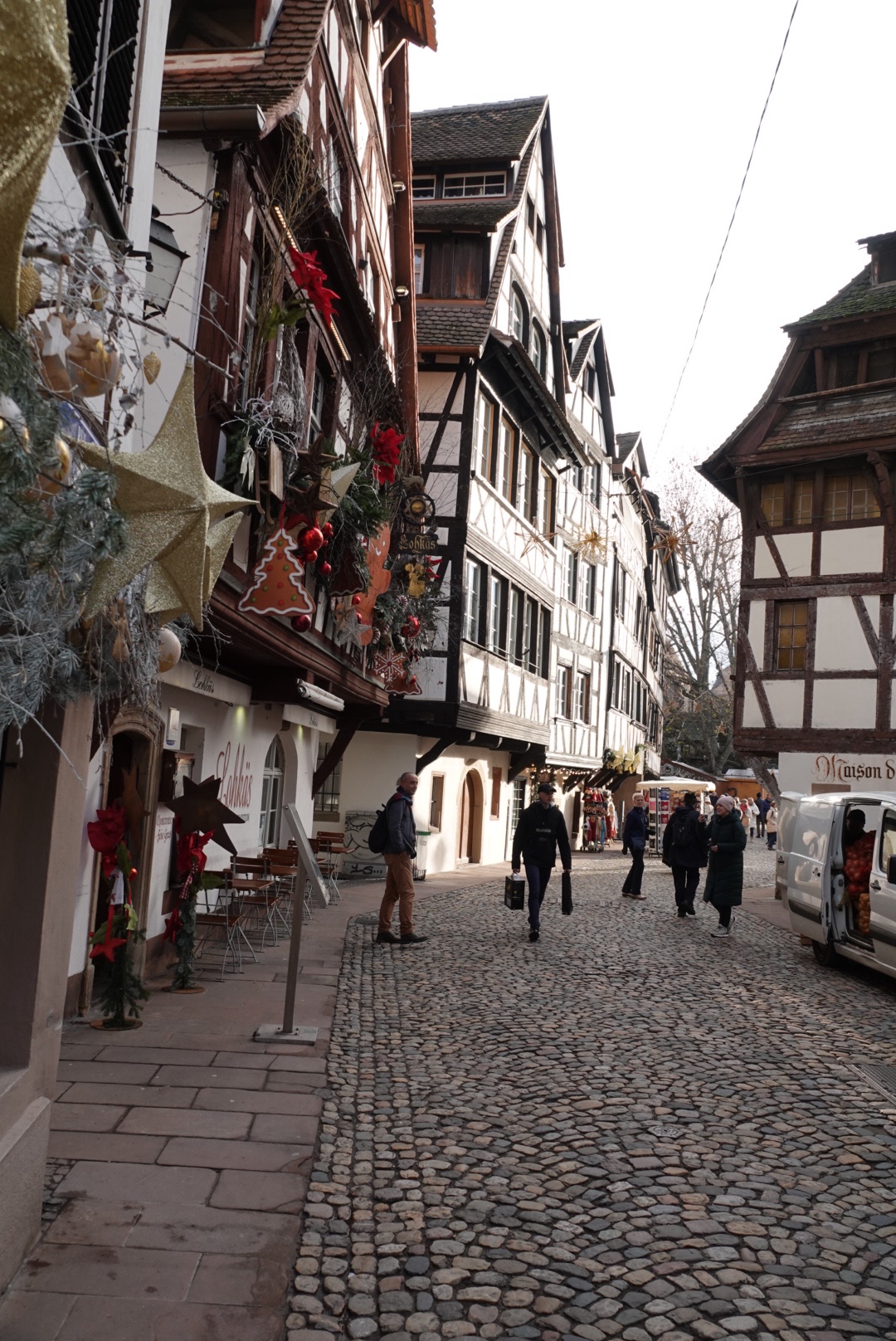


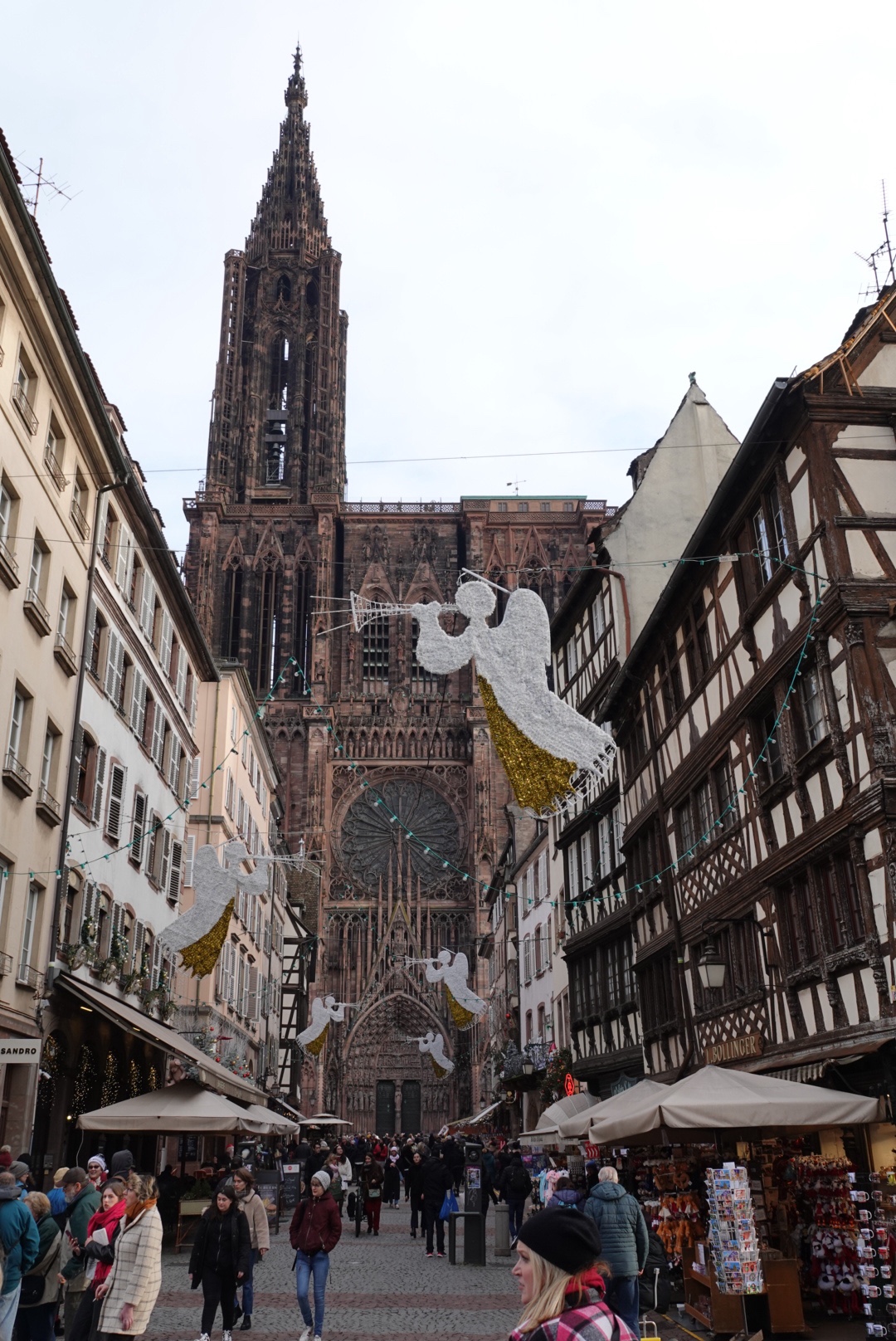
…and the our first glimpse today of the cathedral, and a chance to walk around the exterior before the Christmas markets open and the crowds arrive.




We were directed to notice an interesting musical angel playing BAGPIPES above the main entrance. At the time of the cathedral’s construction there were Celtic monks establishing monasteries in the area, which may explain things. I’m not sure I’ve ever heard of an angel with bagpipes before this, and even zooming in we really couldn’t tell which of the instruments were 15th century bagpipes. Our guide was born in Strasbourg and has lived here for all of her 6 decades, so we’ll just have to take her word for it.
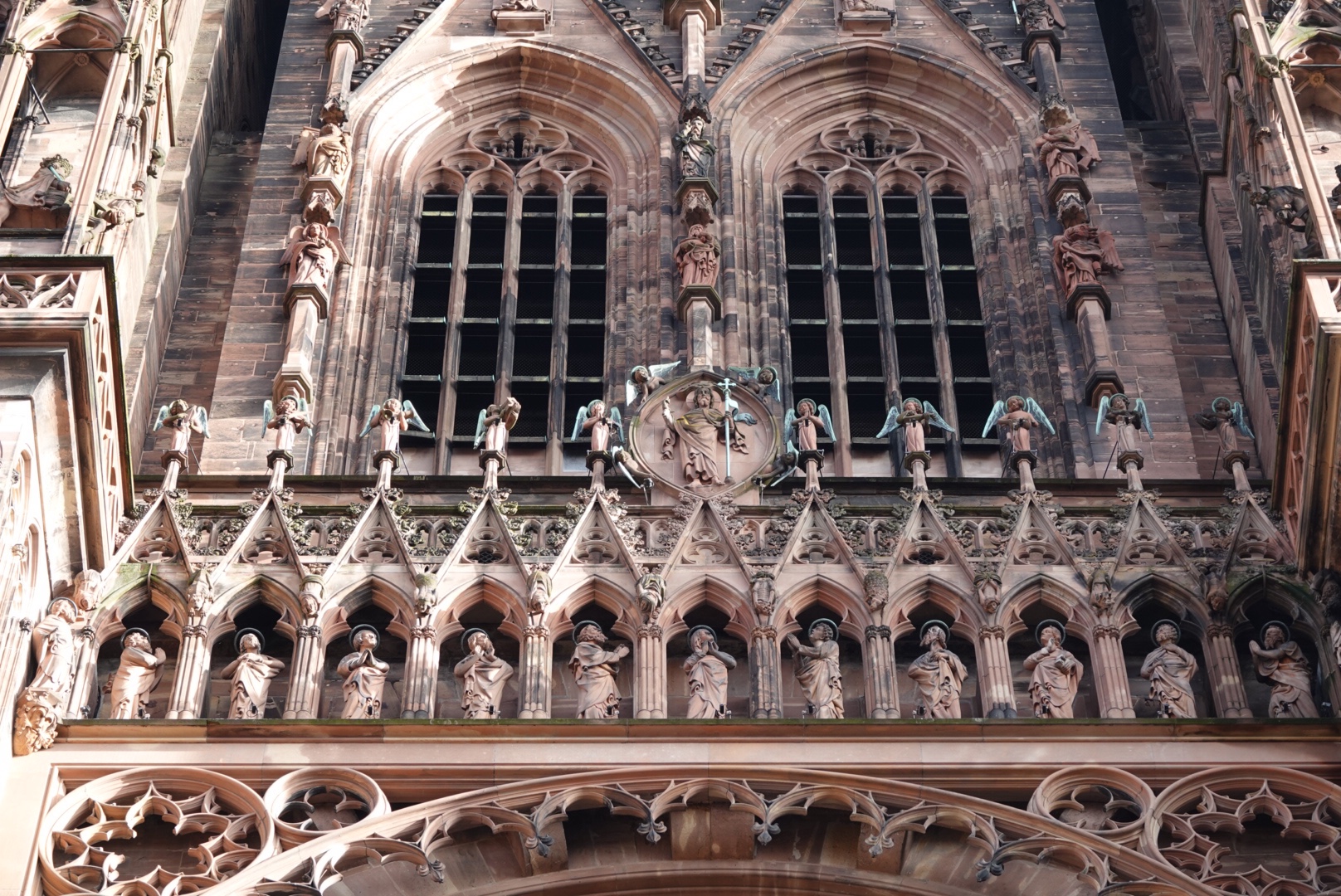
Despite how impressive the exterior is, the highlight of our walking tour was getting to go inside the Cathédrale Notre-Dame de Strasbourg.
The stunning stained glass windows here were removed to safety during the second world war, subsequently stolen by the Nazis, and eventually recovered and returned to the cathedral by the Monuments Men. Noting that many of the figures honoured on the windows were German nobles, that might have explained Hitler’s desire for them, since he claimed to want to establish a third German Empire.

The tapestries were originally created for Notre Dame in Paris, but sold to Strasbourg after the city became French again. Our guide said they were priced exceptionally high because the church in Paris felt they could ask any price they wanted of Strasbourg.
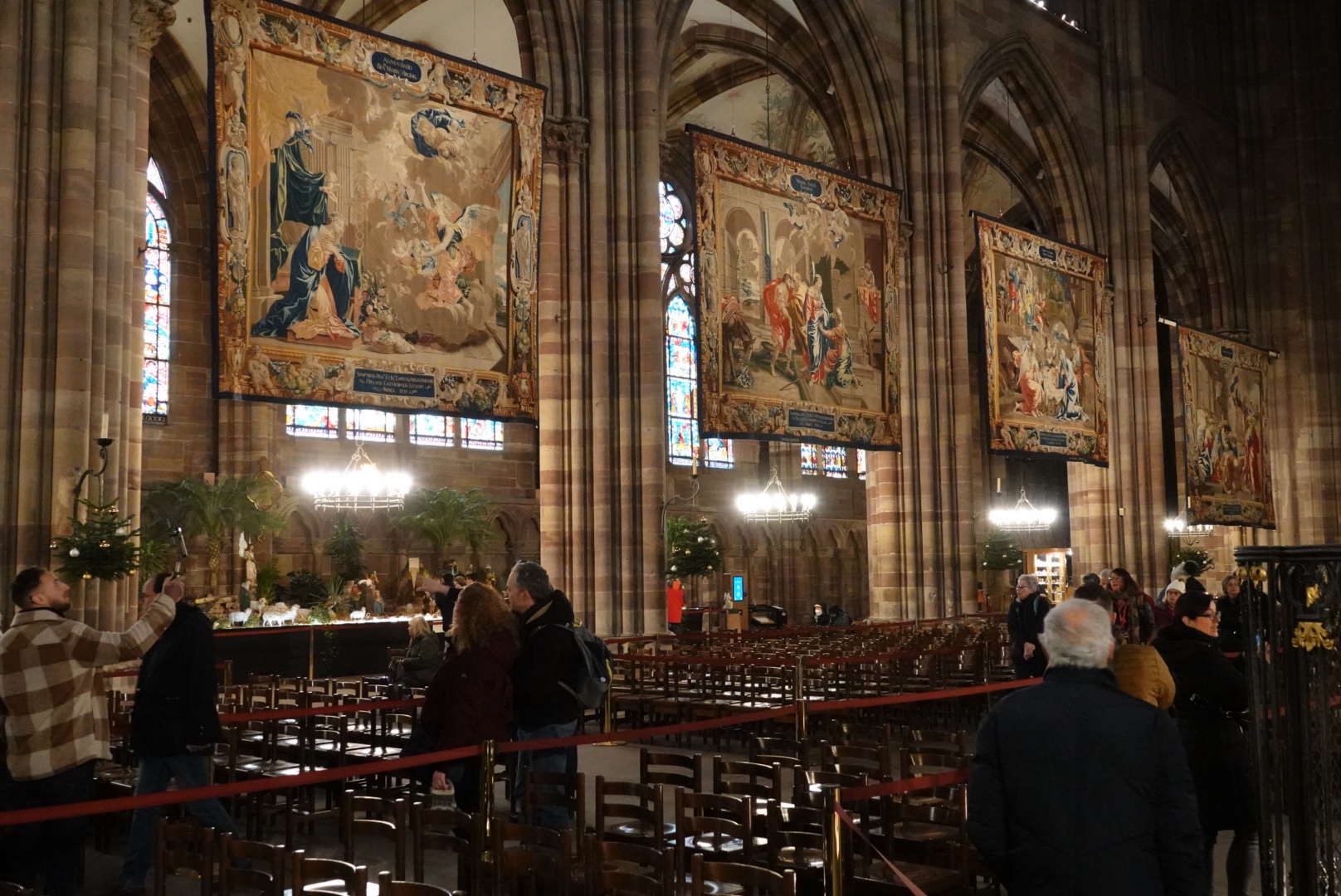

One end of the cathedral boasts a huge rose window, and a large pipe organ.

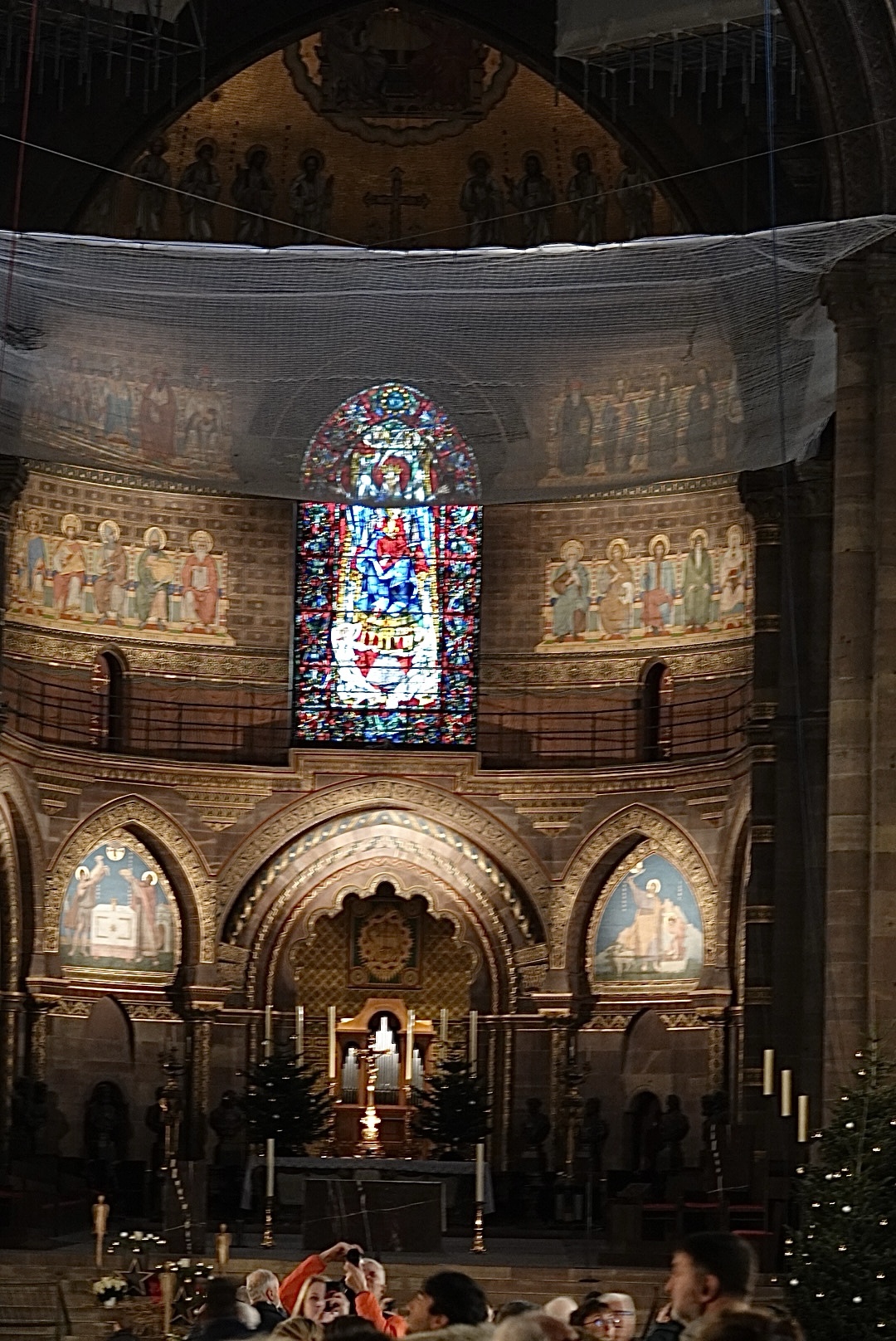
The other end of the cathedral was the only area damaged during WWII. The repairs and the new madonna and child window were funded by the Council of Europe.
The most interesting feature of the cathedral’s interior is a non-religious element: the Strasbourg astronomical clock. The first clock was built here in the 14th century, the second in the 16th century, and the current clock is an 1843 rebuild of the second, which stopped working around 1788. Since the cathedral is only open limited hours, we were not able to see the full movement which happens at 12noon, and at midnight when the “day” also changes.
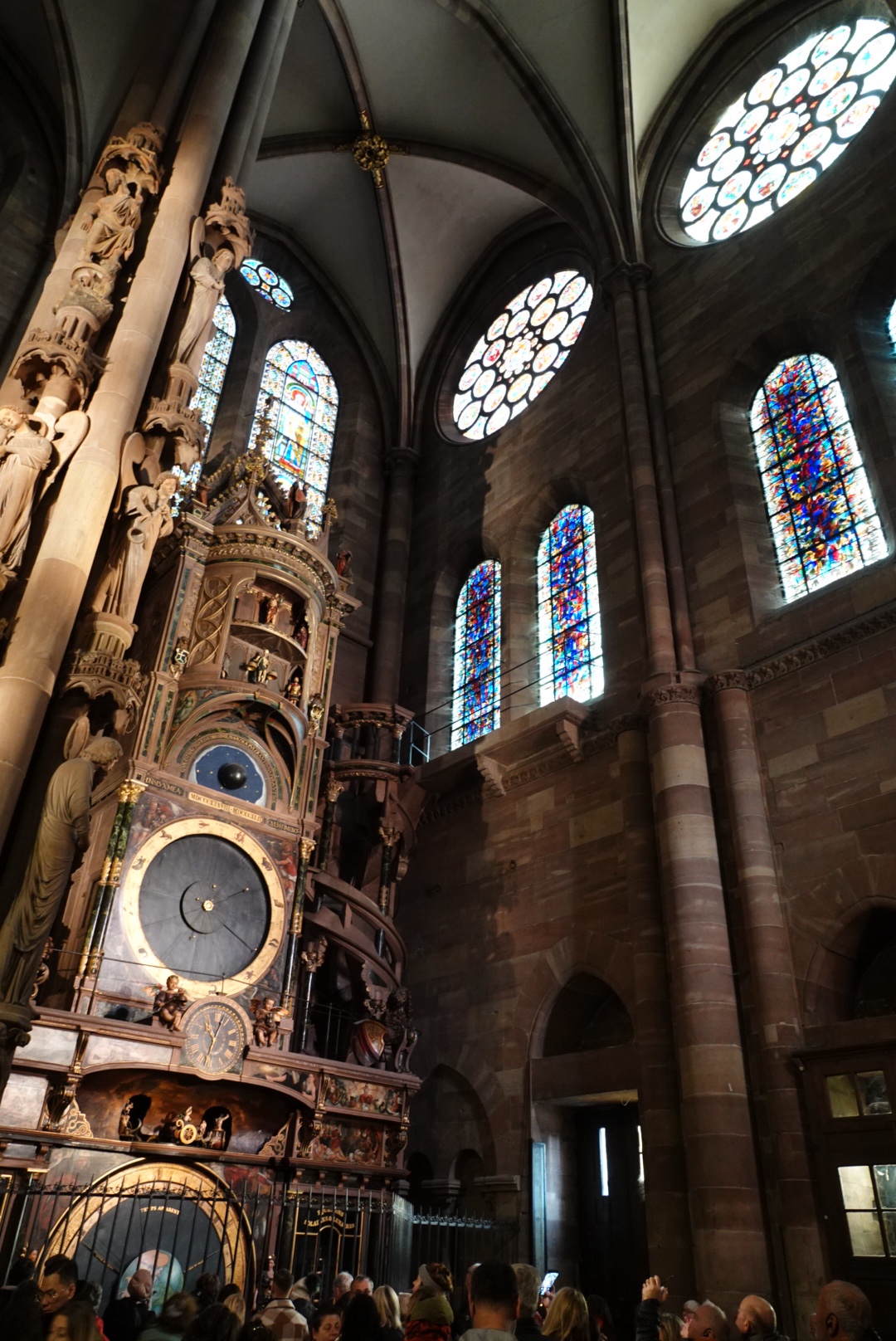

Although it was 11:15, we saw the clock’s 10:45 routine. Why? Because the clock is set to “mean solar time”, which in winter is about 30 minutes behind Central European Time.
At 10:45, the left cherub rang a bell, and on the second top tier of the clock, an “adult” rang a bell 3 times and walked past death (at :15 it is an infant, at :30 and adolescent, and at :00 an old man with a cane, completing the 4 stages of human life). On the hour, the second cherub would have inverted their hour glass. At noon, the cock would flap its wings and crow 3 times, and the apostles would parade past Jesus on the top tier.


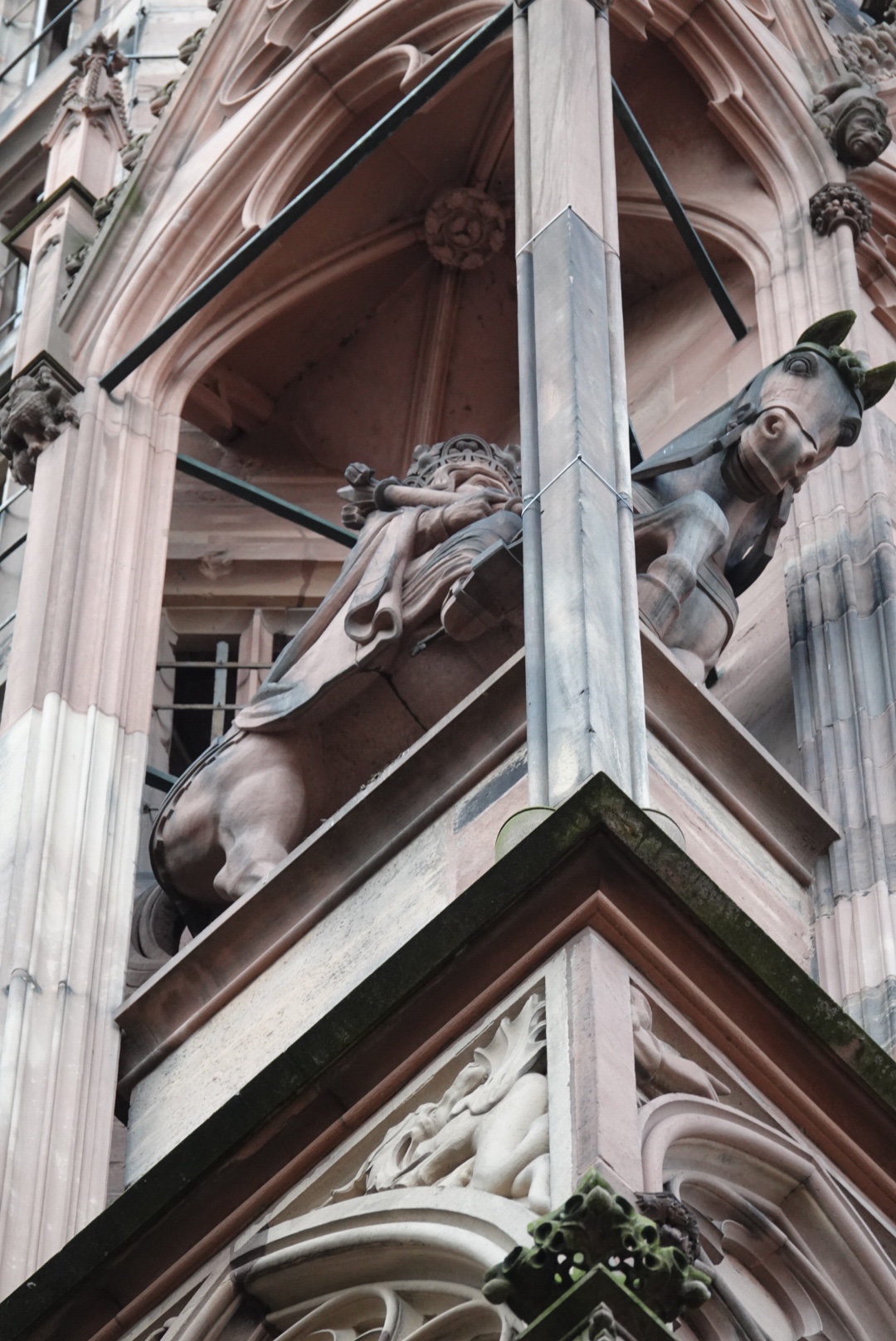
At midnight, the planet/ ancient god on horseback on the lowest tier would change. Today (vendredi in French) the rider was Venus; tomorrow it would be Saturn, Monday/mardi it would be Mars, Wednesday/mercredi Mercury, etc).

The few lights in the cathedral were turned off, and everyone had to leave the cathedral immediately after the 10:45 clock’s strike, so at 11:15 our time, when the building closed until late afternoon. On our expedited walk out, Ted managed to snap a couple of quick photos of the very large nativity scene.


After our short walk through the cathedral, we headed to Place Kléber to see the city’s 30m/100ft tall Christmas tree, and explore a second Christmas market, this one run by all of the city’s charities.

This market featured a few crafts, but mostly food, so we stopped for yummy grilled sausages (bratwurst with cheese for Ted, weisswurst for me) on crusty rolls, followed by a shared kugelhupf (spelled here as “koegelhopf” as opposed to the German spelling) but still the same sweet yeast bread with fruit.
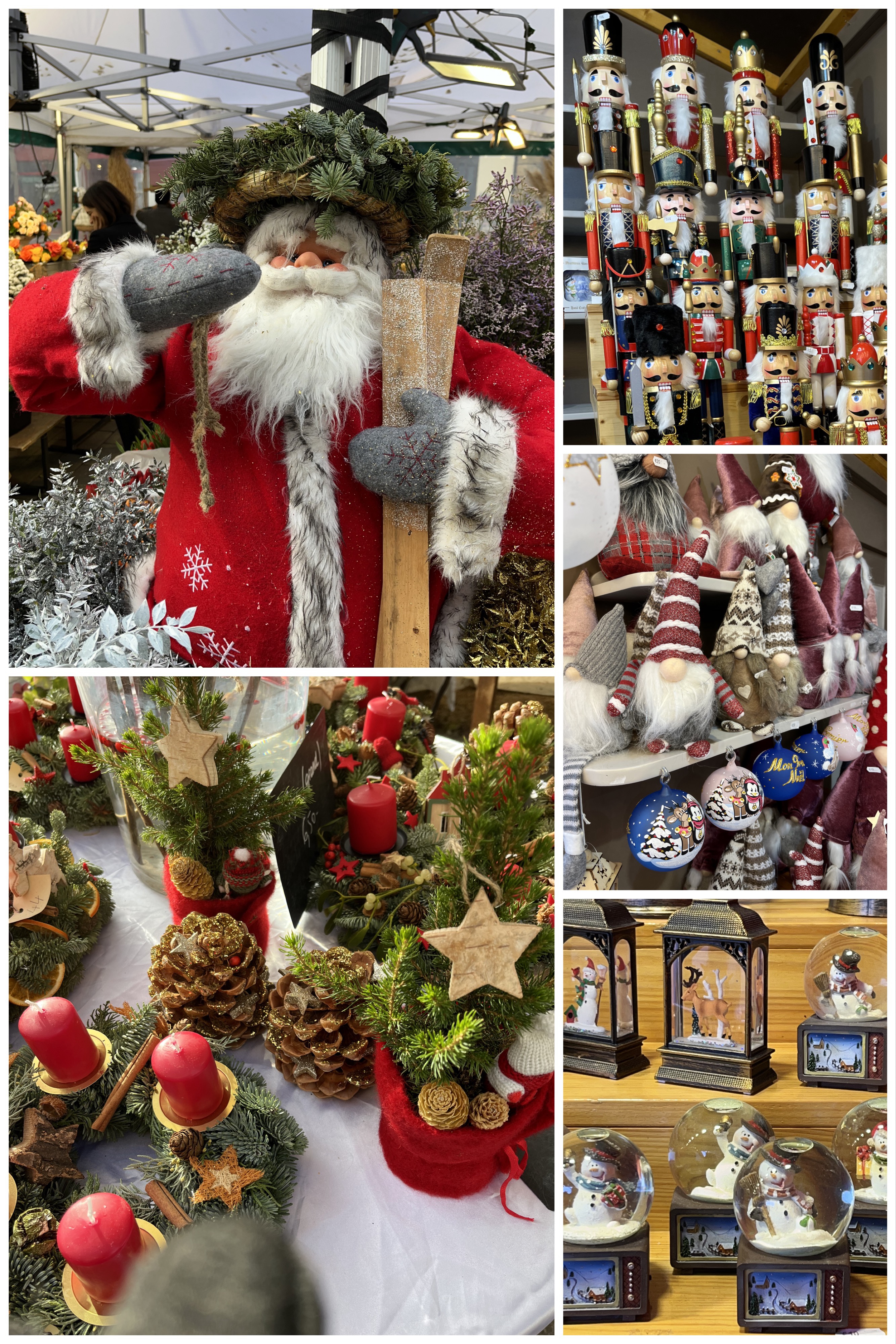
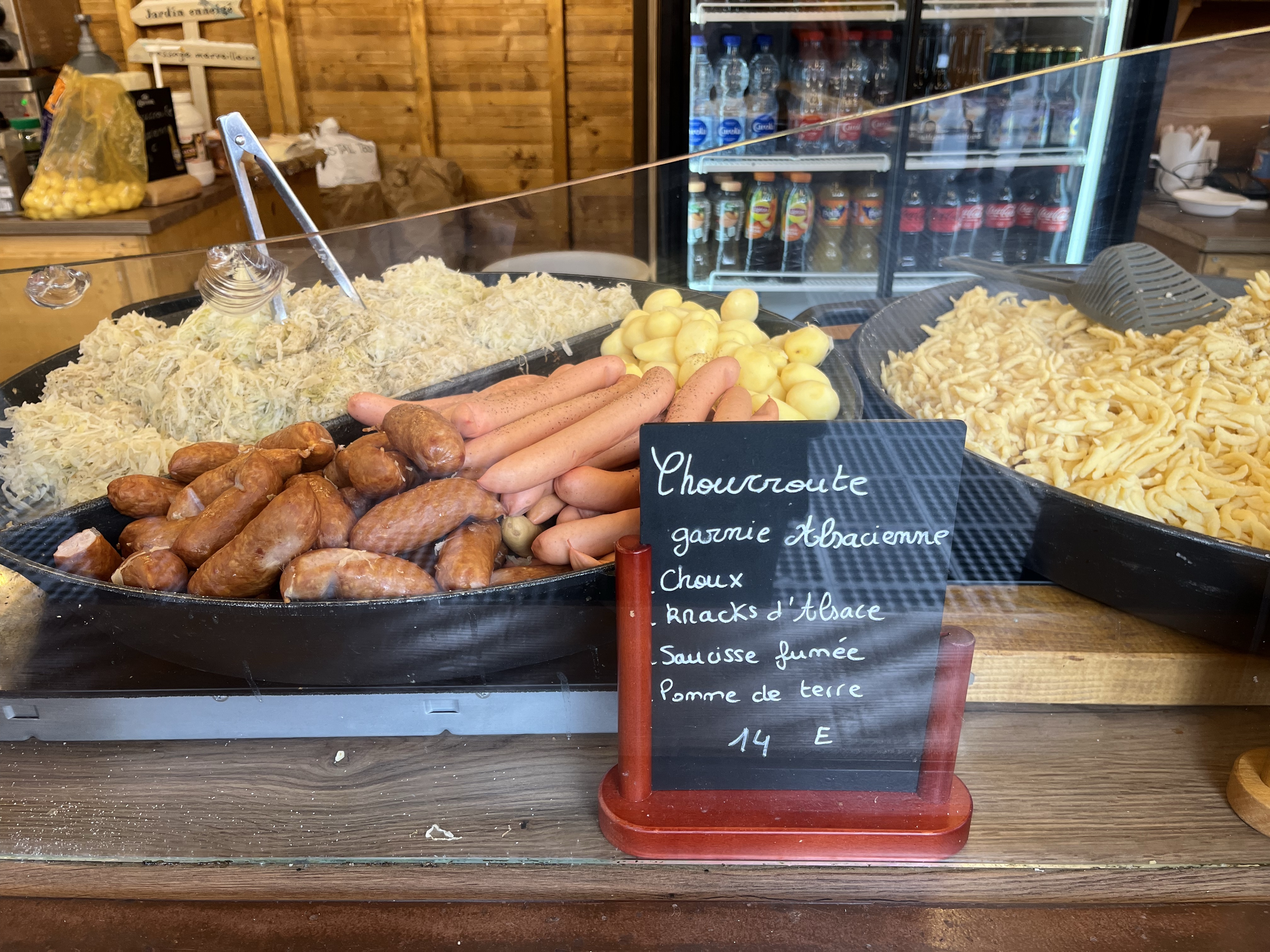

All that remained for us to do was find some vin chaud (glühwein) before heading back to the ship for a short rest.

Our optional 4 hour afternoon/evening excursion was in Gengenbach, about 30 minutes outside Strasbourg, and across the border into Germany: Discover the yuletide traditions of Gengenbach during a stroll through its Old Town and Christmas market. Meet your guide and set off on foot through medieval Gengenbach, passing through one of the historic city gates and walking along narrow, cobblestone alleyways. See the baroque-style Benedictine abbey and St. Mary’s Church, its impressive tower considered one of southern Germany’s finest, as well as the 18th-century Löwenberg Palace and the half-timbered Scheffel House. Enjoy free time to browse the Christmas market, where you can search for mementos or sip a cup of mulled wine and nibble on roasted almonds. Cap your tour at the Town Hall; each year it is transformed into the world’s largest Advent calendar house. Immerse yourself in the festive spirit of the season as you watch the daily opening of another calendar window on the building’s facade, then return to your ship.
I’ll admit, I’d never heard of Gengenbach before, but here we are on the western edge of the Black Forest, and who wouldn’t want to see the world’s biggest adventure calendar? Too bad it doesn’t hold the world’s biggest chocolates!

We had a short walking tour through this small picturesque town, marvelling at the towers to the old gates, the well-preserved half-timbered houses, the beautiful storefronts, the small (just 60 booths) but lovely Christmas market, and the churchyard.

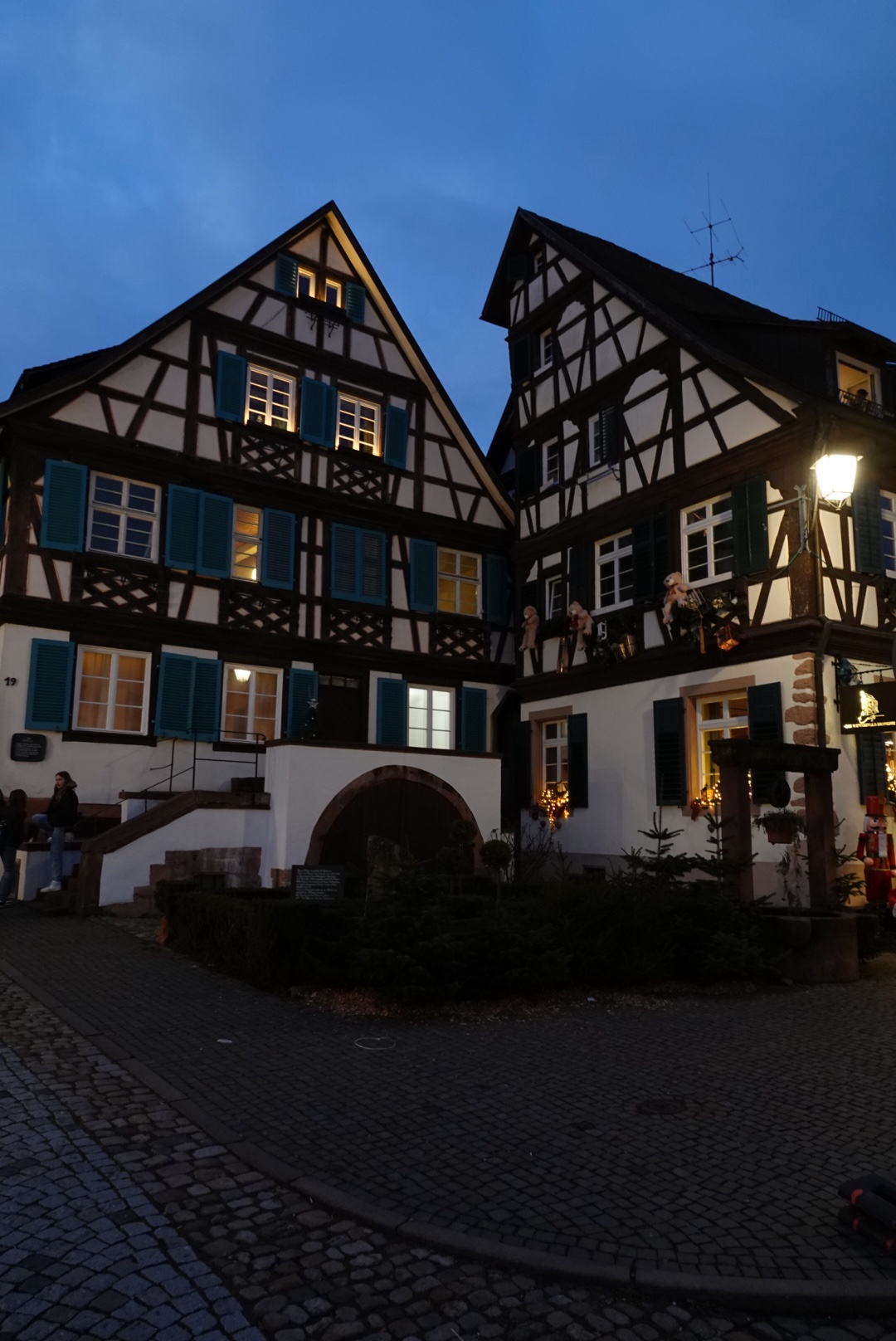
The homes along Engelgasse (Angel Street) date back to the 12th century, and have been continuously occupied. It’s amazing that with relatively little upkeep, they have stayed both sturdy and beautiful. Their wood is rot and weather resistant, so it’s “just” a matter of regularly caring for the plaster and paint!

We turned the corner to see a dwelling decorated with Christmas bears!
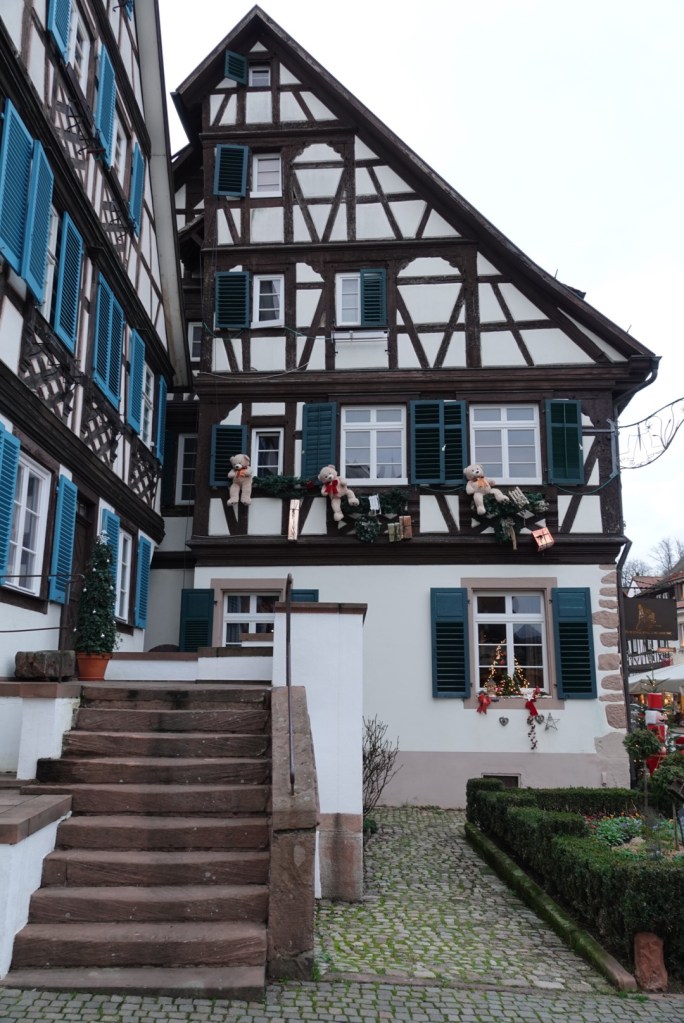
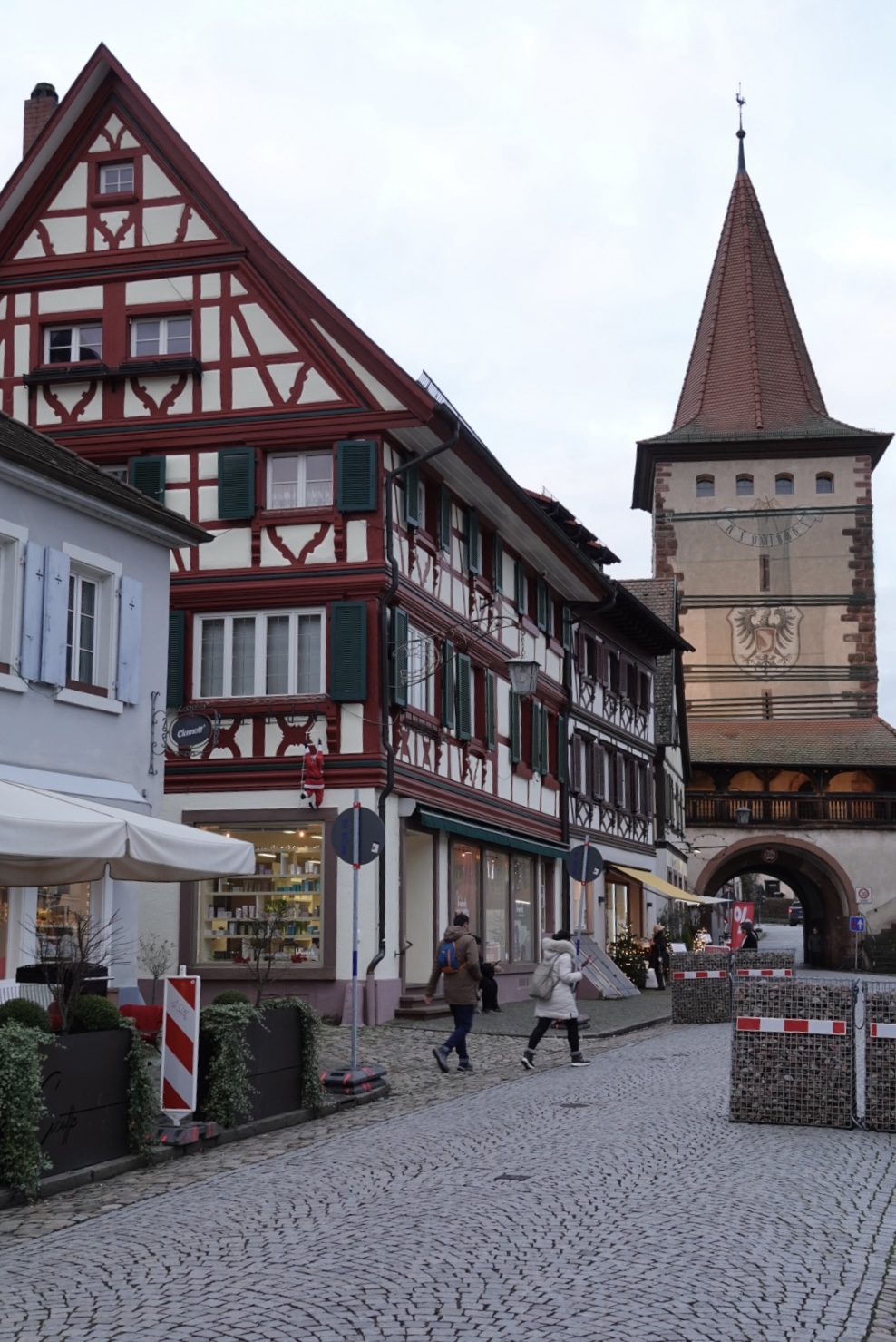

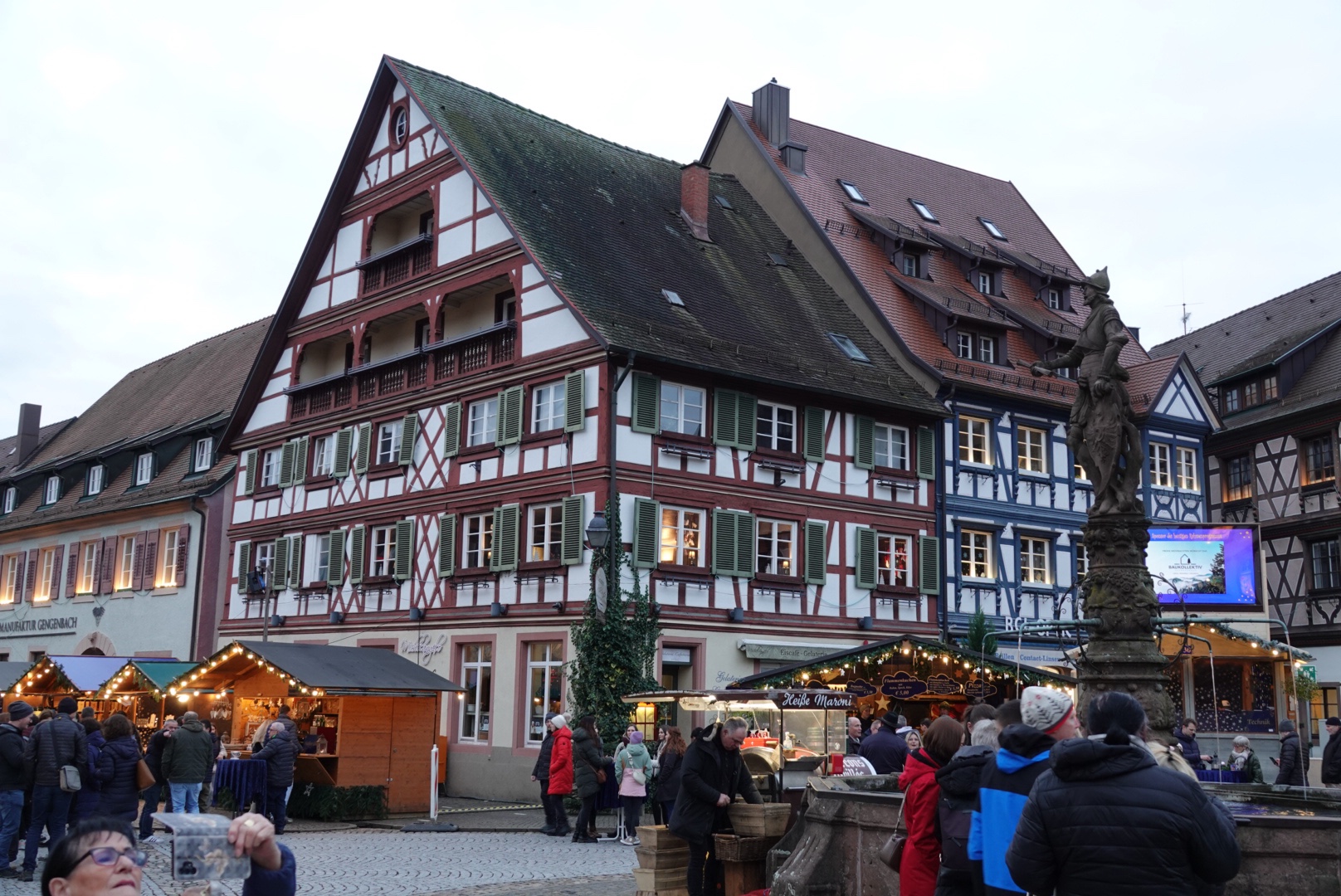

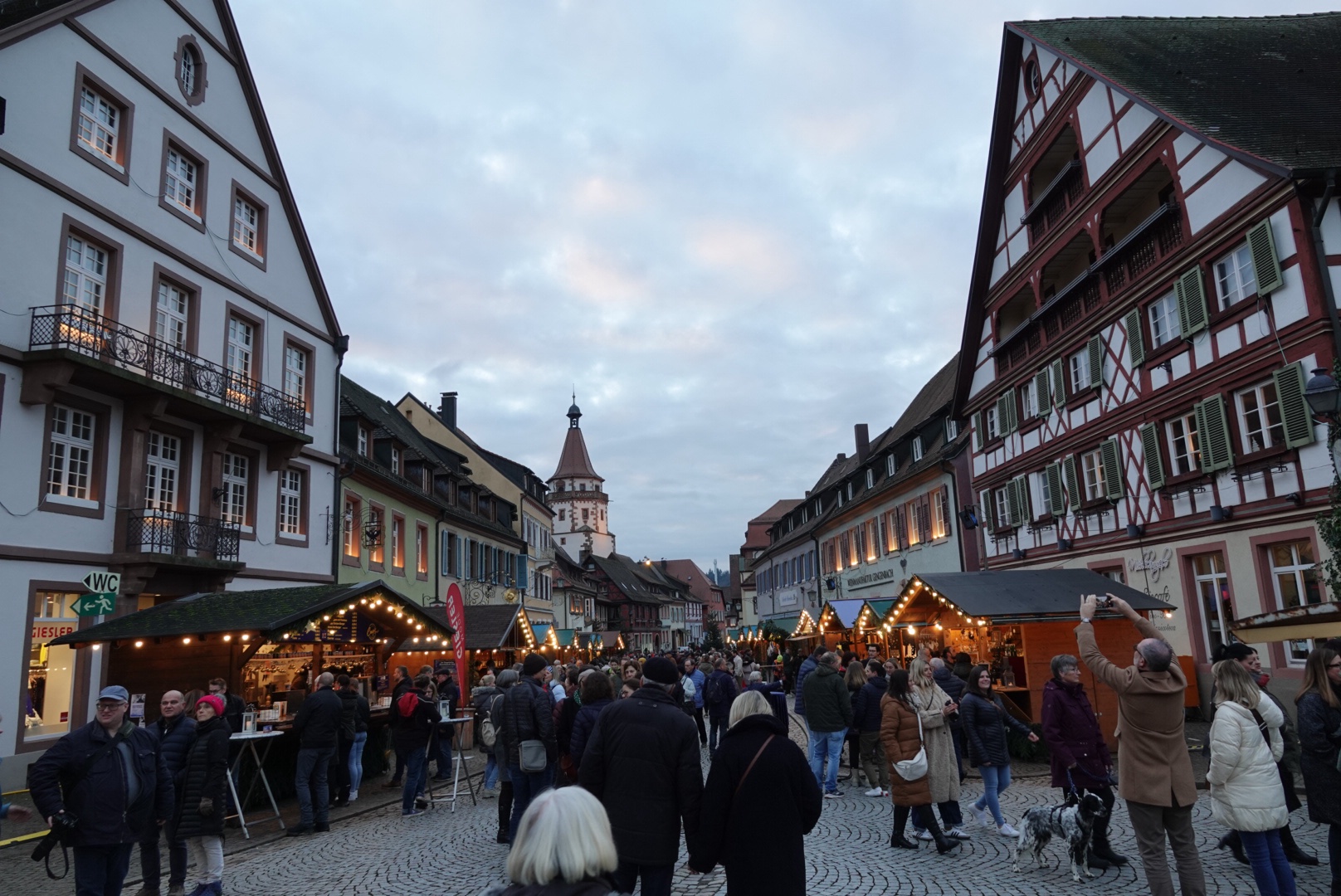
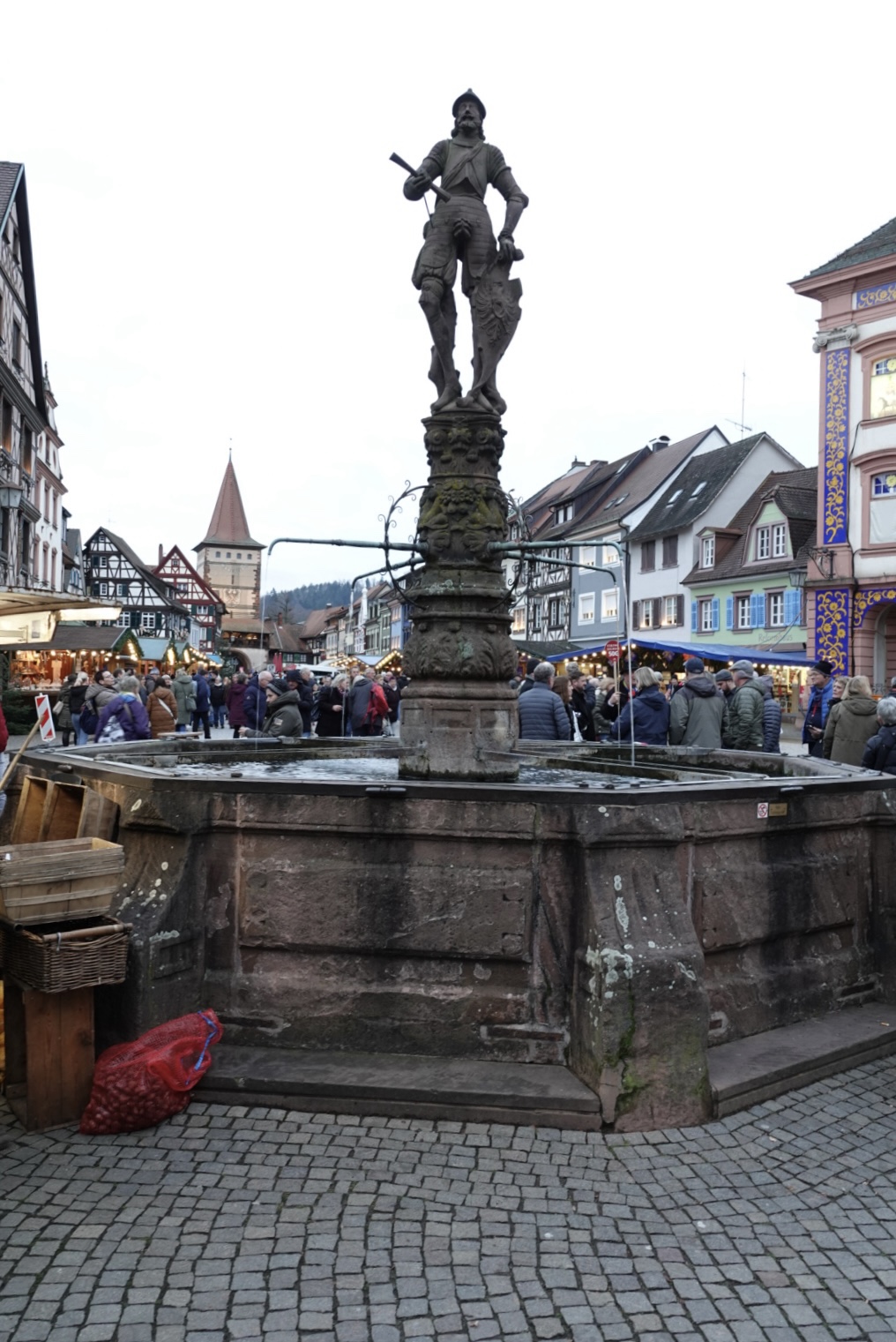
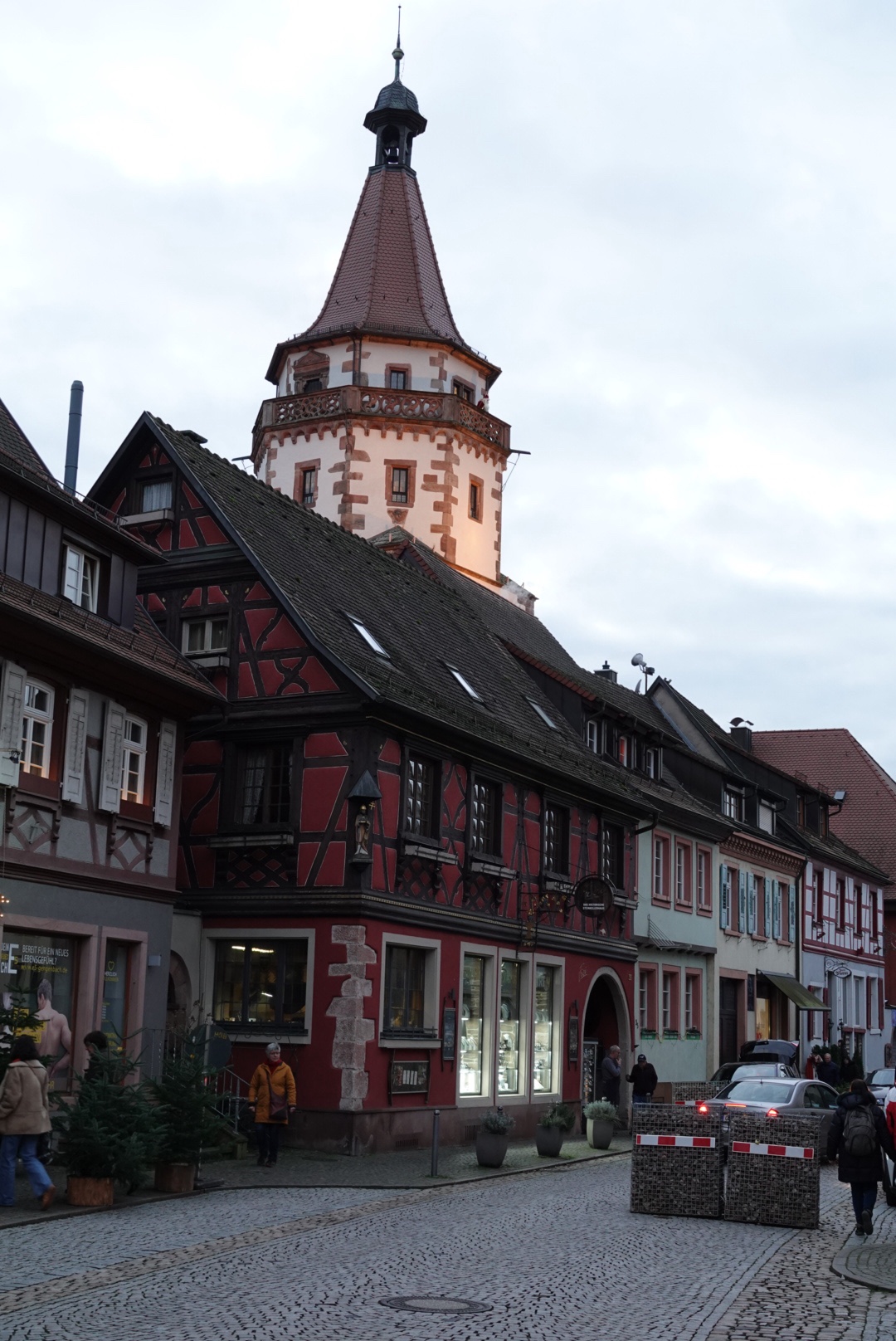
A Benedictine abbey was established here in the 8th century. While the abbey itself no longer operates, except as an abbey bakery, the abbey’s associated church is still an important feature of the town. Stadtkirche Sankt Marien (St. Mary’s Church) was rebuilt in the baroque renaissance style after 1689 – when it was badly damaged by retreating French forces in the Nine Years War.

Naturally, we “needed” to sample Gengenbach’s local glühwein, since it is in another of Germany’s excellent wine regions, Bad-Württemberg. Ted had the wine, which was less sweet than the others we’ve enjoyed so far, but I got distracted by “Heiße Liebe” (hot love!), a Gengenbach specialty of hot kirsch liqueur topped with whipped cream and cinnamon. Hot love indeed!


After sunset, the entire town became magical.


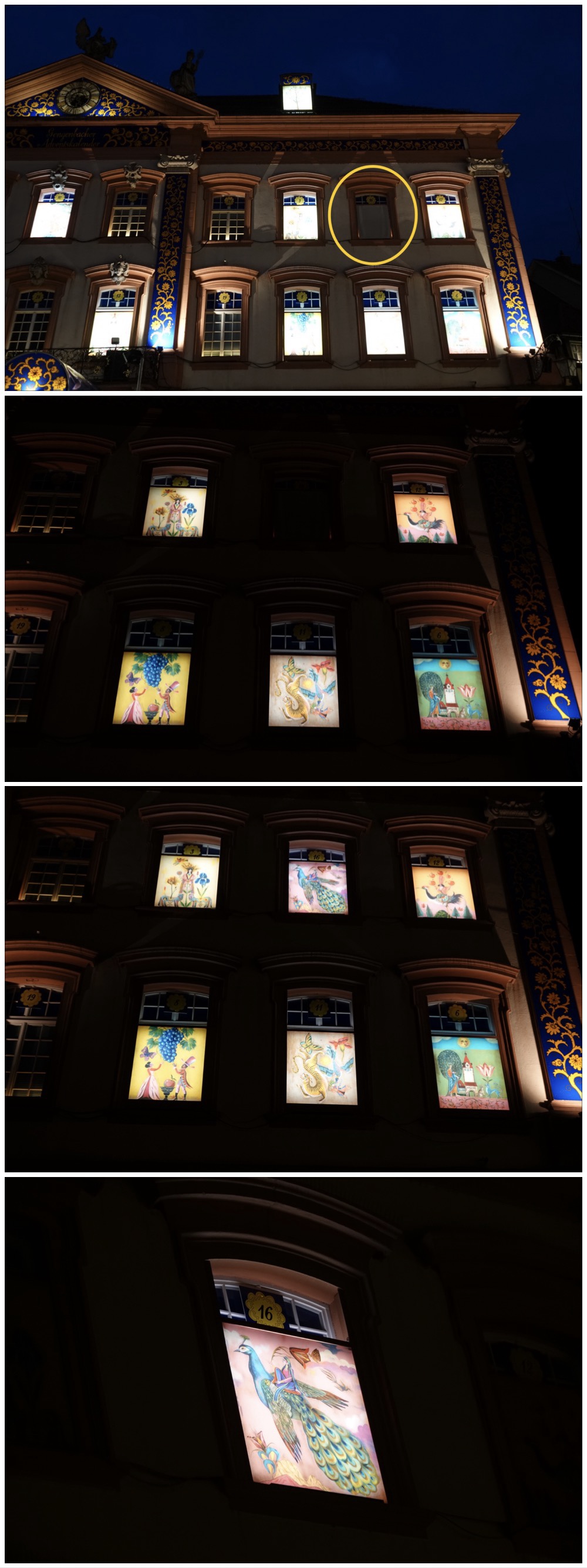
And then it was time for the event we’d come to Gengenbach to see: the opening of window #16 on the town hall, which for the past 20 years has been turned into the world’s largest advent calendar. (The Guinness Book of World Records has verified it!). For the Christmas season, each of the town hall’s 24 windows is painted with a “treat”, which is revealed around 6:20 p.m. In the past,the windows have featured art by Andy Warhol and Marc Chagall, among others. This year, the Berlin artist Olaf Hajek created paradise motifs.

Prior to the big reveal, as they do at 5 p.m. each evening during Advent, a band and singers took the stage in front of the town hall to perform carols. We were surprised at how many of the songs were in English, but happy that my favourite German Christmas carol (Leise rieselt der Schnee) was part of the show.
After the music, there was a children’s dance and theatre performance written to complement the paradise theme of the windows. A young girl has lost her map of the path to paradise, where milk and honey flow. She engages the help of some Christmas elves, an astronomer chasing stats, and even some Christmas cookie bakers (baking cinnamon stars!) to help her find it, but to no avail. She eventually meets the gatekeeper to the town of Gengenbach, who convinces her that this very place is a little piece of paradise in which she can live happily ever after. It even has happy cows and industrious bees to provide her milk and honey!

Then… all the lights go out, and the newest window is lit and opened. What fun!!
Dinner shipboard tonight was a bit later than usual (because they delayed it for our tour group’s return) and featured a buffet style feast of German/Alsatian dishes: chicken, sausages, Schweinshaxe (pork hocks), sauerkraut, red cabbage, potatoes, bread dumplings, spaetzle, salads, pickles, freshly baked pretzels, and delicious desserts including poppyseed streusel cake. We didn’t stay for the ice creams or warm dumplings with vanilla sauce, but I did wear my dirndl!
Cruise update: We were all told just before dinner that the Rhine is still closed to all shipping between Cologne and Strasbourg, so tonight we pack our bags in preparation for transferring onto the Viking Einar in Cologne and continuing our journey ON THE RIVER to Amsterdam. Unfortunately, that means that in addition to missing Basel and Breisach at the beginning of the cruise, we’ll also miss Mannheim, Rüdesheim, and possibly Koblenz. Tomorrow we’ll have an unscheduled visit to Speyer to break up our bus travel day. No one is happy, but we also recognize that unusual weather events, and river water levels, are out of Viking’s control.
KEEP CALM AND DRINK GLÜHWEIN!
 Rose and Ted’s Excellent Adventure
I really enjoy adding your daily blog to my morning reading — especially in this season when the cheerful photos and gluhwein references bring me back to my Christmas in Wien (1976)
I was sorry to hear you had to miss Rüdesheim in particular — I remember especially loving a museum of mechanical music machines there — but that was about 1972 so who knows if it’s still there. We were on a very rudimentary river cruise compared to Viking’s, but at about 15, the introduction to lox, capers, cassis sorbet and the other kind of locks were magical. That boat did even have a small pool. My poor mother was traveling with all four of us — brother aged 4 or so and two sisters in between to meet my father in Rotterdam — doubt she found it very relaxing but I loved it. Thanks for the memories!
LikeLiked by 1 person
Envious! I haven’t been back to Strasbourg since I was there in high school as an exchange student. I “lived” in Obernai (it looked much like the German town you visited) but we would go into Strasbourg for big events.
You’re right about the dialect-I was constantly having to remind my “family” to please not speak in it as I was having a hard enough time understanding French spoken witb a German accent😂
Hope you continue to have a great time!
Clay
LikeLiked by 1 person
Rose, loving your blog and following your Christmas Market adventure. I know it is disappointing with the impact of the river levels, but love how you and Ted always go with the flow!
What is the name of your favorite German Christmas carol? It was lovely and I’d like to learn it as part of my deutsche studies.
Nancy
LikeLiked by 1 person
Gotta -literally in this case – go with the flow! “Leise rieselt der Schnee”. Bony M does a fabulous version!!!
LikeLiked by 1 person
What a fabulous day!
Barbie
LikeLiked by 1 person