October 14 Itinerary: En route to the coastal town of Essaouira we will visit an Argan co-operative to see how local woman produce Argan oil. In Essaouira our city tour includes the beautiful medina (a UNESCO World Heritage Site) and the Orson Welles Square and Memorial, dedicated to the famous director’s filming of Othello. We may get lucky and spot the famous tree climbing goats in the Argan trees.
🐪 🐫 🐪 🐫🐪 🐫🐪 🐫🐪 🐫🐪 🐫🐪 🐫🐪 🐫🐪 🐫🐪 🐫🐪 🐫🐪 🐪 🐫🐪 🐫🐪 🐫
Our drive today was through agricultural areas, palm tree nurseries, lots of olive groves, and areas rich in phosphate, especially around Chichaoua.
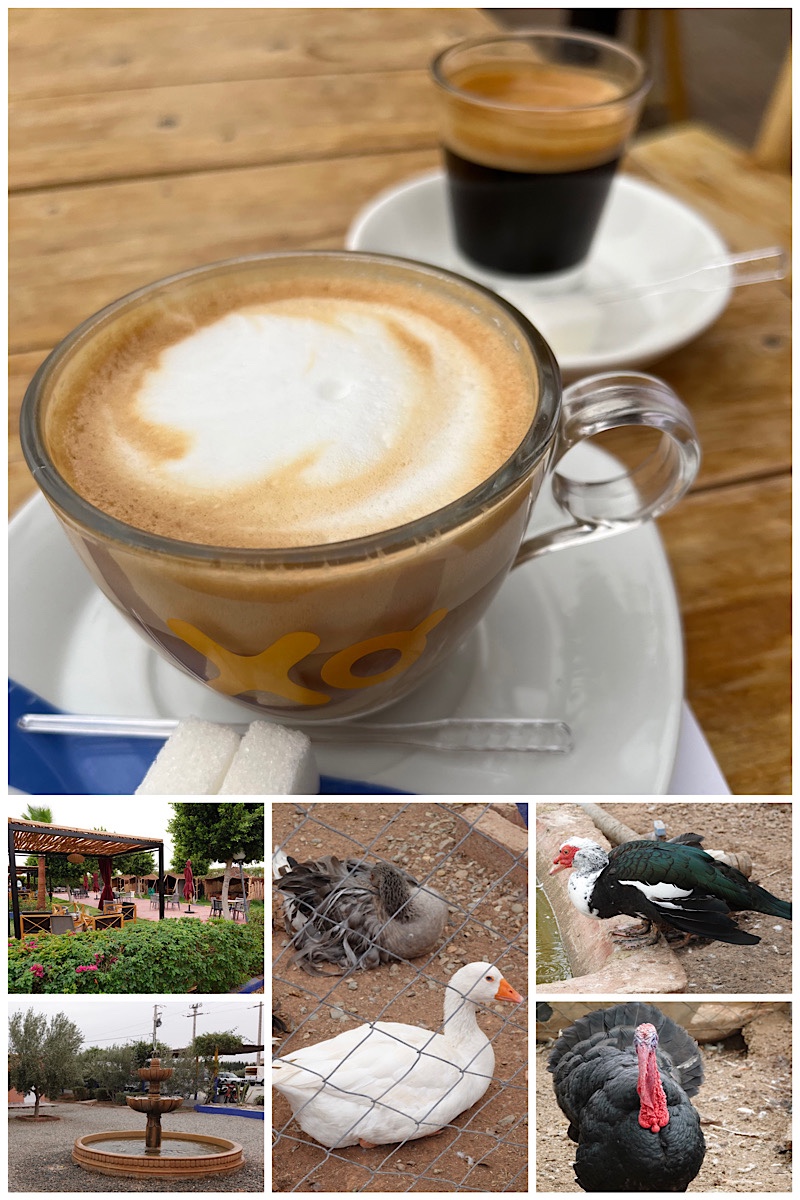
We had our morning coffee and comfort stop at the Mazagan Café just west of Chichaoua. Sometimes it’s the little surprises that make a trip: a roadside stop with a café, gardens, playground , prayer rooms, super clean WCs, and geese, ducks, a turkey … and peacocks (who were upon the roof of their enclosure, and so avoided being photographed).
In the time between our coffee break and reaching the women’s argan cooperative we had on our schedule Fouad gave us some insight into Morocco’s health care system.
The national health care program called AMO (Assurance de Maladies Obligatoire) applies to all workers, and includes their spouses and children up to 21. Coverage is for basic health care, hospitalization, lab tests, maternity and post-natal care, illness and injuries, optical and dental treatment. Everyone enrolled in AMO is free to choose health care practitioner and clinic
Public sector workers have separate national social healthcare called KNOPS, which includes everything in AMO plus prescriptions.
There is also national Social Security (CNSS) which is contributed to by employers and employees at 2.5% of salary to a maximum of 400 dirham per month.
Those who are unemployed, or self-employed in agriculture (like most Berbers in the mountains) have access to free health care through a program called RAMID, based on the principle of social assistance and equity for those who do not have jobs which pay into national healthcare.
Moroccans also have the option to pay into supplementary private insurance.
We were told that the current government, at the King’s direction, is reviewing the health care system to allow more equal access for the poor.
Listening to all that information got us to our next stop: a women’s argan cooperative in Lahsinate.
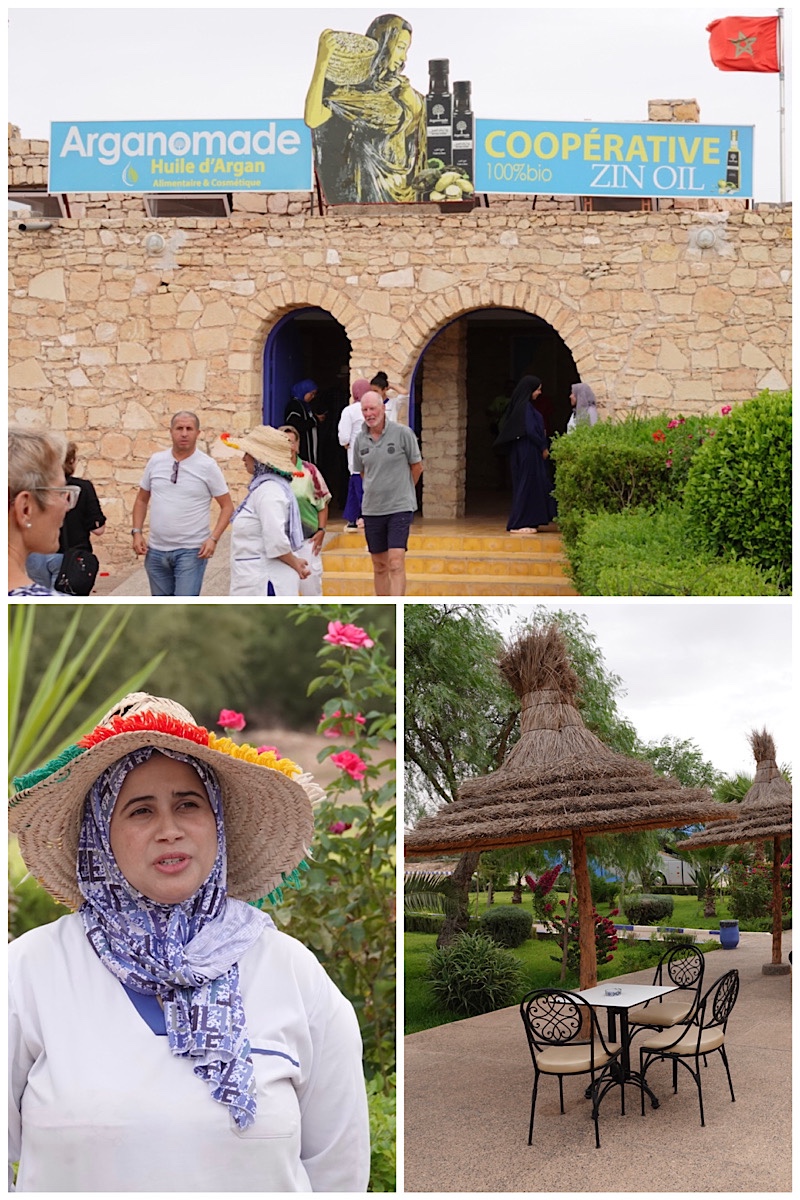
I have to admit that before visiting Morocco when I thought of argan oil, what came to mind was hair products, but argan oil has apparently been used for centuries for a variety of culinary, cosmetic and medicinal purposes. It is rich in essential nutrients, antioxidants and anti-inflammatory compounds. In Morocco, 100% argan oil is traditionally used for dipping bread or drizzling on couscous or vegetables.
Our guide Loubna walked us into the argan grove to visit a 500 yr old tree that is still bearing fruit. She explained that argan only grows in this area of Morocco.

Then we experienced a traditional greeting with hand drums and ululations.
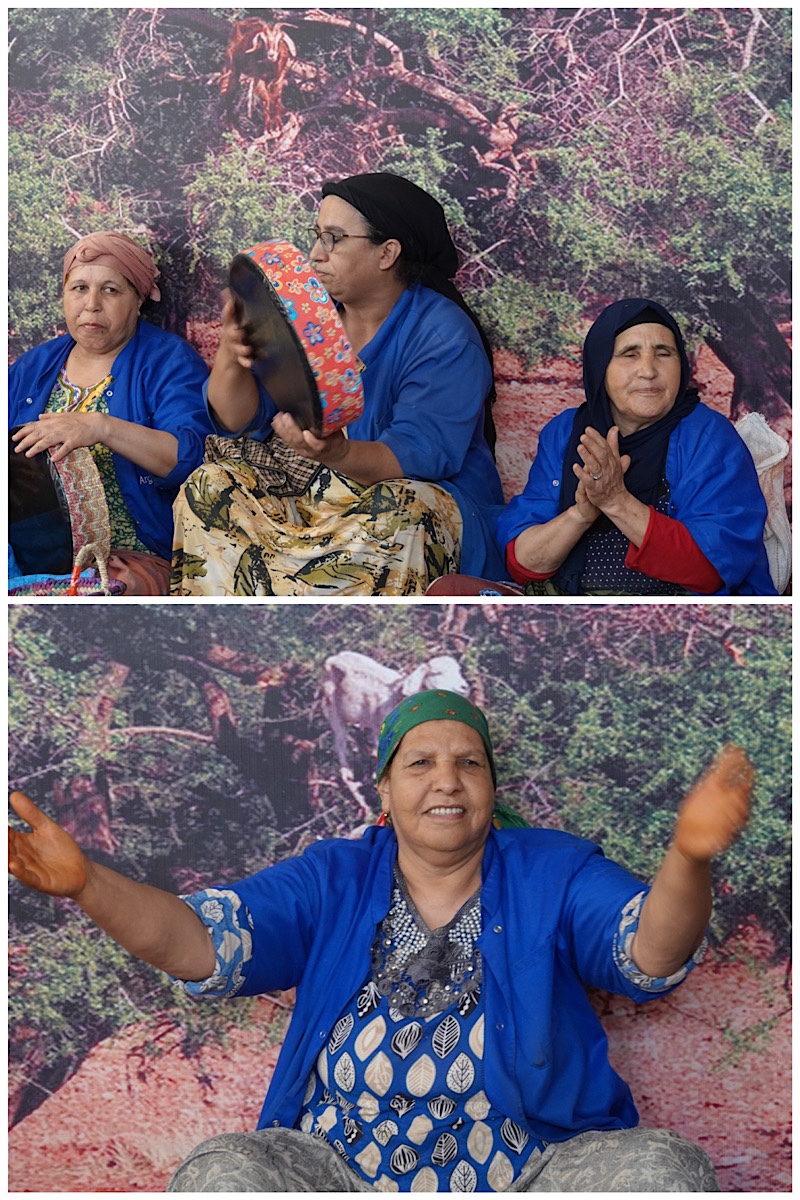
We watched the argan nuts being processed by hand. First the nuts are shelled by hand, with the shells retained to be used as animal feed.
Next the nut gets smashed into pieces with a rock. The nutmeat is burned as fuel – it is the inner kernel, the argan “seed”, that is eventually processed into oil.
Roasted seeds are used for food products (they smell absolutely heavenly!), and raw ones are used for cosmetics.
Grinding the seeds to release the oil is a labour intensive job. THAT lady has no Grandma upper arm flaps!

Of course, our group had the chance to purchase cosmetic products, as well as argan blossom honey, and a spread made of argan oil, almonds, and honey.
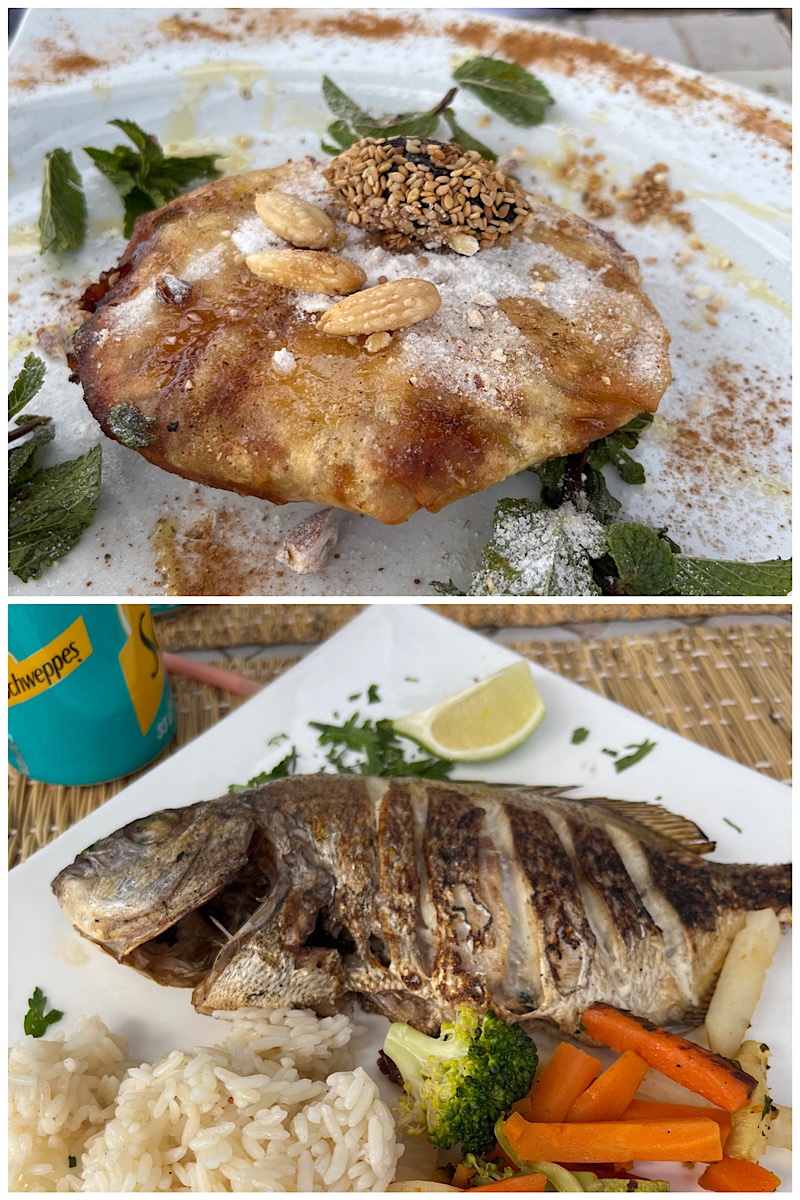
It did not take much longer to reach Essouaira, where fresh fish was on the menu at Fanatic Restaurant right on the Atlantic coast at Essouaira Beach.
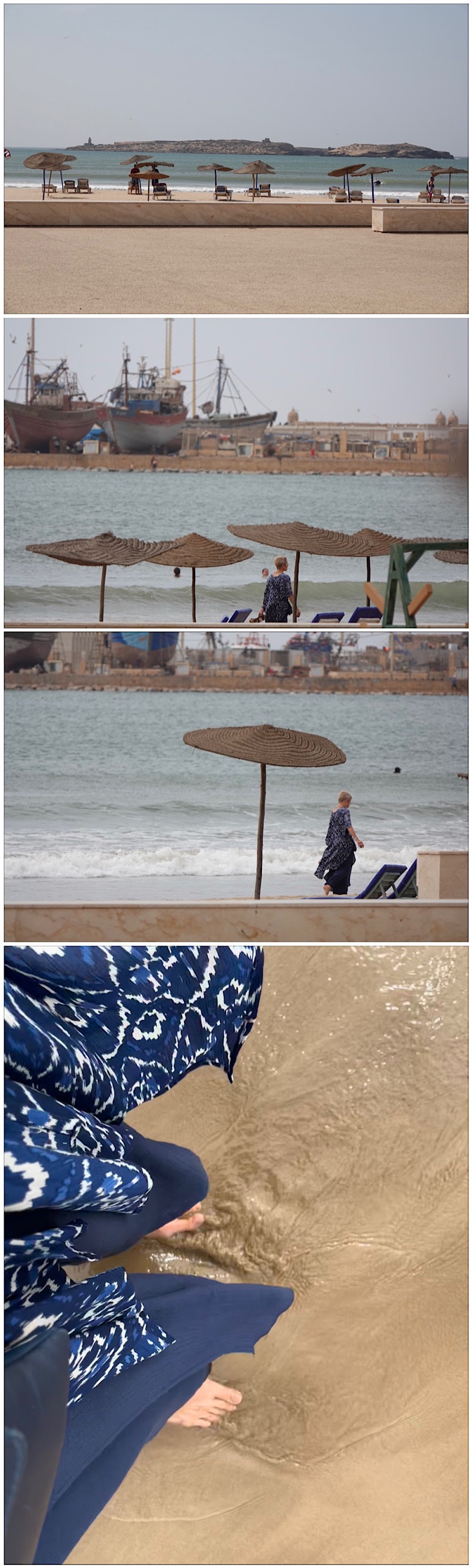
Essouaira, meaning wall or rampart, is a fairly new name for the city, which was formerly Mogador. Sultan Mohammed III walled the city and intentionally established it as an international port of trade in 1765. He had a French and an English architect lay out the city specific to those needs, including creating a diplomatic section.
Essouaira’s basin is fairly shallow; when Casablanca was established as a deep sea port during the French occupation it reverted to a fishing port, and remains that today.
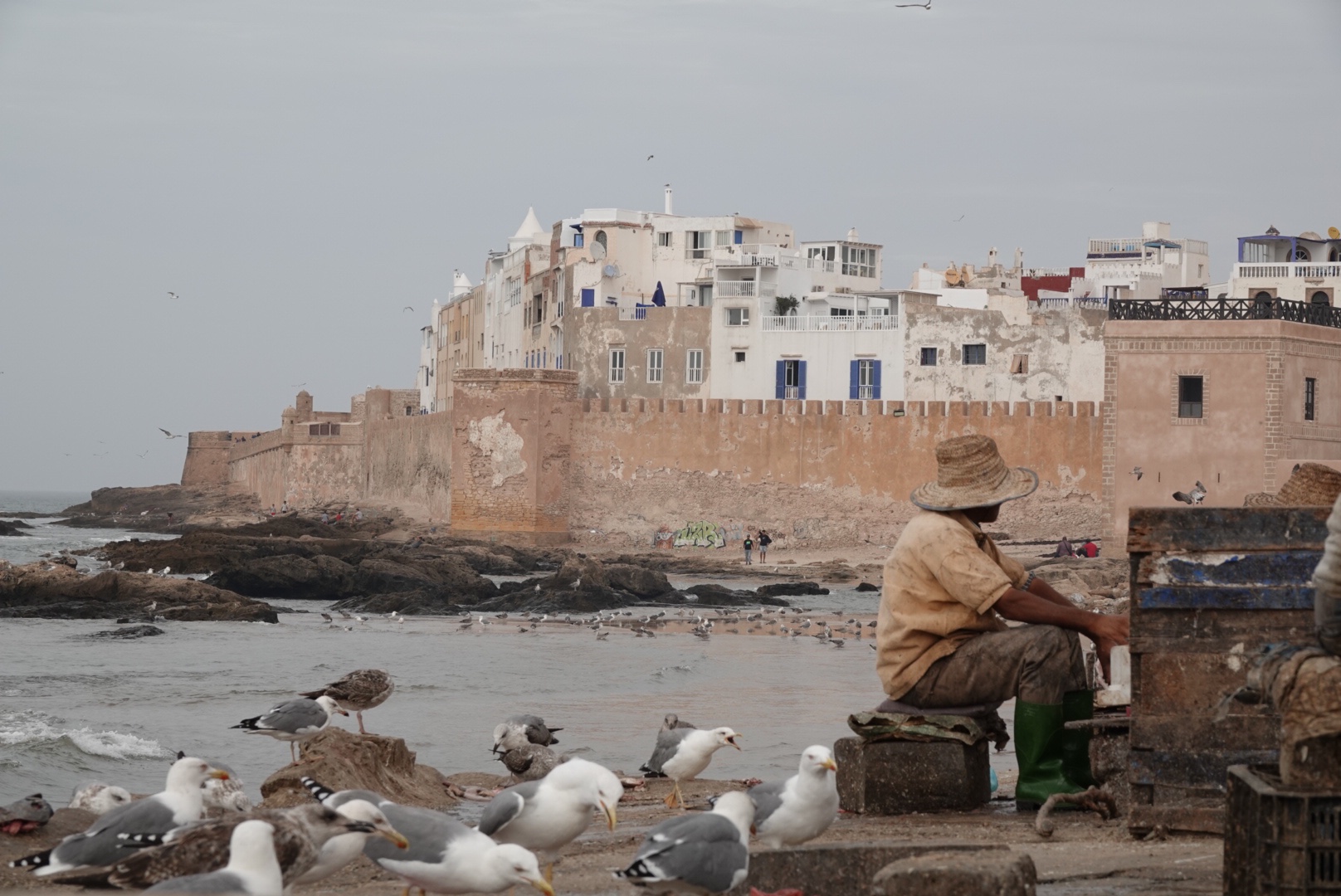
Our guided tour of the medina began at the port with its blue fishing trawlers. One to three fisherman work on each small blue boat, fishing for everything from tiny sardines to several species of shark. For some of the larger fish, fishermen use “long lines” up to 2 km long with hundreds of hooks baited with sardines. Nets are used to catch smaller ocean fish and sardines, while traps are used for Atlantic lobster.
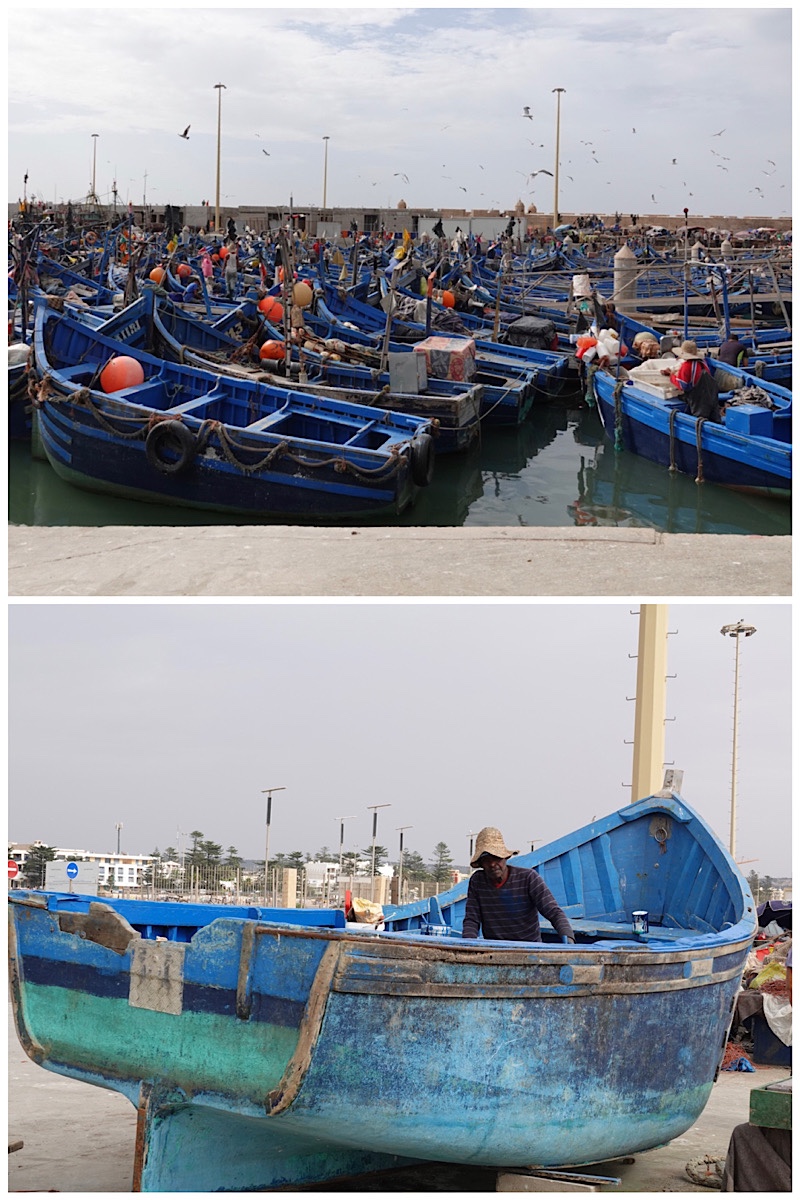
From the fishing port we entered the medina through Bab-el-Marsa, the gate of “La Marine”, or Navy Gate. The date inscribed on the gate is 1184, which is 1769 in our Gregorian calendar. All 3 monotheistic religions are represented on the gate, indicating a welcome to traders from everywhere.
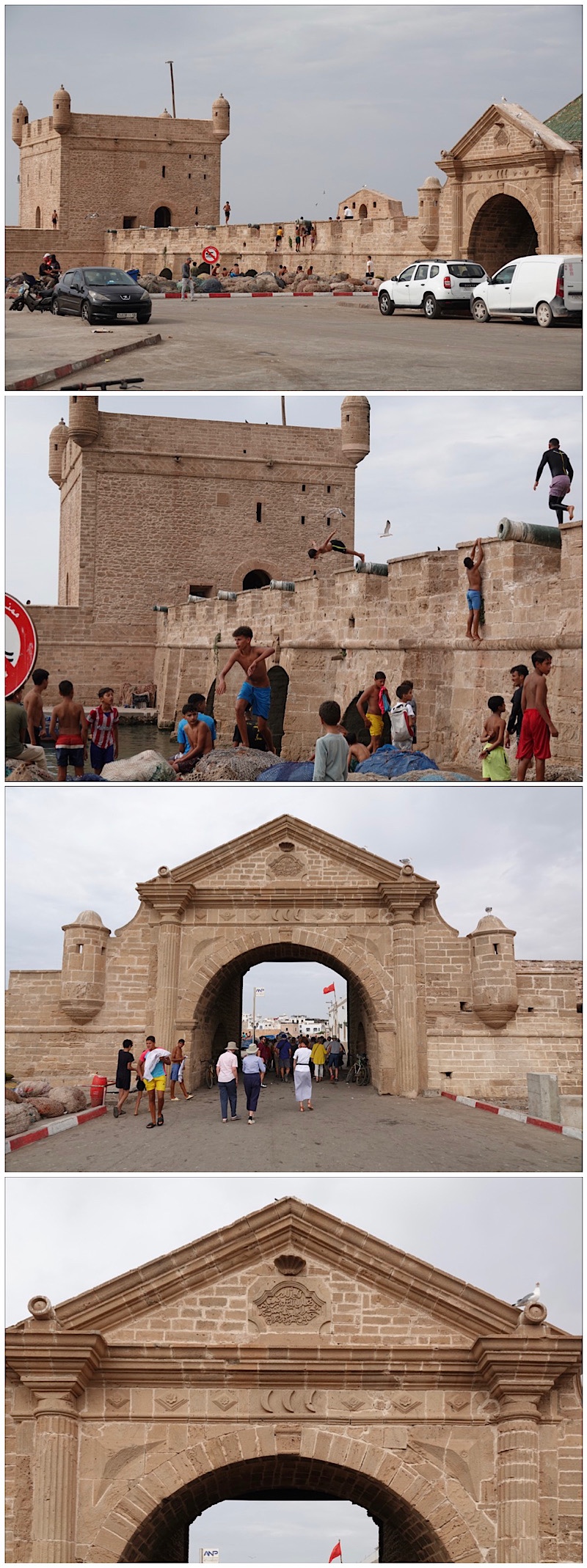
The medina was designed with a combination of Basque and French architecture, and originally included places of worship for Moslems, Christians, and Jews. The Portuguese cathedral is currently being restored, even though there is no one living here who will use it, because it is part of the area’s history/ patrimony and valued as such. We learned that the minarets here – and all over Morocco – are square because Morocco was never conquered by the Ottomans who have round minarets. We were surprised to learn that the medina had two large Jewish quarters with 38 public synagogues plus more private ones. Our guide said it would be wrong to ask how the locals get along with Jews, since Jews are the locals. There is apparently evidence that the Jews were in Morocco 2000 years before Christ, long before Christianity or Islam.
Much of the Medina was a garrison; current shops were once stables, munitions storage, and barracks. The nature of the fortified city as a trade centre meant that- unlike a lot of the dark and labyrinthine medinas we’ve seen – this one has bright, wide open streets.
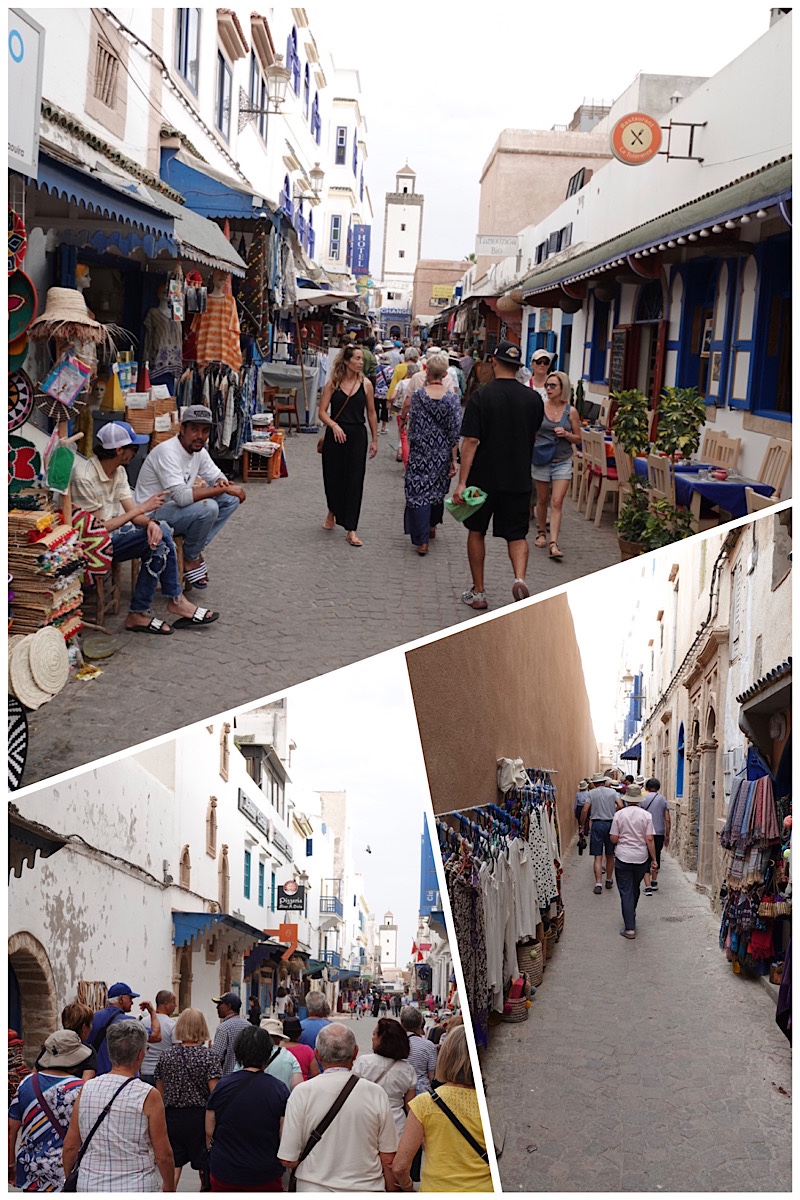
We walked wide passageways past all kinds of stores and restaurants that now populate the original diplomatic quarter at the intersection of the 18th and 19th century sections of the Medina. The embassies and consulates all moved to Casablanca when that city became the new trade port.
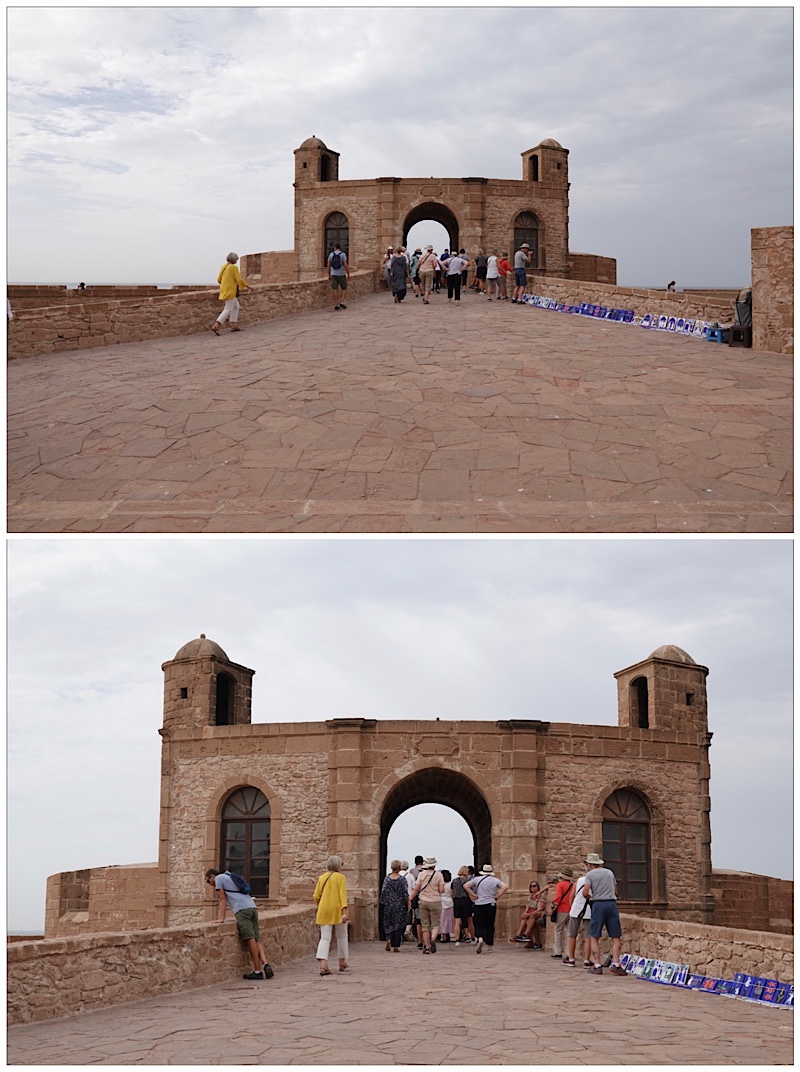

The cannons here came from Spain, Portugal, and the Netherlands, who all had big colonial fleets in the 18th century. Those we saw in the bastion were made in Barcelona November 30 1780 during the reign of Carlos III (they are ornately engraved with that information), and were last used against the French, when the bastion’s 18th century firepower was defeated by 19th century weapons.
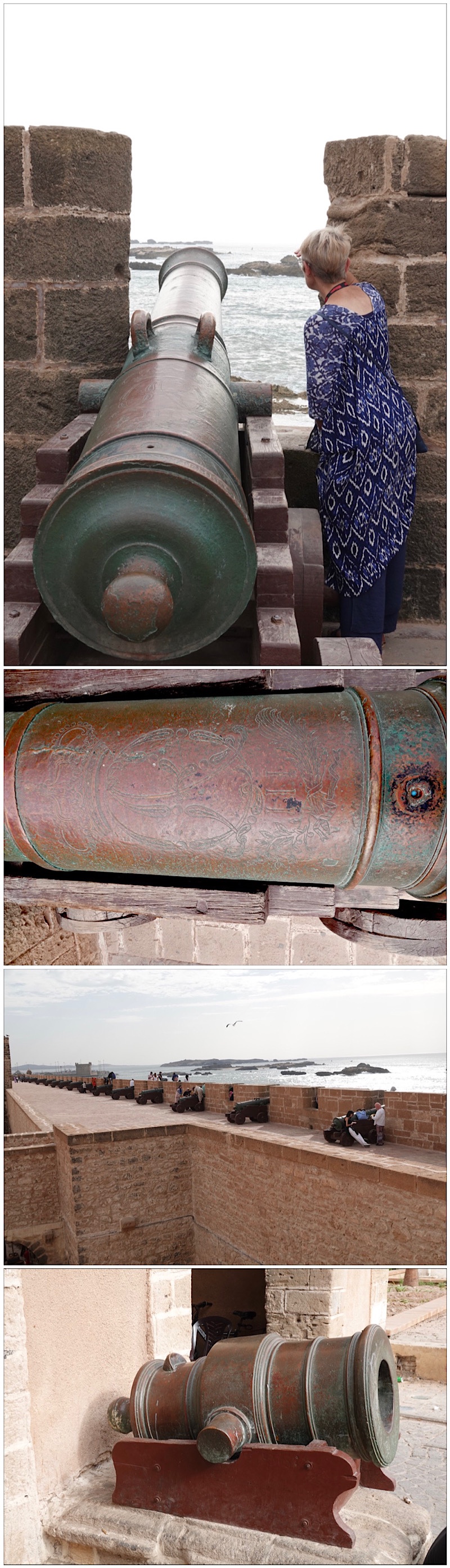
From the bastion we had a clear view of one of Morocco’s large Atlantic coastal wind farms. The coast is windy 300 days per year! Wind plus solar plus green hydrogen production are slated to make Morocco an energy exporting powerhouse in the future. Our guide opined, “Morocco doesn’t need oil. Countries who have oil all have problems.”
We’ve been seeing a LOT of street cats in Morocco, but those in Essouaira were certainly the healthiest looking. Our guide told us that reason there are so many cats in the Medina dates back to the time that was a trading centre that needed cats to eliminate mice and rats, and prevent plague. Cats wandering the medina now are too well-fed to be much interested in rodents other than as playthings. He also told us that the cats that have a clipped ear have been spayed or neutered.
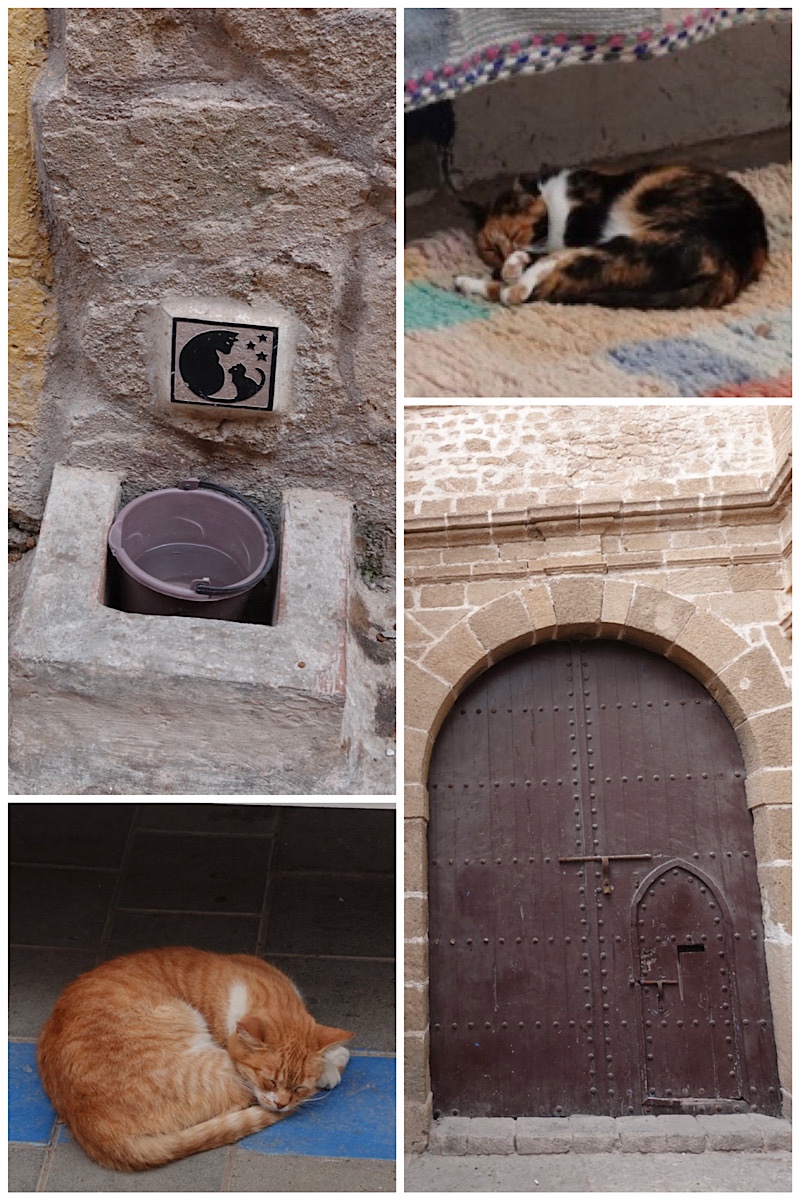
A bit further along we entered the Jewish Kasbah/ ksar (fortified inner city) Through a gate carved with Stars of David.
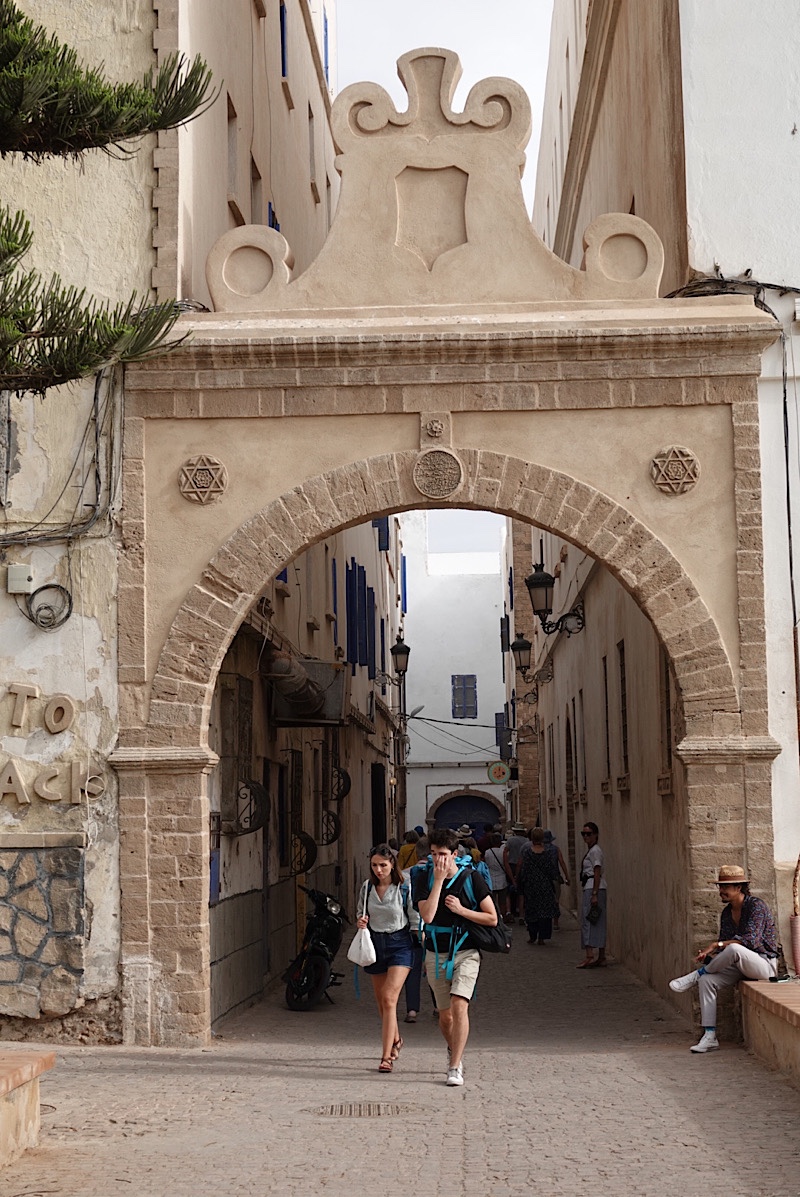
Mohammed III encouraged Moroccan Jews to settle in the city and handle the trade with Europe. In fact, Jews once comprised the majority of the population, but there are now none. The two biggest factors in Jews leaving were the changes in trade, and the founding of Israel.
We passed by a delicious-smelling bakery. Our guide told us that bread is never wasted here. Any unsold bread is bundled up to be sold very cheaply to farmers to use as feed.
We finished our tour in a silver workshop dating to 1906, located beside a courtyard full of beautiful multi-coloured bougainvillea. Morocco is the biggest user of silver in Africa, creating jewelry and ornamental items in a fusion of Jewish, Arab and Berber styles.
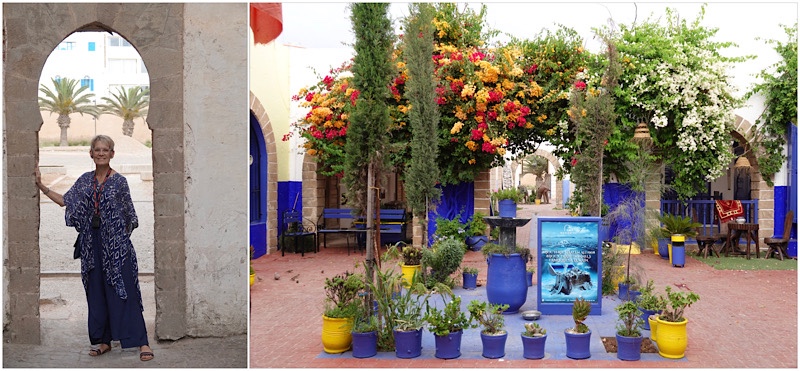
In my opinion, this was the most interesting medina we’ve explored in Morocco. As for Orson Welles’ Square? It is in such a state of disrepair that it wasn’t worth visiting. Those goats in the argan trees? Also MIA. It’s just not the right season.
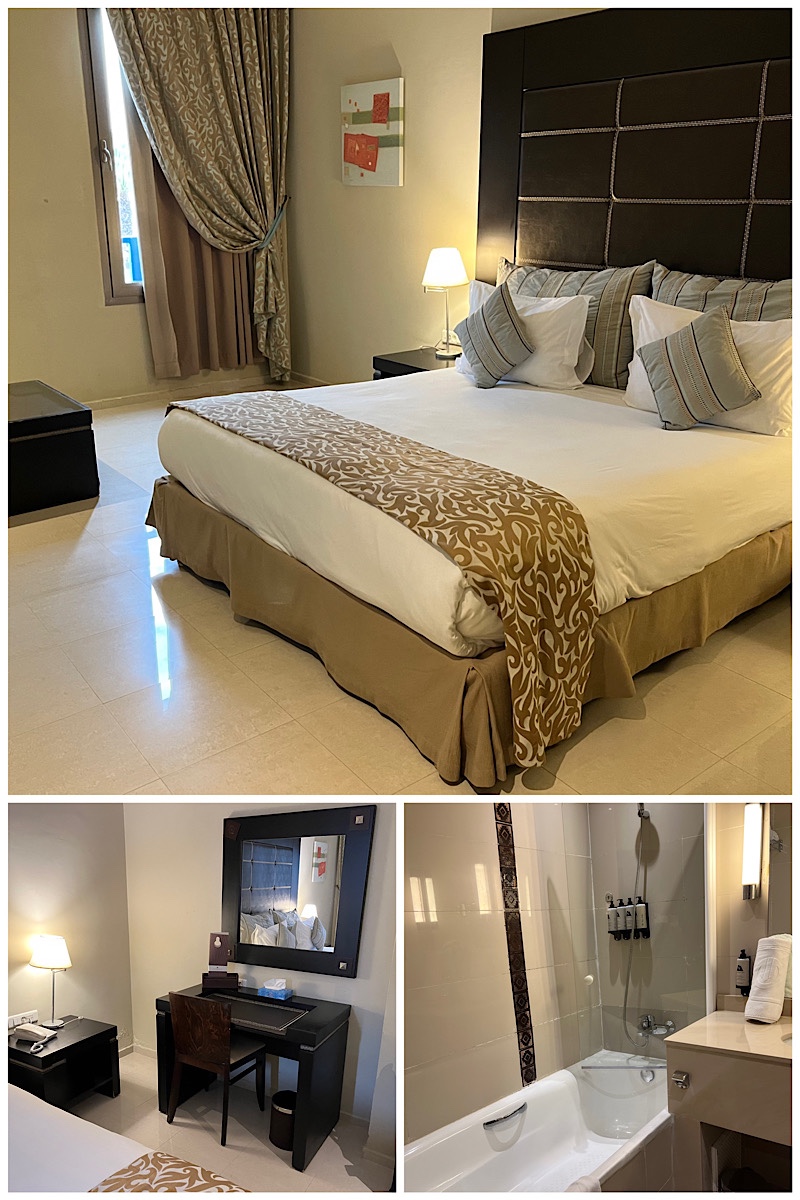
Our accommodation tonight was beachfront at the lovely Hotel Atlas Essaouira & Spa. By far the nicest hotel and best dinner of the trip, featuring fresh seafood salad on the buffet!
Tomorrow we travel back to Casablanca, having come full circle in our exploration of Morocco. I’ll have a few final notes, then we’re on our way back “home”.
 Rose and Ted’s Excellent Adventure
Your outfits are so lovely and appropriate! So much nicer than usual tourist dressing!
<
div dir=”ltr”>
LikeLike
Thank you – I appreciate that. I do try!
LikeLike