October 12 Published Itinerary: The 1,000-year-old “Red City” of Marrakech is drenched in culture and history. Our full-day tour includes the Mejorelle Gardens, the Saadian Tombs, El Bahia Palace and the Medina. At Djemaa El Fna Square we see snake charmers, acrobats and scribes writing letters for the illiterate.
🐪 🐫 🐪 🐫🐪 🐫🐪 🐫🐪 🐫🐪 🐫🐪 🐫🐪 🐫🐪 🐫🐪 🐫🐪 🐫🐪 🐪 🐫🐪 🐫🐪 🐫
After last evening’s disappointment and grumbling, most people woke up in a better mood. For our part, a decent night’s sleep and perhaps the best water pressure we’ve had in the shower yet in Morocco let us focus on the positives: look at where we are and what we’re seeing and doing!
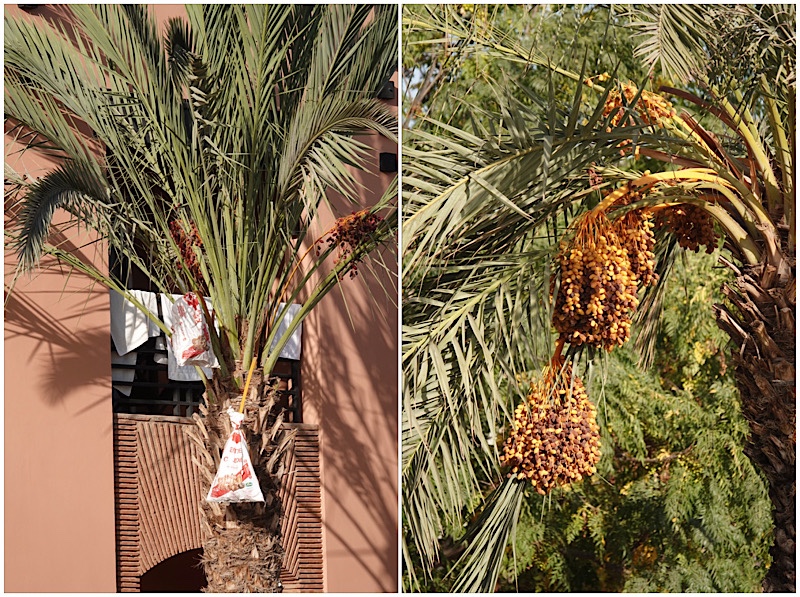
Marrakesh is a city in 3 sections: the Medina (old city) , the Ville Nouvelle (the new city dating to the French occupation), and the Gueliz (derived from the French word “eglise”, church). While we drove past some of the upscale shops and high-end hotels along Mohammed V Avenue in the new city, we really only visited sites within the medina.
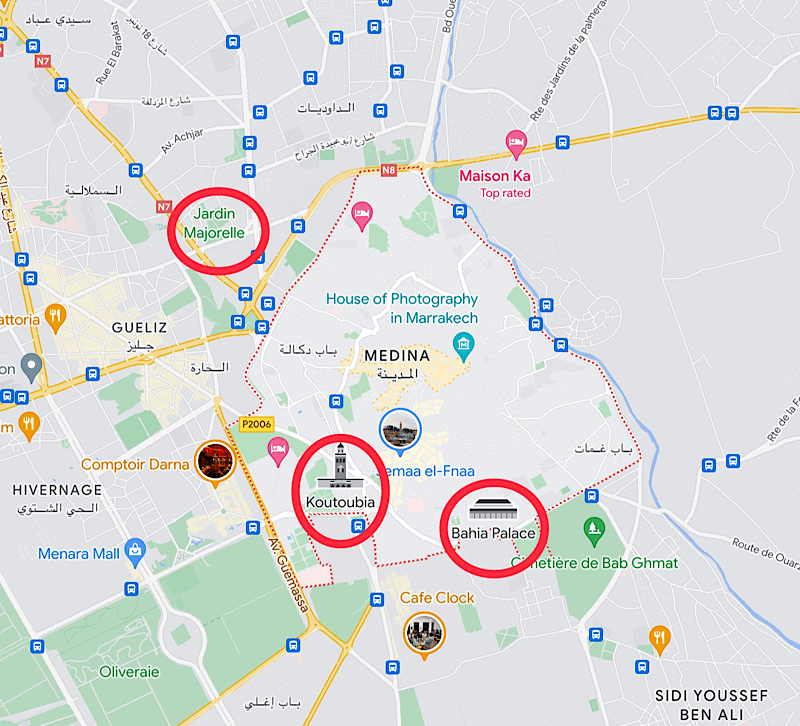
The approximately 20 km of city walls with 19 gates date back to the early 12th century, laid out by the Almoravid dynasty which founded the city in 1070 CE as their new capital. They look surprisingly pristine; repairing damage from this year’s earthquake was a priority in order to have the city centre ready for the IMF conference currently in progress.

Our tour’s first stop was the Majorelle Garden, containing plants from all 5 continents artfully arranged in manicured stone-covered beds along red pathways. The garden was founded in 1920s by the son of famous furniture designer Jacques Majorelle, who had been invited to Morocco in by a French general during the country’s occupation. The gardens were abandoned after Morocco’s independence in 1956, but were purchased and redesigned by Yves St Laurent in the 1960s.
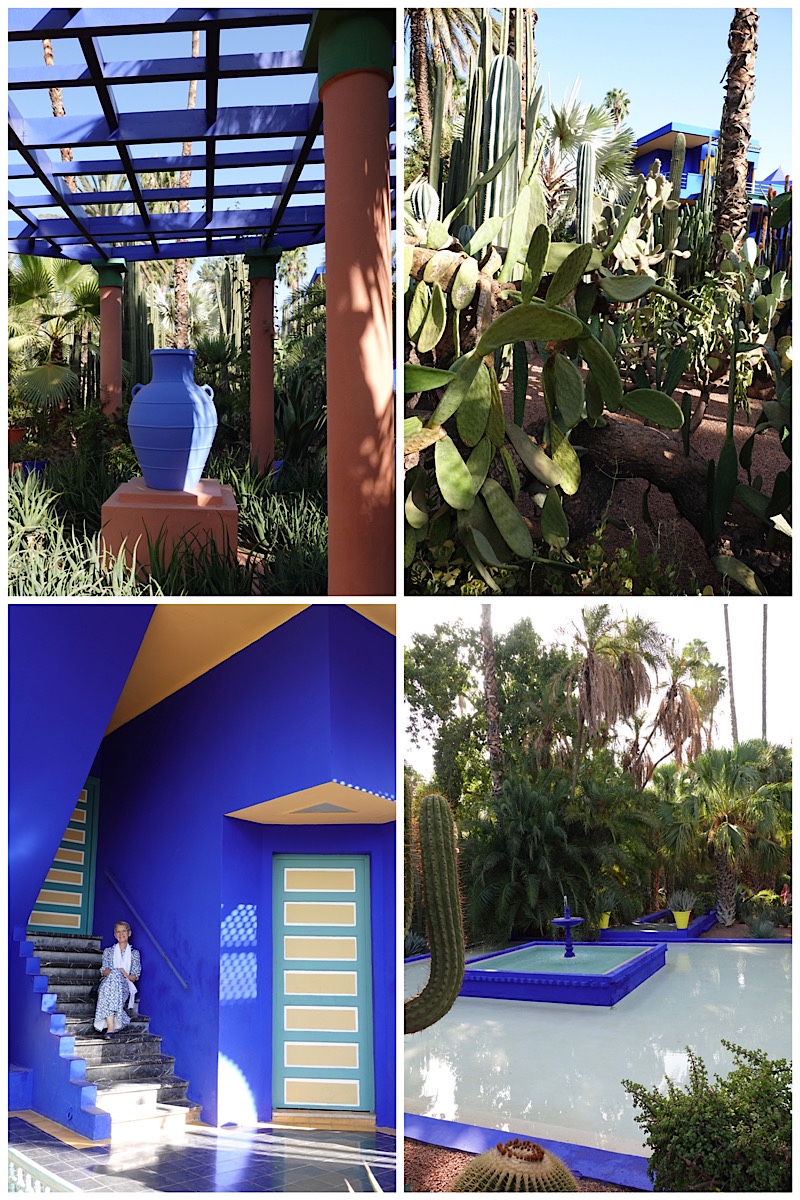
YSL decided to retain the garden’s original name, but his connection to Marrakech remains on the street later named after him.

To be honest, the garden is pretty but not spectacular, simply because most of the semi-arid climate plants don’t have much colour. The most interesting thing about the garden may be that there is staff constantly “combing” the stones around the plants, and the vibrant blue and yellow paints used everywhere.

Then it was on to the 12th century Koutoubia Mosque, the largest mosque in Marrakech. Its name comes from the Arabic word for bookseller, since the mosque is located where a huge book market once stood.
The mosque’s 77m/253ft tall Moorish style minaret was damaged during the earthquake, but repairs are almost complete. Legend has it that the topmost orb of the minaret’s decoration was made from the melted gold jewelry of the wife of Caliph Yaqub al-Mansur.

Beside the 12th century mosque are the remains of pillars from an even earlier dynasty’s mosque, dismantled with the change of power. When the French arrived, they dug under the old mosque hoping to find buried gold. There was none.

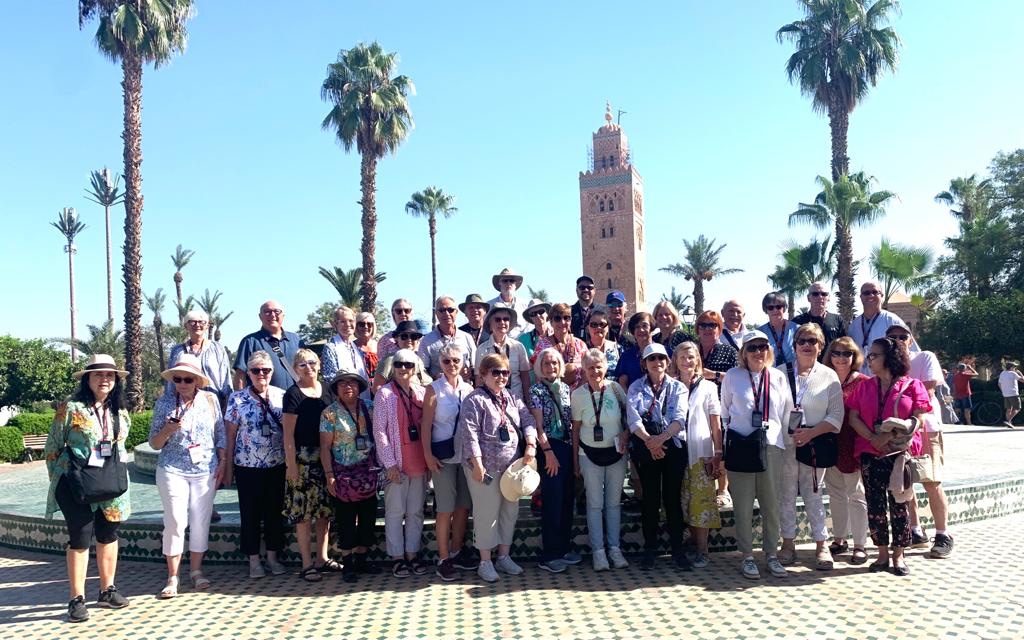
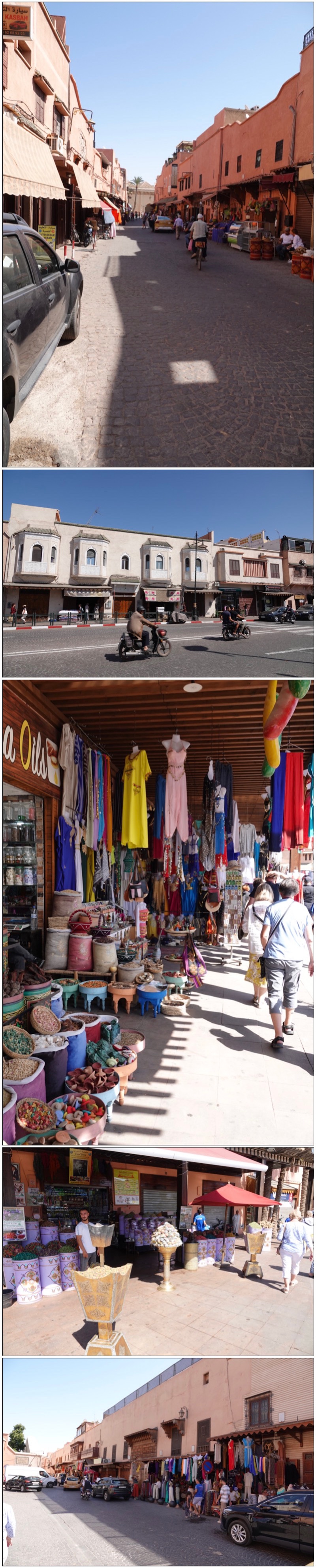
Parking a tour bus near the medina is a challenge. We got as close as we could (traffic here is crazy!) and then walked a couple of blocks through streets lined with shops, crowded with people, and filled with the kind of big city hot weather smells that no one loves.
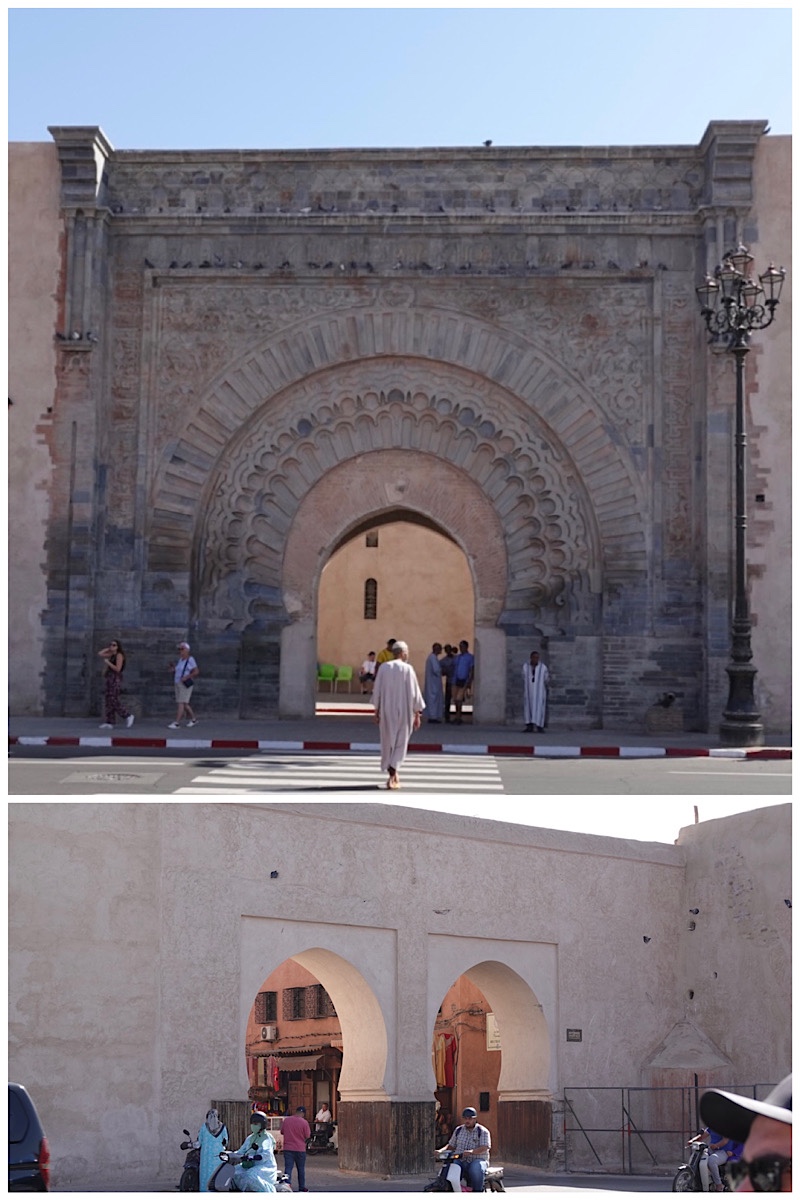
We entered the Kasbah marketplace through the Bab Agnaou (Gate of Agnaou), built by the Caliph Al-Moudha al-Mansour between 1185 and 1190. The gate’s name may have come from the African country of Guinea, recognizing 12th century traders coming from there to Marrakech.
We did not – again – spend time perusing the wares of the marketplace, but were taken specifically to visit a traditional pharmacy to learn about the many plants used in Moroccan cosmetics and alternative medicine.

We started with a cup of green tea with saffron. Saffron is used as a mood enhancer – something all of us found humorously appropriate!
The resident pharmacist/herbalist shared a wealth of information, beginning with centuries old cosmetic formulations.

Argan oil comes from ironwood (argania spinosa) trees, whose roots reach down 4 times the height of the tree above ground, and are uniquely suited to semi-desert climates. Argan oil used for cosmetics comes from ground raw argan nuts. I think I associated it specifically with scalp/hair health, but the pharmacist explained that a few drops put into pure lemon juice and used as a daily nail soak both whitens and strengthens nails! As for hair, given the median age of our group, the pharmacist was quick to point out that argan oil cannot grow back what is already gone! We bought a small bottle for my daughter-in-law, even though she already has gorgeous hair.


Next we learned about the oil from prickly pear cactus SEED. One ton of cactus fruit yields 60 lbs of seeds which makes 1 litre of oil. No wonder it costs $120 USD for 100 ml ! The oil’s nickname is “organic Botox”. No matter that it apparently works wonders on wrinkles, acne scars, and age spots, I didn’t buy any.
Among many other cosmetic items highlighted, the one that made all of us perk up was the argan oil, orange, and ginger soap. We all agreed that it smelled great, but what caught our attention was the pharmacist’s “warning” that the ginger in the soap would make us “tingly” … and maybe a bit frisky too! He hinted it was eminently suitable for showering á deux.
Then it was on to more serious stuff: herbal medicines.
There was a 5-oil blend of arnica, argan, nigella sativa, castor, and rosemary that when shaken, very sparingly applied, and gently massaged into joints counteracts rheumatic pain. Thank goodness we don’t need it, but lots of our group members bought it to try.
He talked a lot about nigella. Oil made from the flower’s roasted seeds is used for curing ear infections, especially in children. Rubbing dried unroasted seeds and holding them near your nose in a piece of gauze clears the sinuses as well as eating wasabi or strong horseradish. We all tried sniffing it. Wowzers!
Roasted nigella seeds made into a cream with frankincense is widely used here to treat psoriasis. We picked some up for grandson #2.
We all got a dab of oil from the blossom of bitter/Seville oranges. The scent is a sleep aid like lavender, but unlike lavender does not affect estrogen levels! The pharmacist joked that prolonged lavender use can be a strategy to “relax” your husband.
Next came a discussion about spices and natural flavourings, beginning with SAFFRON!
The herbalist started by saying that saffron is too expensive just to be used to colour food. We didn’t know that it is also an antiseptic and antibacterial.
Until today, I also didn’t know that the word Paella is Arabic for leftovers; saffron was historically used to preserve leftover foods and neutralize spoilage.
Real saffron has a hospital/ antiseptic smell that we were able to experience firsthand. We were cautioned that if what we’re being sold doesn’t smell like that, it’s not really saffron (and the smell lasts for up to 5 years). Also, a thread of saffron in water will turn the water yellow and FLOAT – if it sinks, it is not saffron! Each gram is good for 33 days or 33 portions of 5 or 6 strings per portion. At a very reasonable $10 USD per one gram container, we bought one to share with son #2 and family.
Apparently, hot lemon water (the vitamin C is an essential component here) infused with a couple of threads of saffron in the morning helps mitigate tinnitus. That’s how I’ll use my share!
We also bought some Moroccan spice mixes to take home: Ras El Hanout, a combo of 35 Moroccan spices for meat tagines; a 4-spice chermoula marinade base combo of coriander, cardamom, ginger and nutmeg; and spicy Harissa powder. Hopefully #2 will make big enough batches of food with these to share with us.
A few other interesting facts (there were msny, many more but I couldn’t keep up with my notes!):
Nutmeg in high quantities is nature’s LSD, and nutmeg-infused coffee helped gain Marrakech its early 20th century “druggy” reputation.
Cumin in water is natural Pepto Bismol (“Nausea, heartburn, indigestion, upset stomach, diarrhea”)
Cardamom cleans the intestines and prevents gas (chew it!)
Ambrette pods rubbed on the skin are an effective deodorant, and stored in closets prevent moths and silverfish.
Menthol crystal inhalation (menthol crystals are just a solid form of mint essential oil) and peppermint oil massage are both used to relieve migraine pain. The herbalist demonstrated how a tiny peppermint crystal in cold water created an incredibly pungent minty smell!!
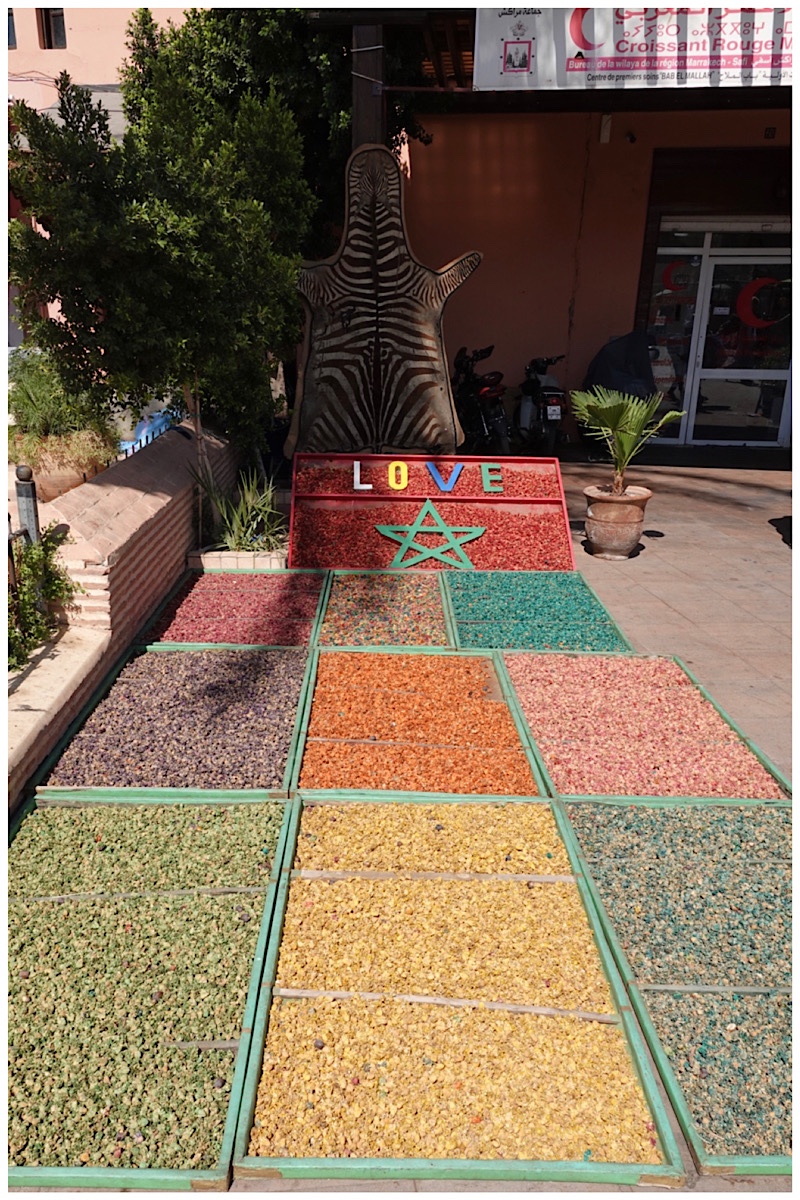
Folks in our group bought a LOT of products at the pharmacy. After paying for my very small order, I snuck outside to the sweets vendor and bought almost 500 grams (just over 1 lb.) of wonderful sticky honey and sesame treats. The sweets vendor contended bravely with all the bees that inevitably surround the honey-sesame stands. He gave the sweets an extra sprinkle of toasted sesame seeds, plus a quick spritz of water to keep them from sticking together, and then packed them into a paper bundle for us to take away. (After sharing a couple of our treats with new friends, Ted and I ate the rest of them for “dinner” instead of going down to the hotel’s repetitive buffet offering.)
Our next stop in the medina was the Al Bahia palace, a 19th century construction intended to be the greatest palace of its time. It was built by Si Moussa, Grand Vizir to the Sultan, and named in honour of his first wife. Bahia denotes beauty and brilliance. The palace was recently closed for large scale repairs due to earthquake damage, but had been partially opened to allow tours for delegates from the IMF congress. Lucky us, since we got to see almost as much as they did.
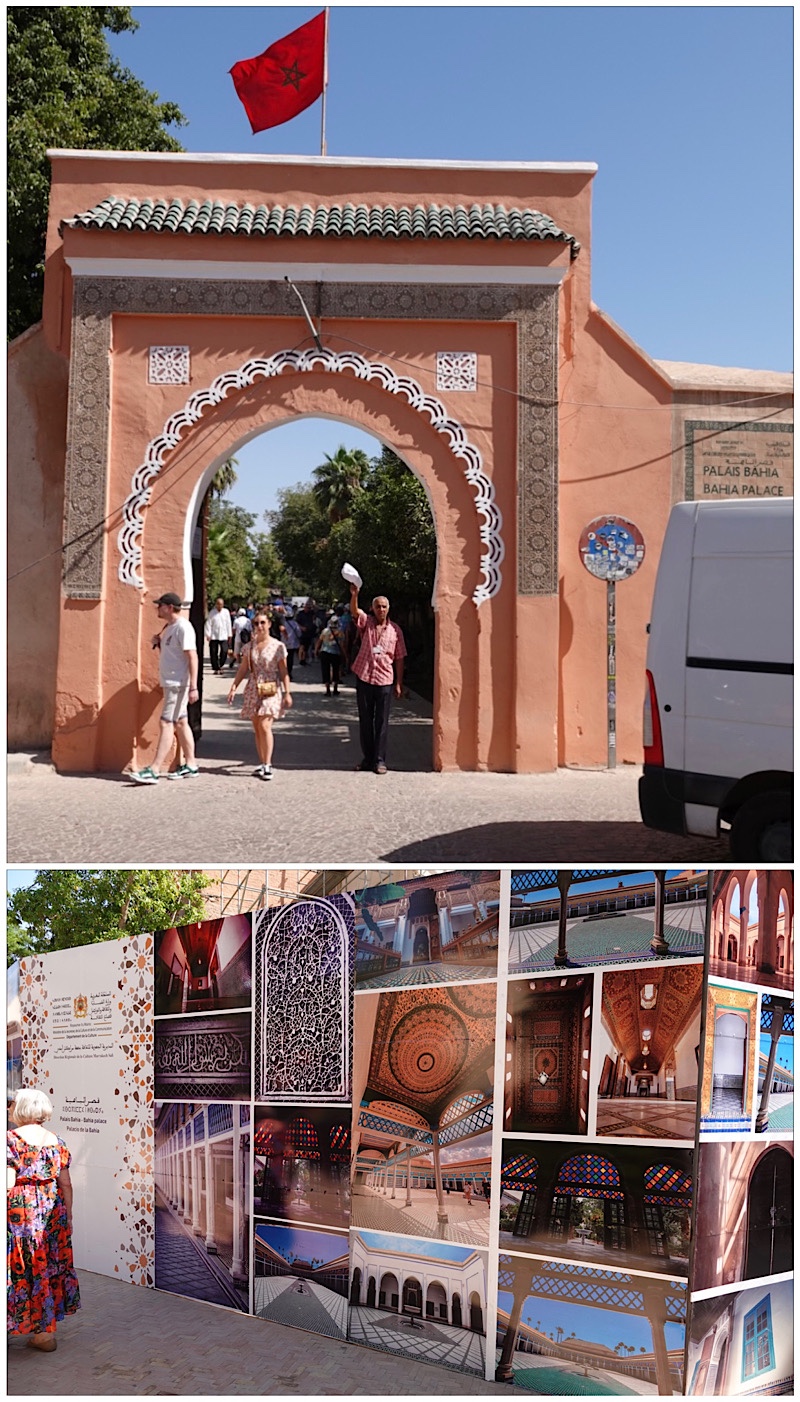
We entered a small open air riad with the typical 4 (one for each season) gardens. The pillars and tops of the outdoor walls were intricately carved.

The Vizir’s reception room, with a fireplace, zellige (the ornate cut tile mosaics), and an intricately decorated cedar ceiling in an upside down boat shape. The words inscribed in Classical Arabic in plaster beside the doorways mean “good health”.

The small courtyard for the vizir’s 4 wives, each with living quarters and private baths.
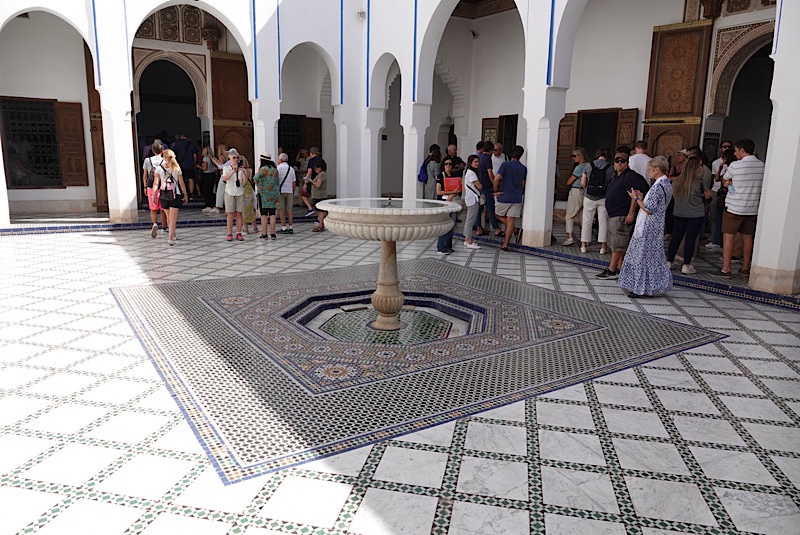
We were able to enter the first wife’s room, with Al Bahia inscribed on its walls.

There was also a large courtyard surrounded by multiple rooms, for the vixir’s hareem: his concubines and their children.
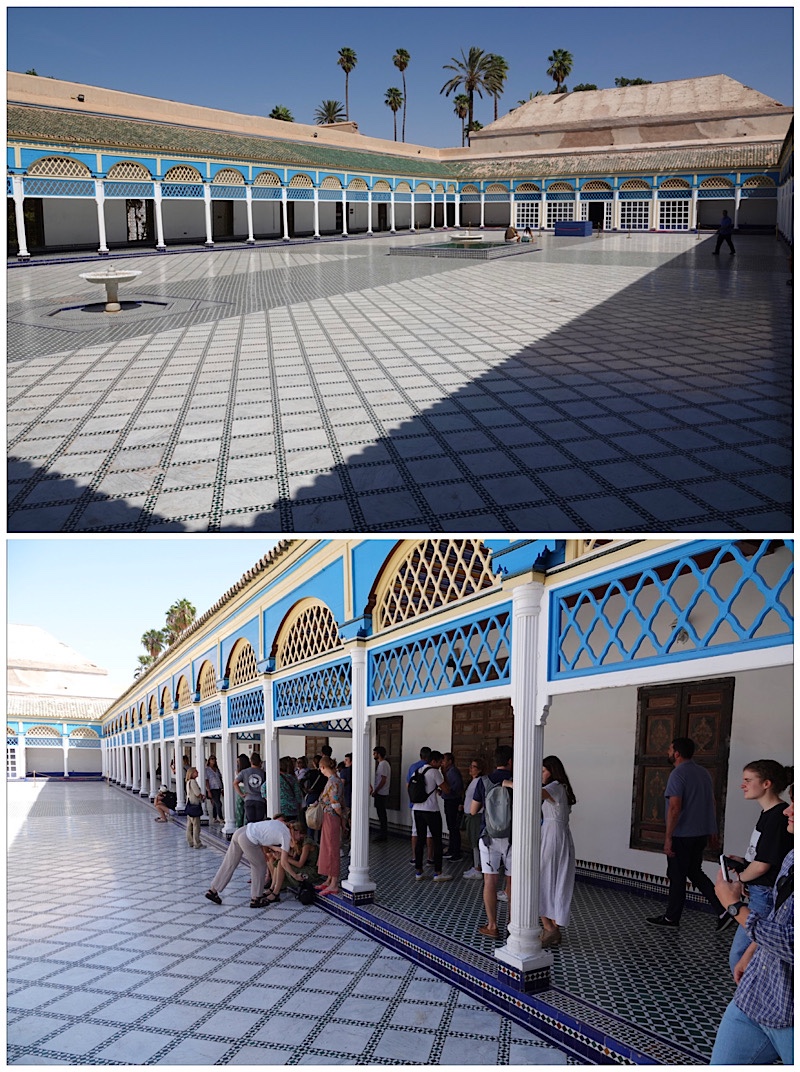
We had an included lunch today near the palace (a small gesture to assuage us for all the snafus so far). Lunch was Moroccan salad and tagine. Again. Good, but becoming boring. Not so the venue, which was just stunning.

After lunch, we deferred our early evening plans to tomorrow and simply called it a day. All of us need a short break.
We’re back into the High Atlas tomorrow – hopefully – to explore a waterfall !
 Rose and Ted’s Excellent Adventure