
October 7 Itinerary: A maze of stone and marble surrounded by orchards, Fez is the spiritual centre of Morocco. The old town’s maze of alleys, houses and shops sit in the shadow of the mosque’s minarets. From their workshops in the back alleys potters, charcoal burners, goldsmiths and weavers still practice their ancient trades. The Jewish Quarter here has long had a reputation for producing the finest ironwork in the country. On our full-day tour you will see the Medina (a UNESCO World Heritage site), the Najjarine Fountain, the Moulay Idriss Mausoleum, the Karaouine Mosque and more.
🐪 🐫 🐪 🐫🐪 🐫🐪 🐫🐪 🐫🐪 🐫🐪 🐫🐪 🐫🐪 🐫🐪 🐫🐪 🐫🐪 🐪 🐫🐪 🐫🐪 🐫
12:38 a.m. Adorable grandson #2 calls to video chat, having miscalculated our 8 hour time difference. He signs off after an “I love you” and a “sorry”. Quickly back to sleep.
2:00 a.m. A time-challenged rooster starts crowing, which sets off a pack of dogs for 20 minutes of yipping, barking, and howling.
3:19 a.m. The dogs start up again.
4:00 a.m. That accursed rooster. Cue the sopranos and altos in the dog choir. Ted gets up to take an Advil, which seems to help him fall asleep.
5:13 a.m. Something sets off the dogs. Maybe a siren going past? They don’t stop. After about 15 minutes the bass section of the barking joins in. Might as well get up to use the bathroom, from where they can still be clearly heard.
5:45 a.m. The dog chorus is still going on unabated after more than half an hour of solid barking when the muezzin’s call to prayer sounds.
5:55 a.m. Blessed silence. Did the muezzin’s melodic call calm the beasts?
7:00 a.m. Our alarm sounds. As does the rooster. WHAT is wrong with that bird?
7:30 a.m. As I’m getting out of the shower, we get the pre-arranged but now completely superfluous group wake-up call.
I’m exhausted before the tour day has even started, and we have 1 more night in this fully-booked hotel.
On a huge positive note, after talking to fellow tour members, we discovered that we DO have air conditioning! A visit to the front desk confirmed its secret location tucked behind the (always open) bedroom door. That bodes well for tonight. As Fouad would say, “inshallah”.

We loaded onto the bus at 9 a.m. to transfer just far enough to allow us to explore Fes on foot.
My best friend commented yesterday that our trip was going to be her only chance to visit Morocco, so today I thought I’d take her along every step of the way.
Fez (written as Fes, the French spelling, here in Morocco) consists of three distinct areas: the Nouvelle Ville (new city) outside the old walls, and 2 areas within the Kasbah – the Fes El Bali medina with its medieval Marinid architecture and vibrant souks, and the 13th century district of Fes Jdid, where the Royal Palace (Dar al-Makhzen) is still located.
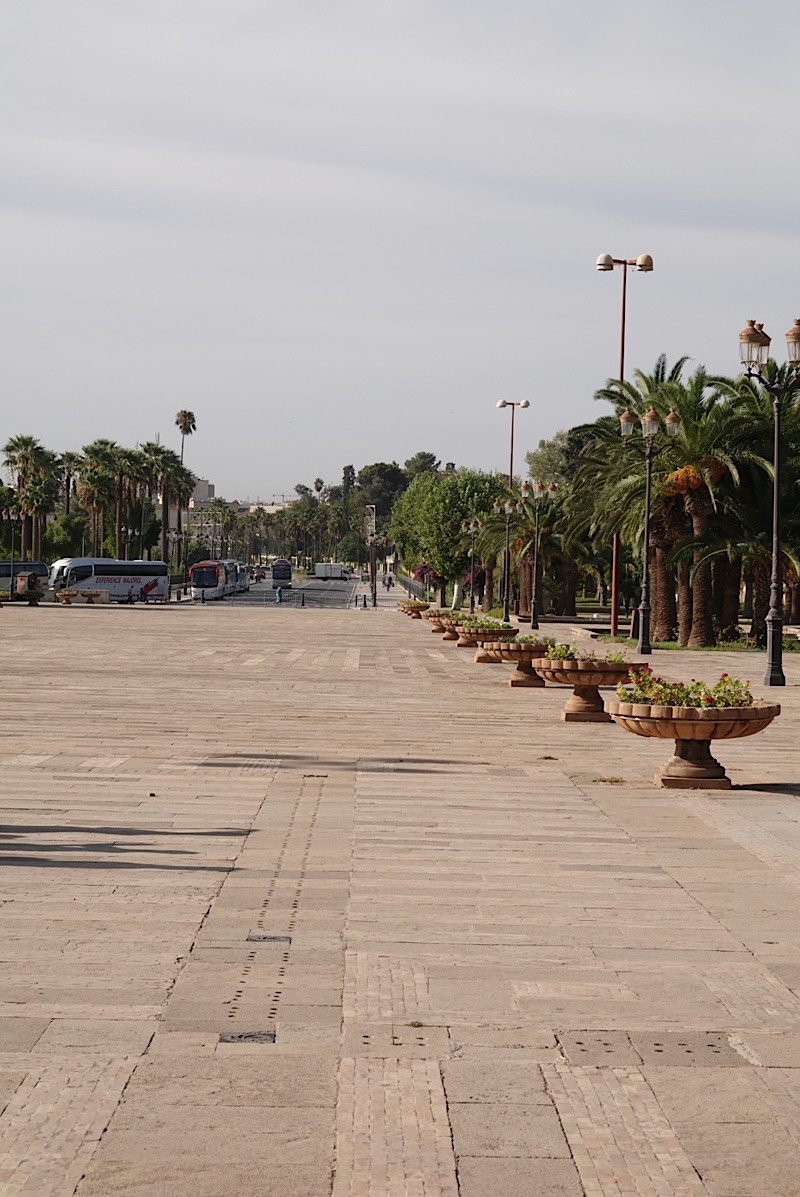
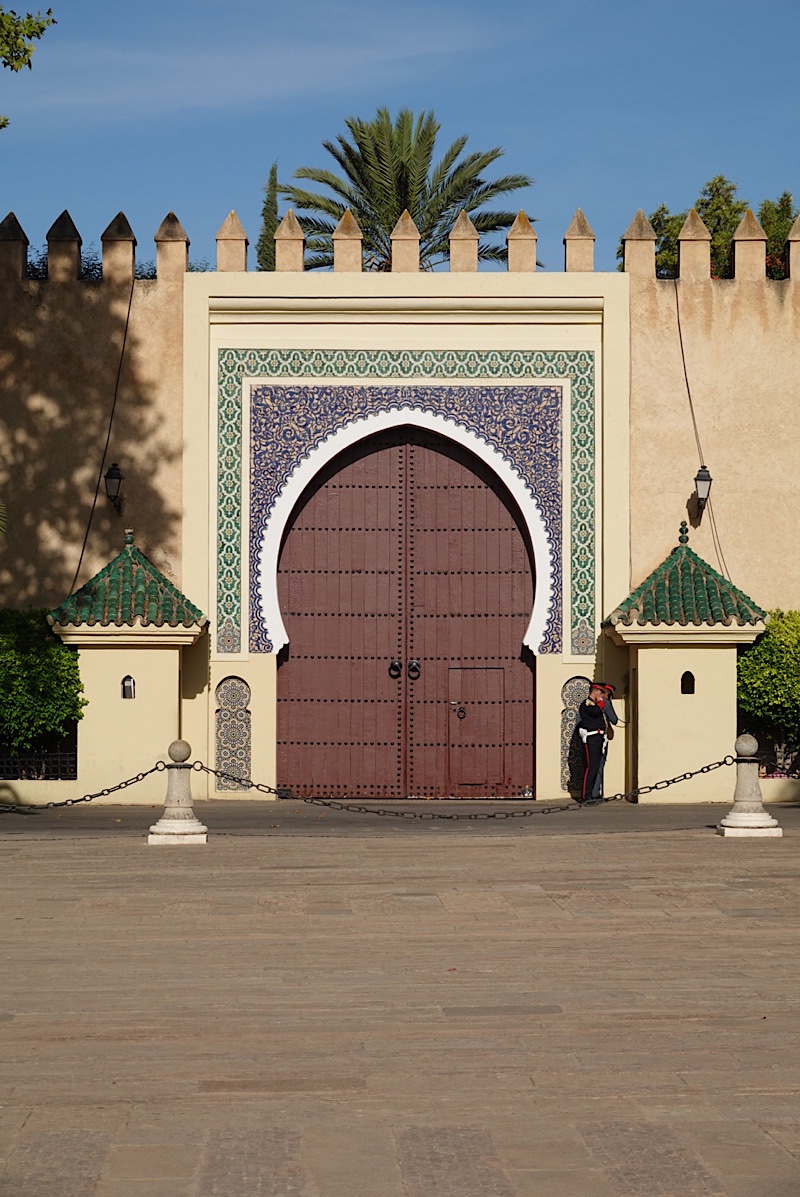
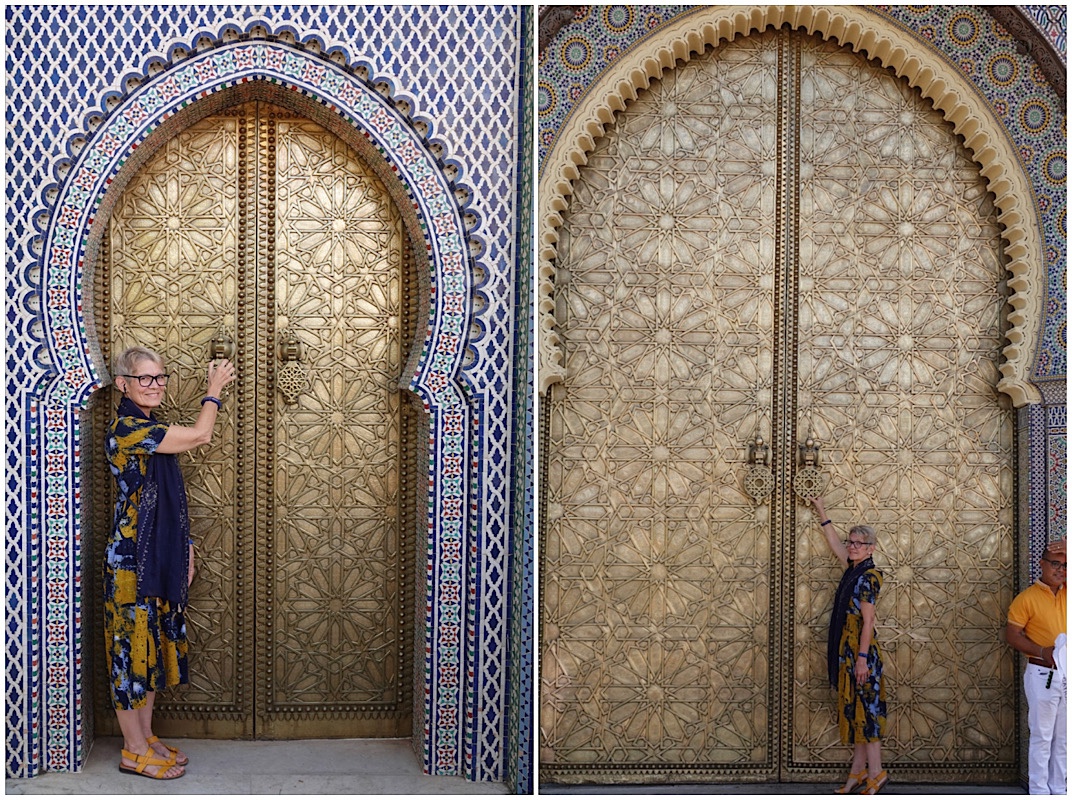
The huge shining bronze-clad cedar doors of the palace were our first planned photo stop today.

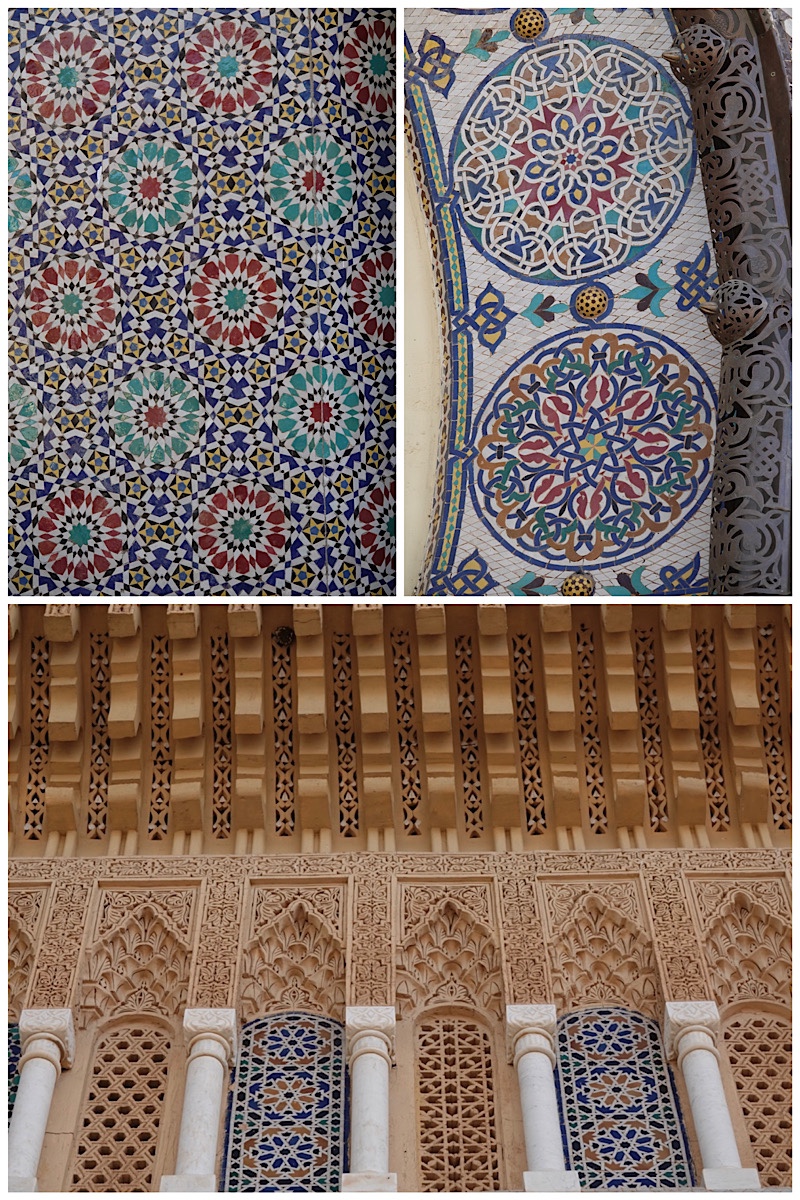

Next we walked through the Jewish Quarter (the “Mellah”) in the Fes Jdid. When the Jewish population was welcomed into Fes in the 9th to 11th centuries, partly to help establish a better economy and partly to,provide a safe haven after their expulsion from Spain, they were housed as a community. Today, Fes’ Jewish residents live in the Nouveau Ville integrated with their Muslim neighbours, and the historic Jewish Quarter houses, in some state of current disrepair, only Muslims.

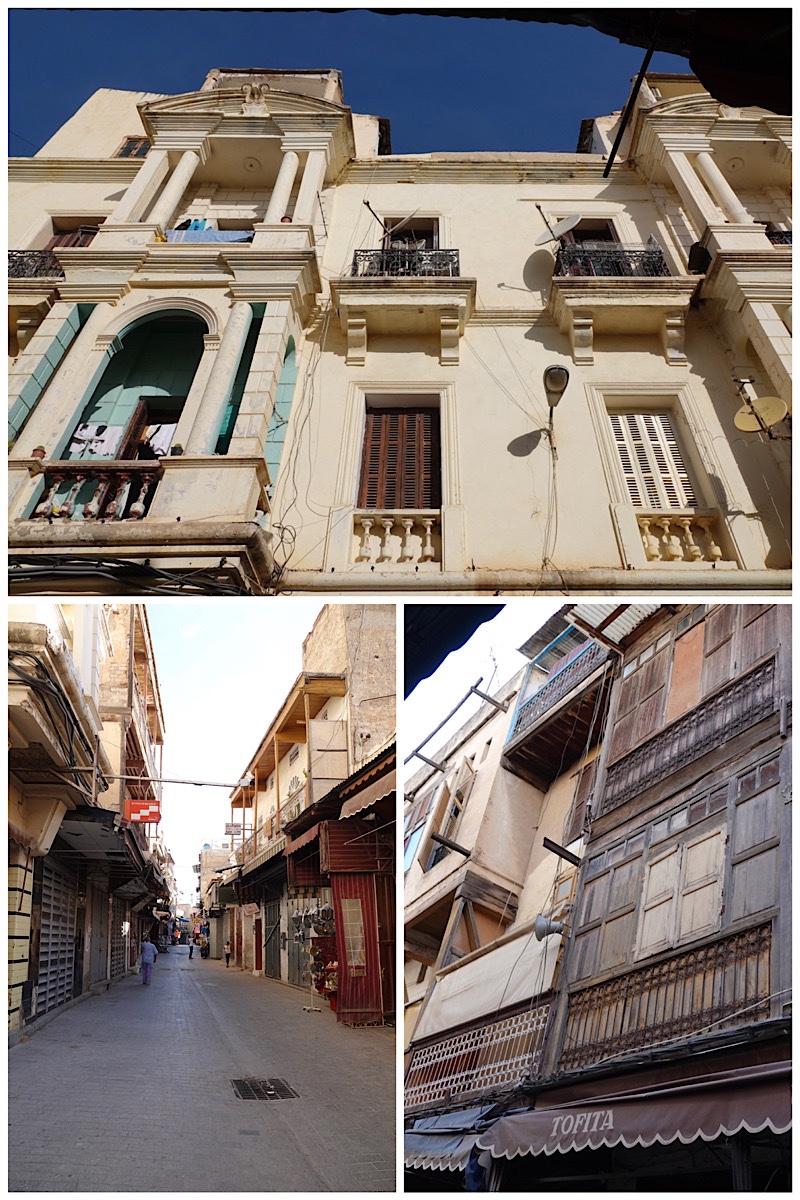
The houses are easily identified as having been Jewish by the fact that they have exterior balconies, and are more than 2 storeys tall. Muslim homes in Morocco never have public-facing balconies.

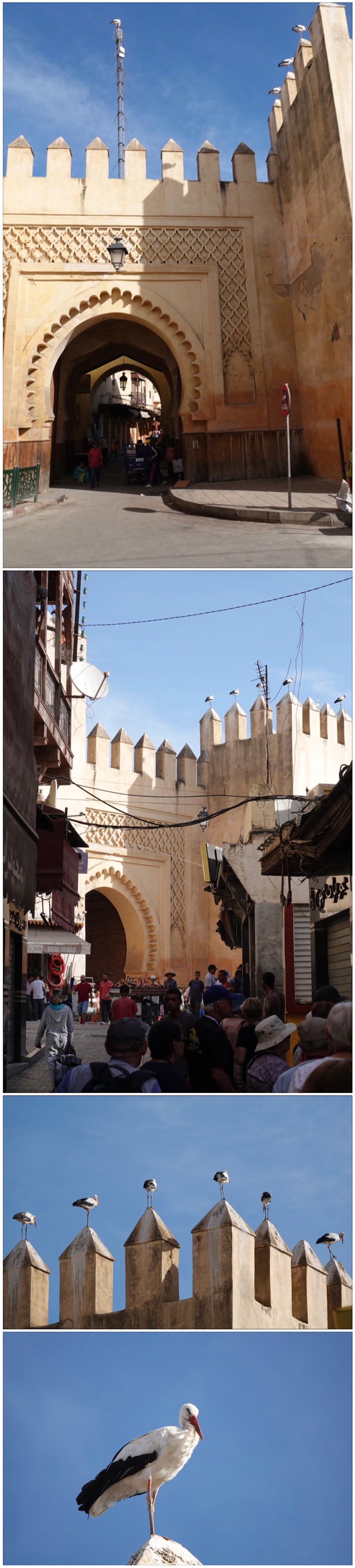
As we exited the gate leaving the Mellah, we noticed multiple stork nests and storks perching atop the crenellated walls!
We got back on the bus for a short transfer to a Fes pottery cooperative, to learn how the zellige mosaic tiles are made.
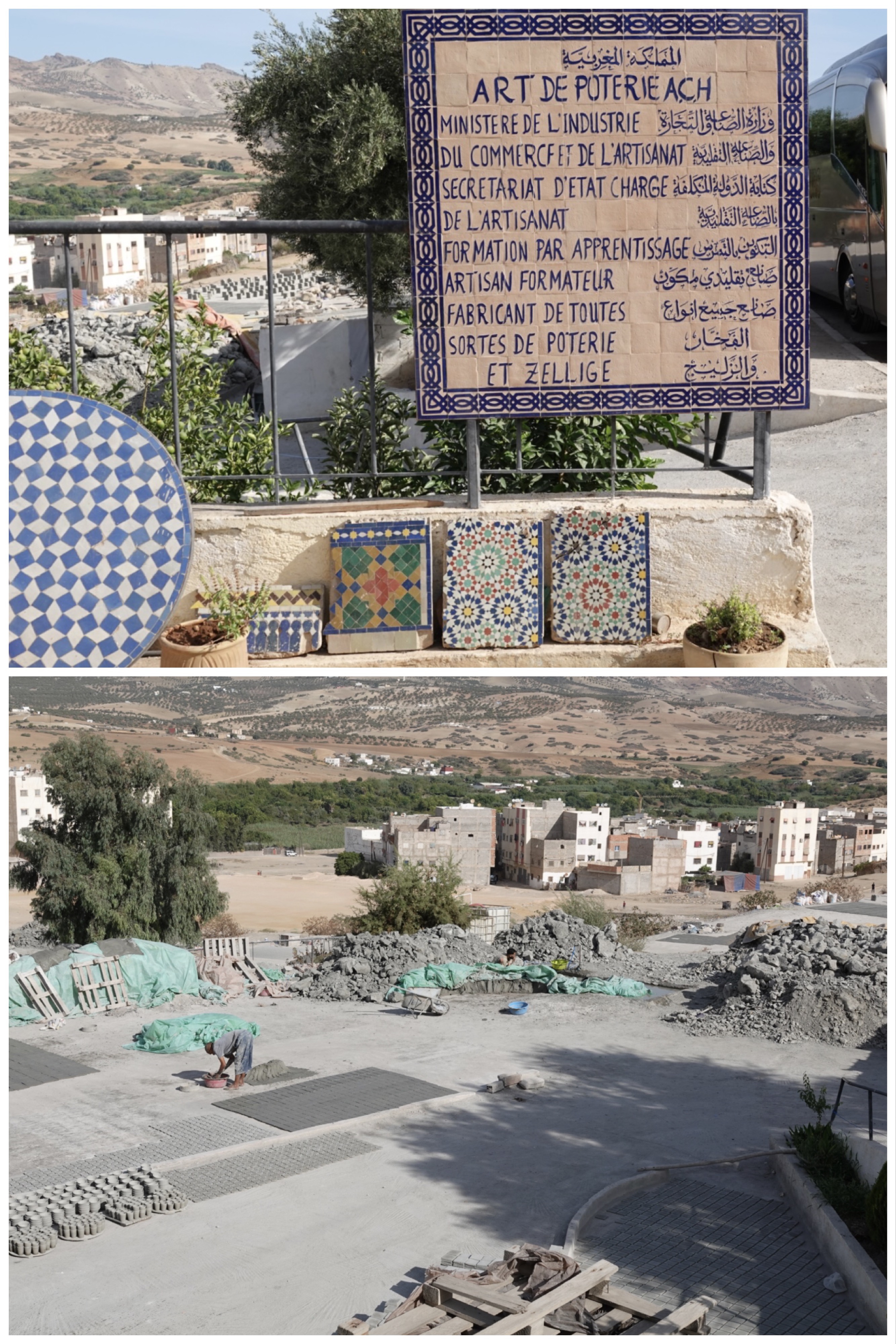

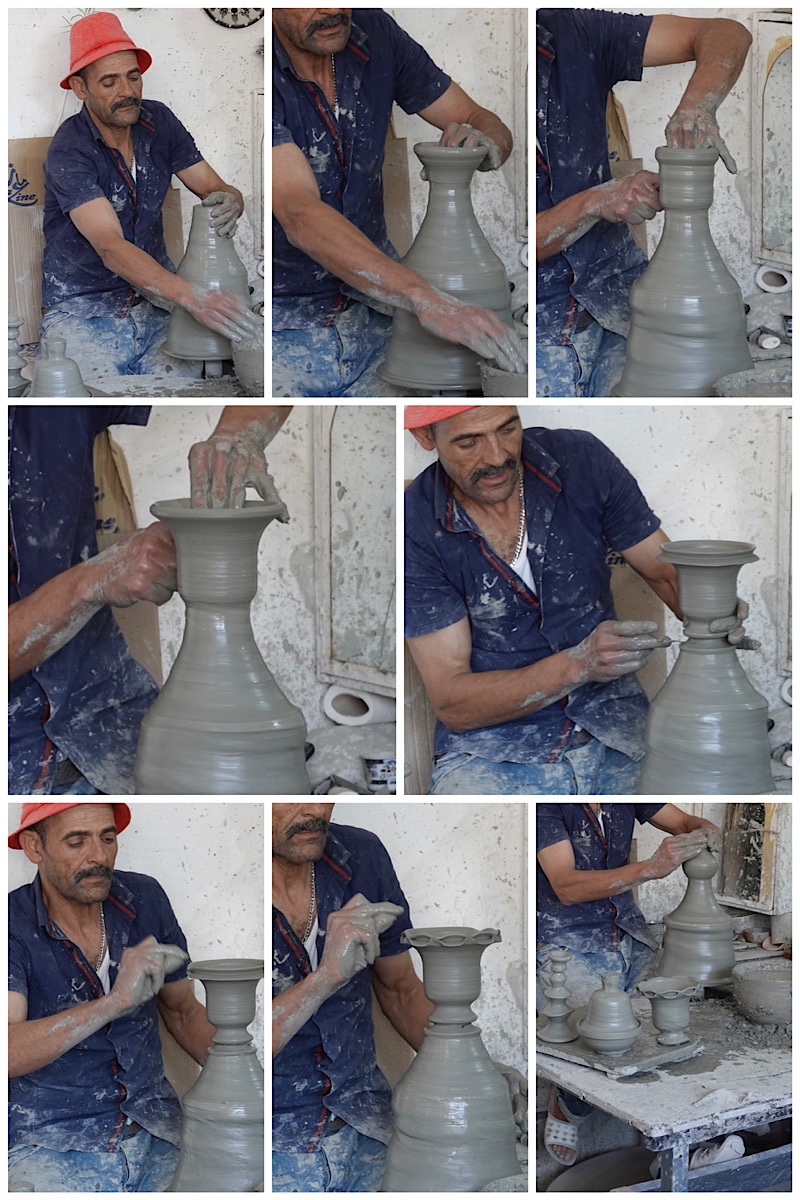
Everything is done by hand. The grey clay is the same kind used in spas, and gives the workers extra supple skin! We also learned that red clay contains lead, which makes it unsuitable for food dishes, but grey clay does not, so can be used for cooking, baking, and eating utensils .
After drying in the sun for 2-3 days, the clay pieces must be fired before glazing. This used to be done on site, but is now done about 15 km away to minimize the amount of smoke pollution near the medina. The firing ovens are fuelled with olive pits, whose oiliness creates hotter burning fires.

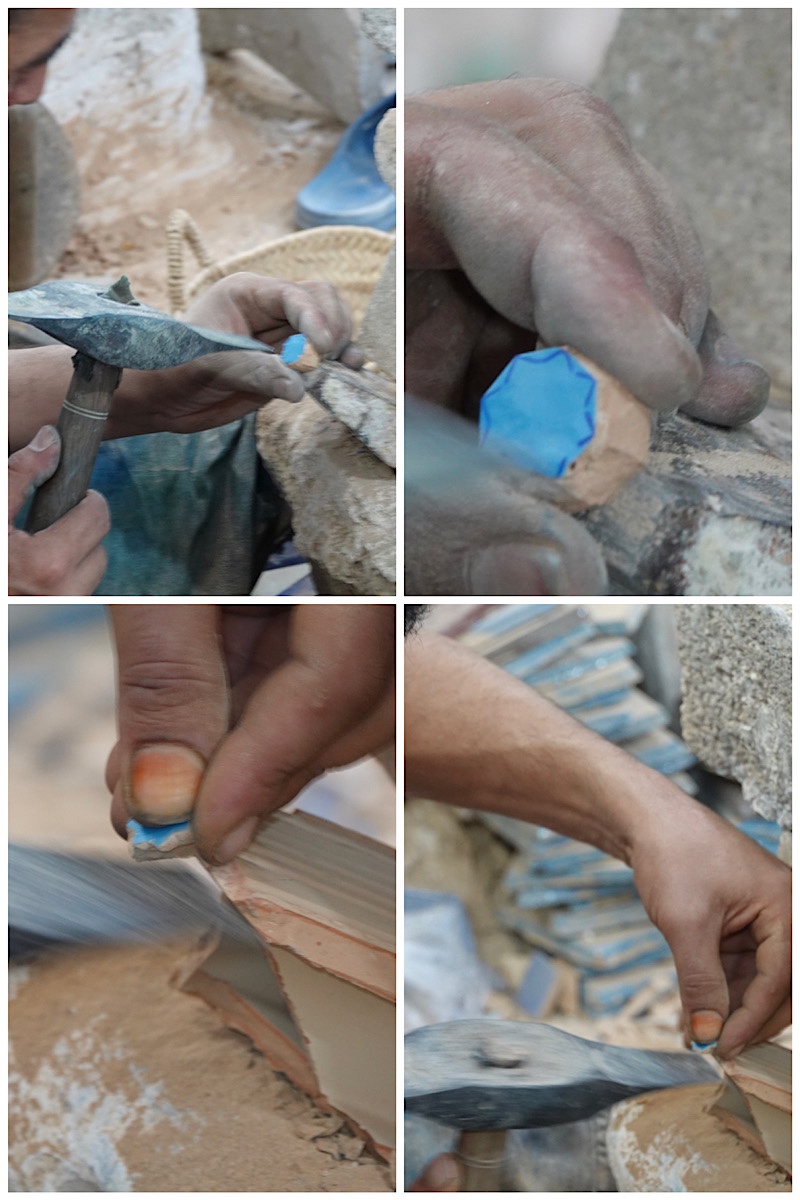
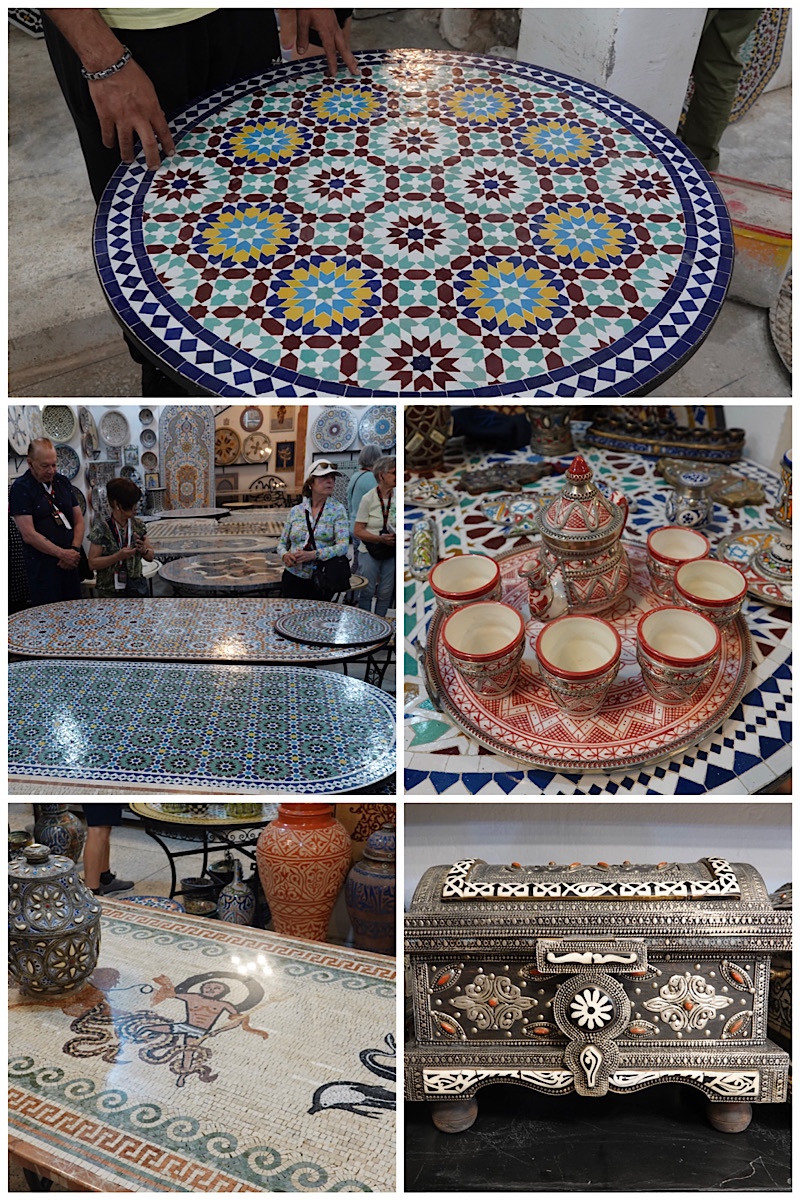
In addition to tiles, we also watched clay dishes being made.


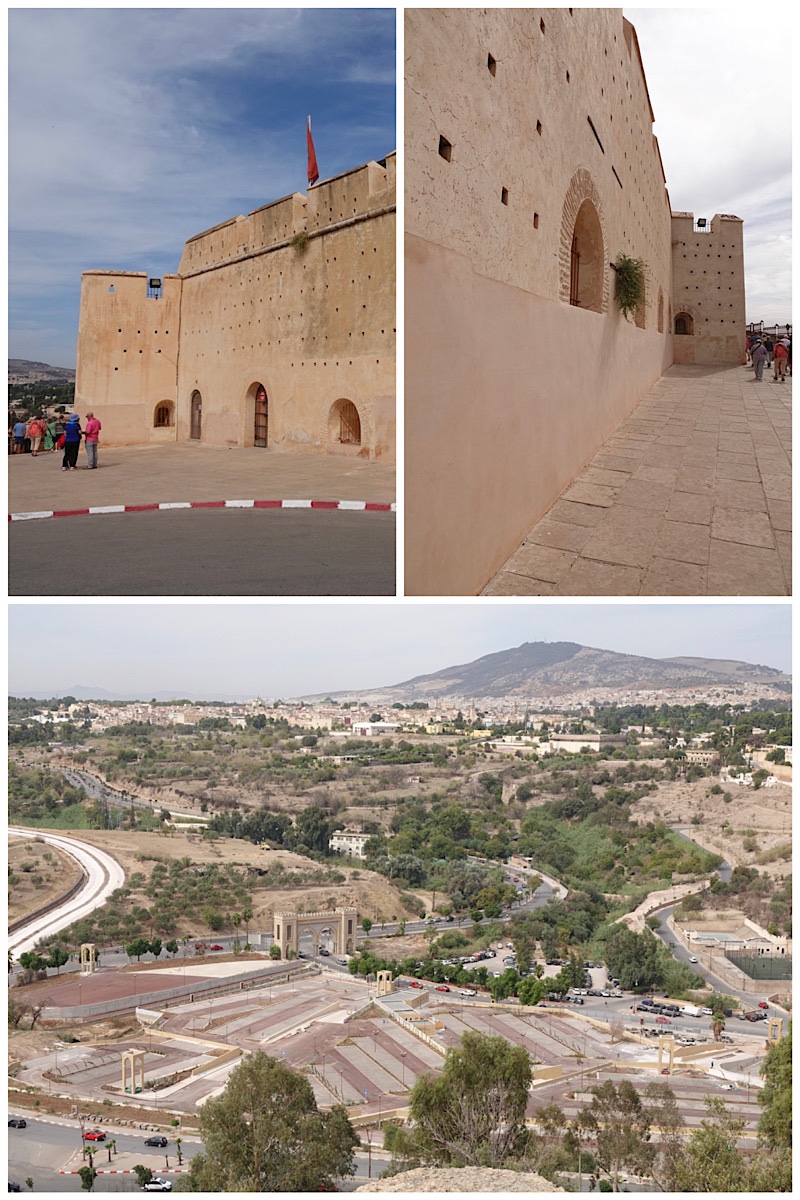
After leaving the pottery workshops and salesroom (no, we didn’t buy anything), we had another very short bus ride to the Borj Sub (South Fort) on a hill high above the Fes medina.
Fes is home to the University of al-Qarawiyyin which was founded in 857 as a mosque by Fatima al-Fihri in 857–859 and is considered to be the oldest continuously functioning institute of higher education in the world. While we did not have the opportunity to see it up close, it was visible from the fort.
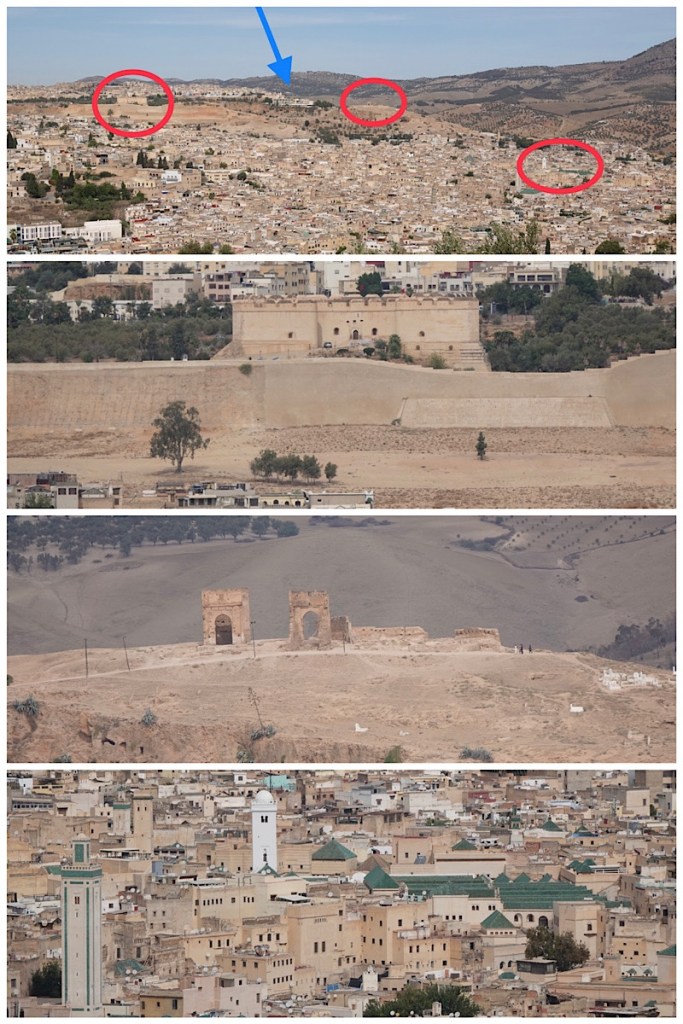
Top: the arrow points to our hotel. The 3 circles from L to R are the Borj Nord (north fort), the ruins of the 14th century Marinid Dynasty necropolis, and the University of al-Qarawiyyin. The next 3 pictures from top to bottom are zoomed in on those 3 circled landmarks.

Bottom: zoomed in.
On our way back down the hill to continue our on-foot exploration of the Fes El Bali medina, we drove by one of the city’s Muslim cemeteries, where all graves face Mecca.

Now it was time for our group to enter the oldest (dating back to the 9th century!) and more labyrinthine area of the Kasbah. Follow along!

The city of Fes is the second largest in Morocco, at around 1.3 million people. At times today it felt as if all of them were in the narrow streets of the medina with us.
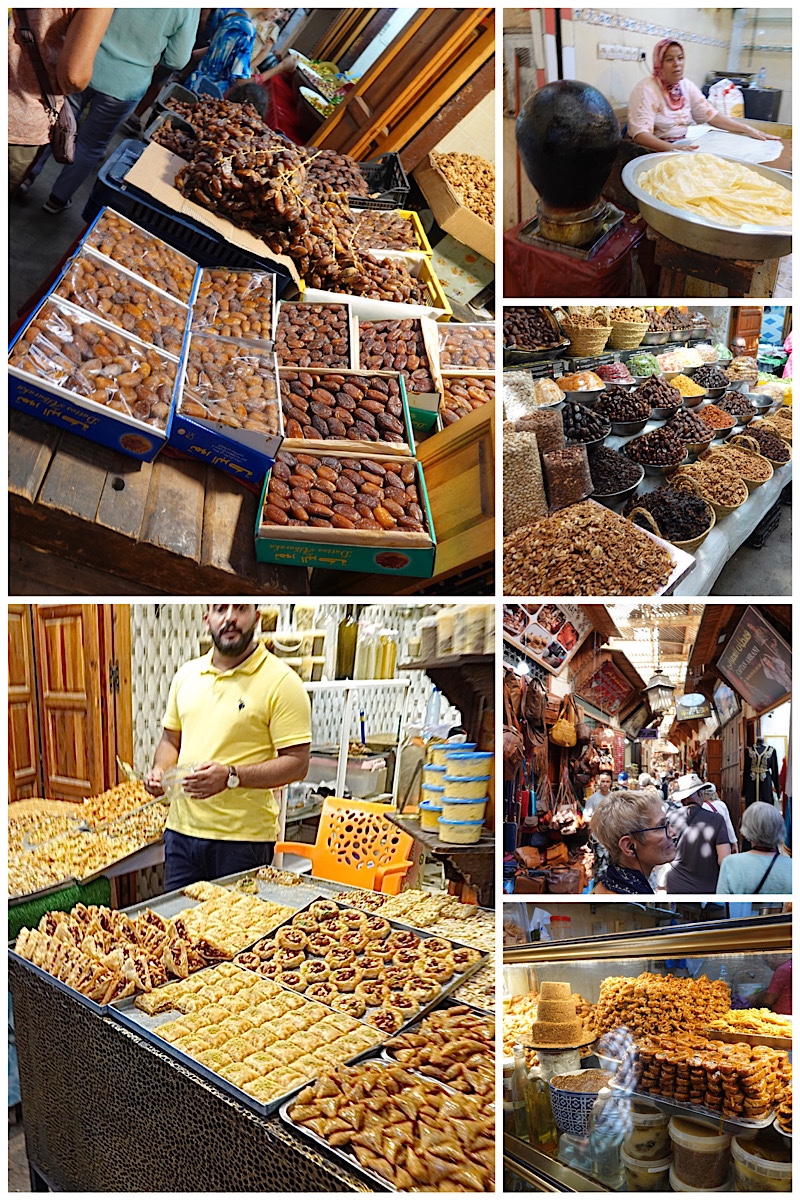



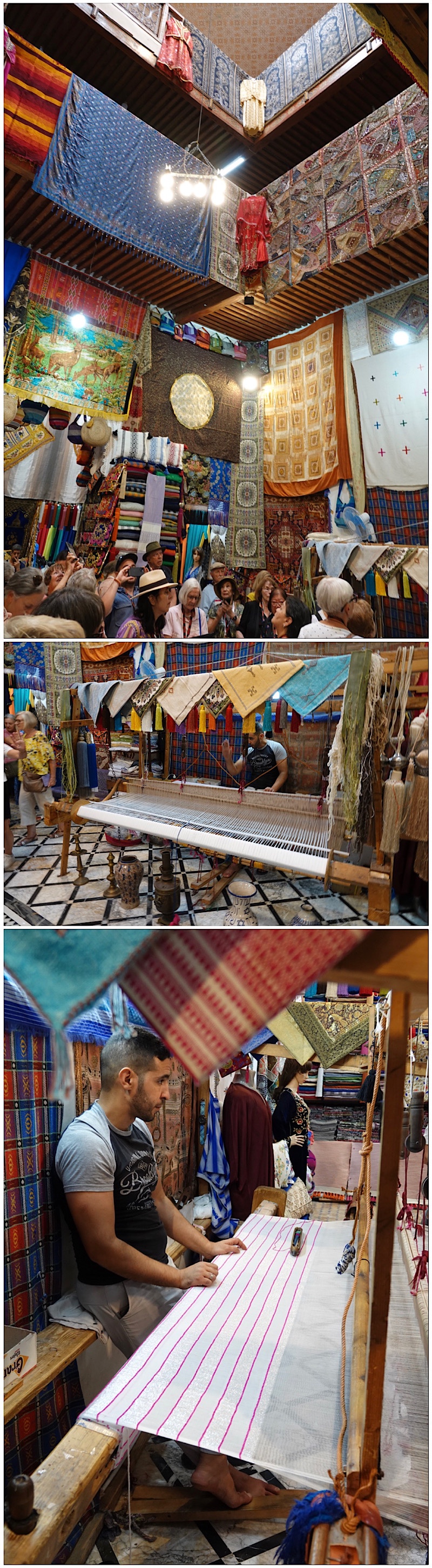

Did I mention our walking pace? A group of 40 in narrow alleys also full of local people doing their weekend shopping, men pushing carte, vendors, cats, and even a couple of donkeys, creates a long line. Somehow our group got split in two. We lost audio contact with Fouad, leading the way, when the combination of distance and thick stone walls prevented our Whisper devices from hearing him. The local guide Alaby and our tour manager Monica were with us, but neither knew where we were supposed to be going. Eventually we came to an open air area where Alaby was able to reach Fouad’s cellphone and determine our destination. So we backtracked. Cue much grumbling and a little bit of panic among our group. I certainly wasn’t the only one getting a bit cranky.
It was already 2:30 and we had yet to stop for lunch. Fortunately, when we got it around 3:00 it was DELICIOUS !
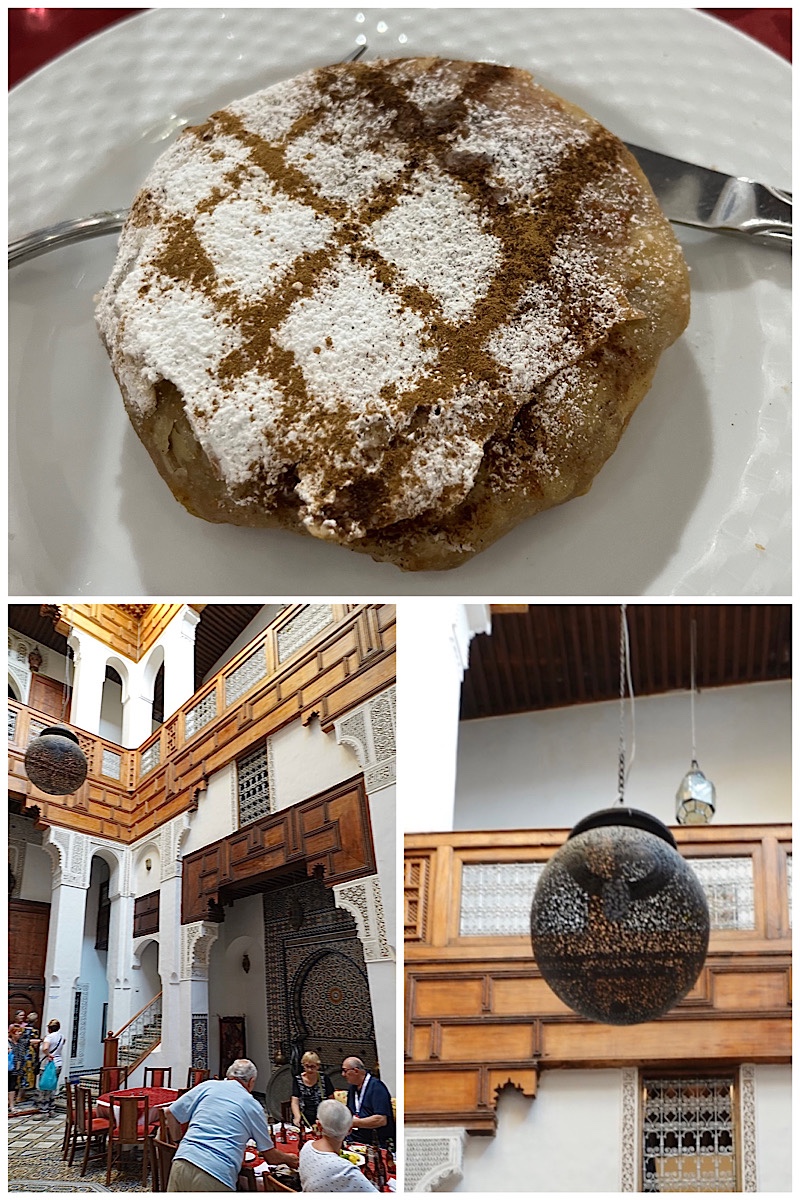
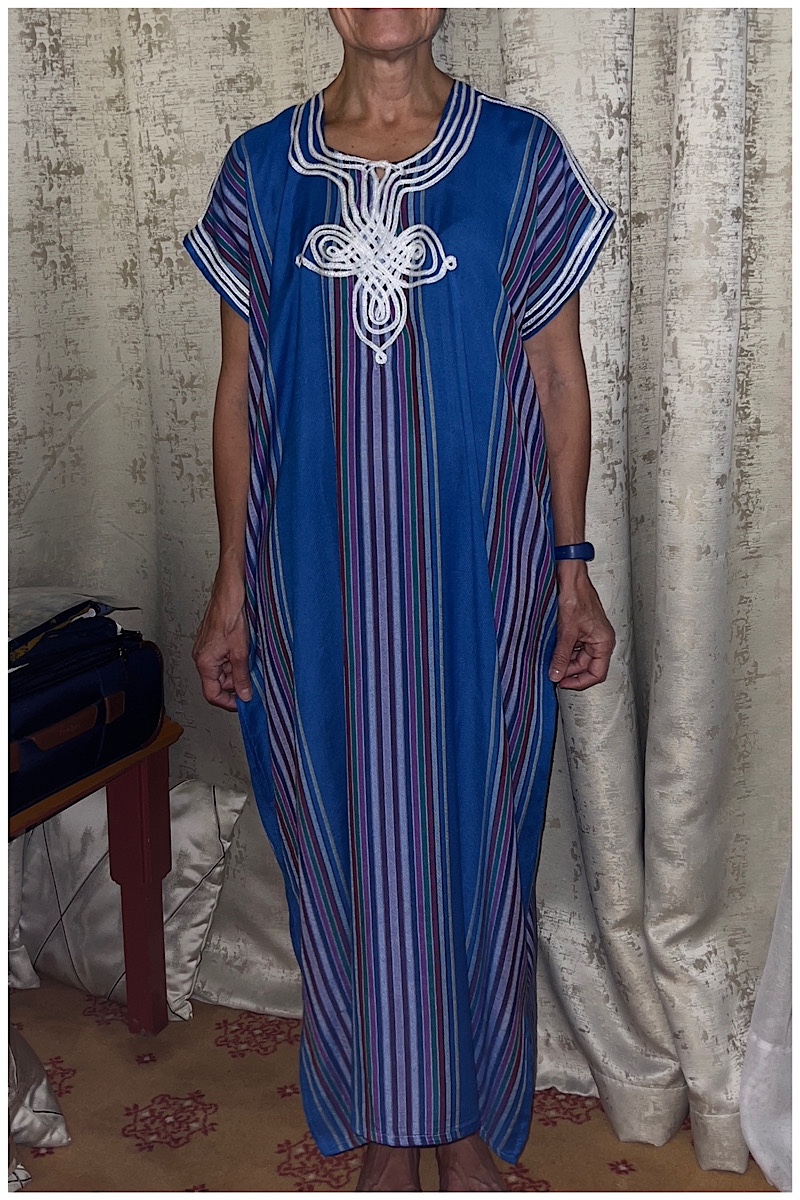
Despite Ted’s active discouragement, and Fouad’s determined insistence that we only buy artisan-produced items, I declined the $200 USD agave silk kaftans at the textile cooperative and bought a $100 Moroccan Dirham ($10USD) knockoff from the vendor outside the restaurant as we left. It may well be made in China (there’s no label), but I supported a local vendor, right? It may be the fastest exchange of money for goods on record given that Fouad resumed keeping us moving at a pace that precluded doing any window shopping. .
The old medina also contains the Chouara Tannery from the 11th century, one of the oldest tanneries in the world, and that was our last tour of the day. I was looking forward to this one, since a pair of Moroccan leather slippers were the only thing I had planned to buy on this trip.
Heading into the tannery we were each given a large sprig of mint to help offset the smell of tanning hides. While this tannery does not use urine to soften hides the way many do, their substitution of acidic pigeon guano is not much less olfactorally pungent.
The Choiara Tannery has always used hides from each of the meat animals eaten by Moroccans: beef, lamb, goat, and camel. The vibrant colours of the final leather products come from natural dyes; their saffron yellow leathers are particularly vibrant.
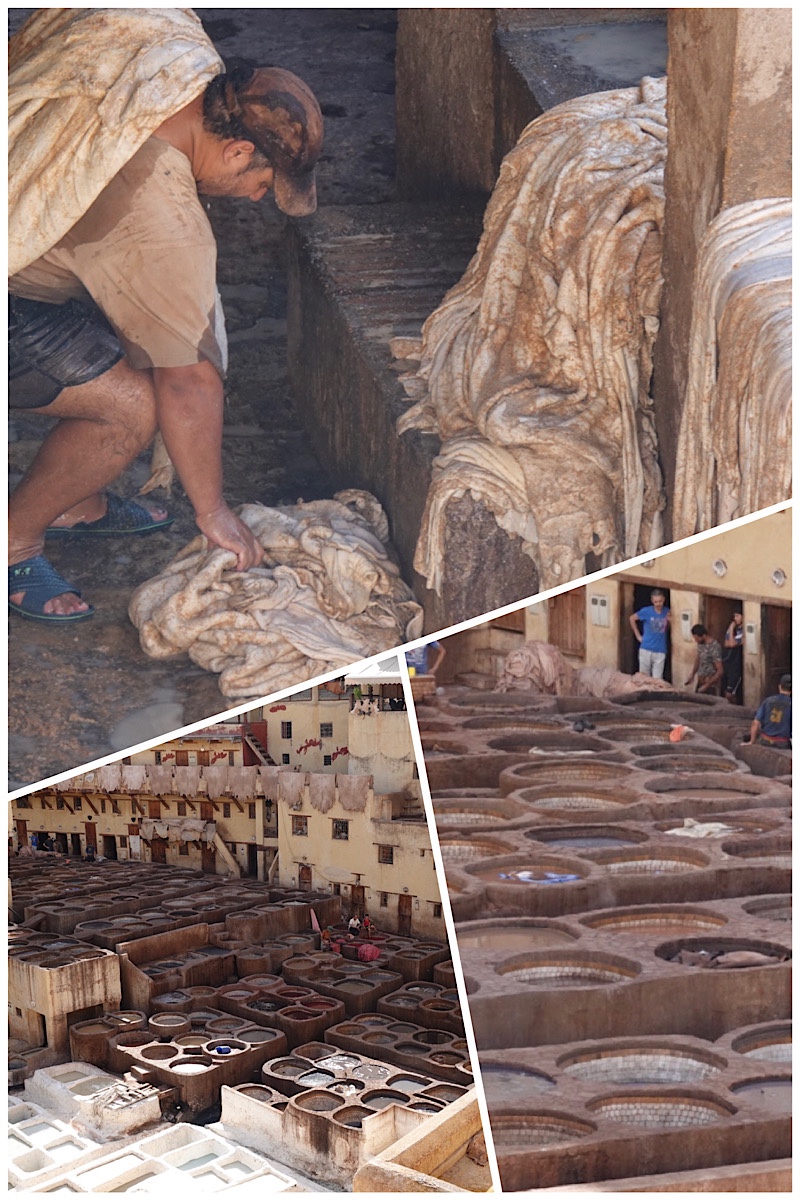

As far as the fes hat, it was named for the city because the red dye used to colour the hat fabric came from that region of Morocco. The city was named by Idris the First, founder of Fes, after the building tools called by the Arabic word فأس Faʾs , which in English would be pick-axes!
What a long and interesting day. Tomorrow is a travel day as we make the long journey to Erfoud and the Sahara Desert.
 Rose and Ted’s Excellent Adventure
<
div dir=”ltr”>
<
blockquote type=”cite”>
LikeLike
Looks like a fascinating day! Your slippers are such a lovely reward for your patience, too! LOL! But, claustrophobic in the medina? Yikes!
How fabulous to experience the tile work – and watch those amazing craftsmen at work. They must sleep well at night – far away from those damn roosters! Trust you and Ted will enjoy dreamland tonight too.
Happy Sunday, Mon amie.
Bisous!
B.
LikeLiked by 1 person
It really does put high prices into perspective watching the work that goes into beautiful finished products.
LikeLike