Itinerary: Our guided tour of Derry shows us this fascinating city’s controversial history, depicted on many houses in the form of striking murals. We visit the old city walls for panoramic views of the city and countryside. Then we proceed to Glenveagh National Park, in the Derryveah Mountains, for a guided tour of Glenveagh Castle and its beautiful Victorian Gardens.
☘️☘️☘️☘️☘️☘️☘️☘️☘️☘️☘️☘️☘️☘️☘️☘️☘️☘️☘️☘️☘️☘️☘️☘️☘️☘️
High24°C/Low11°C and still no rain in sight.
We were in and out of Northern Ireland today, visiting Derry/Londonderry in its eponymous county, and then returning to Glenveagh in County Donegal in the Republic of Ireland.
The border between the Republic’s 26 counties and Northern Ireland’s 6 counties is invisible today, unless you happen to notice that the highway lines indicating the road shoulders have changed from dotted yellow to solid white, or that the speed limit signs are suddenly in miles instead of kilometres per hour. That said, it’s all too easy to imagine barricades, checkpoints, and armed personnel when you’re immersed in stories of “The Troubles”.
For our tour of Derry, we had Tony Moore of Martin McCrossan Northern Ireland City Tours derrycitytours, who talked us through significant turning points in the city’s history from the 6th century to present day. He was serious, and funny, and incredibly knowledgeable about his home city – and we thoroughly enjoyed our time with him.
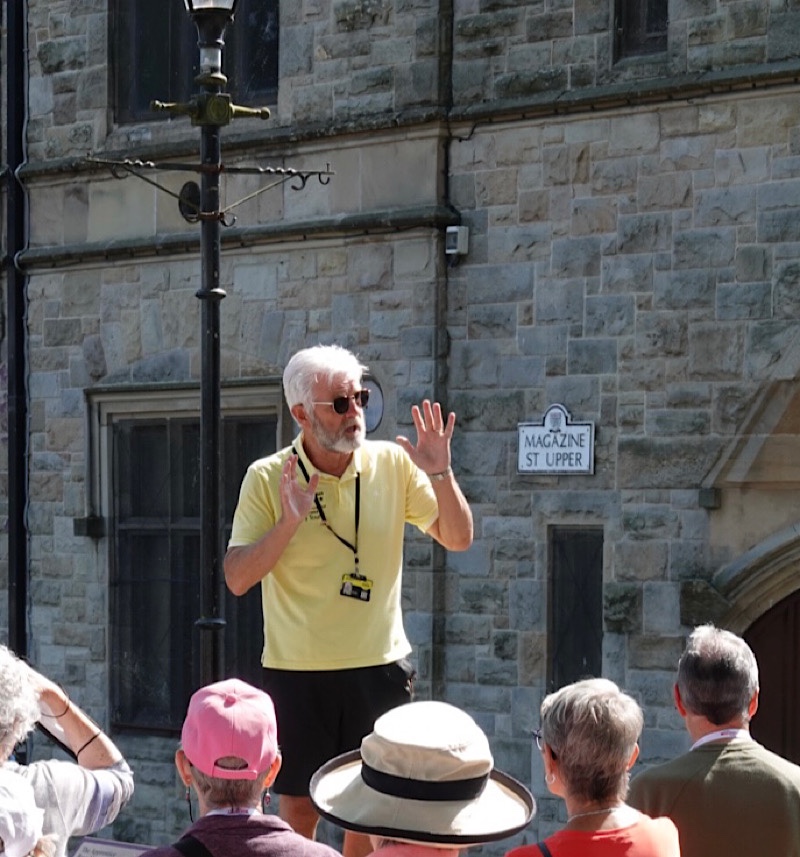
Unfortunately, in a group of 36 people without Quietvox headsets, it was difficult to hear absolutely everything, and even if I had there was so much information that I’m sure to get some wrong. I’ll use Ted’s pictures to remind me of as much as possible – in tour order as opposed to chronological order.
Our first sight in Derry was the relatively new Peace Bridge, a beautifully designed pedestrian/cycle bridge opened in 2011 to cross the River Foyle, connecting the two halves of the city. Interestingly, or maybe sadly, despite “reconciliation”, the west bank of the river is still 97% Roman Catholic/Republican (meaning they’d like to be joined to the Republic of Ireland) and the east bank is predominantly Protestant/Unionist (favouring union with Great Britain). The two sides live in peaceful tolerance of each other, but still are not integrated. The division goes so far as to affect how people refer to the city. The Catholic Irish call it Derry, while the Protestant Irish, English, and Ulster Scots residents still call it Londonderry.

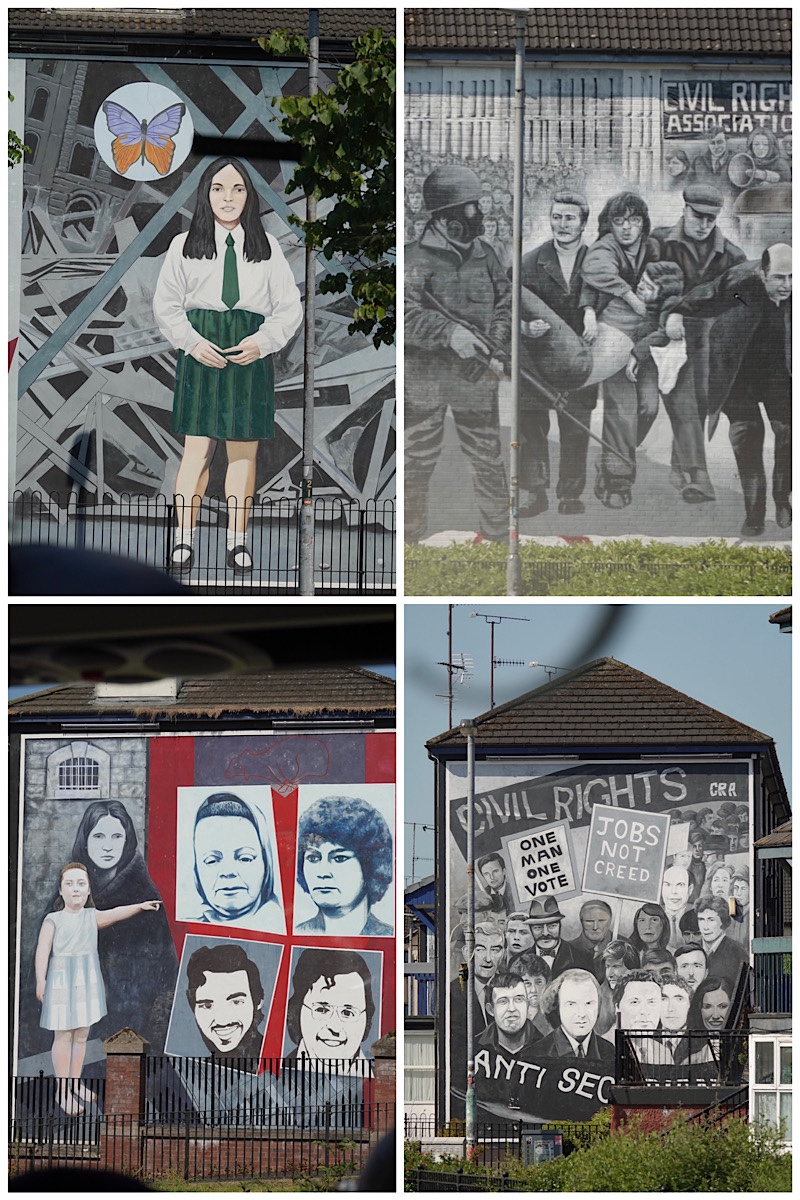
As we drove through Derry, Tony pointed out the many murals painted on the sides of buildings. Most of the murals are in remembrance of those who lost their lives during The Troubles: the first child caught in the crossfire, the hunger-striking interred IRA members, and the peaceful protesters killed by the British military on Bloody Sunday. Other murals reflect the wish for peace, and honour those who worked toward it.

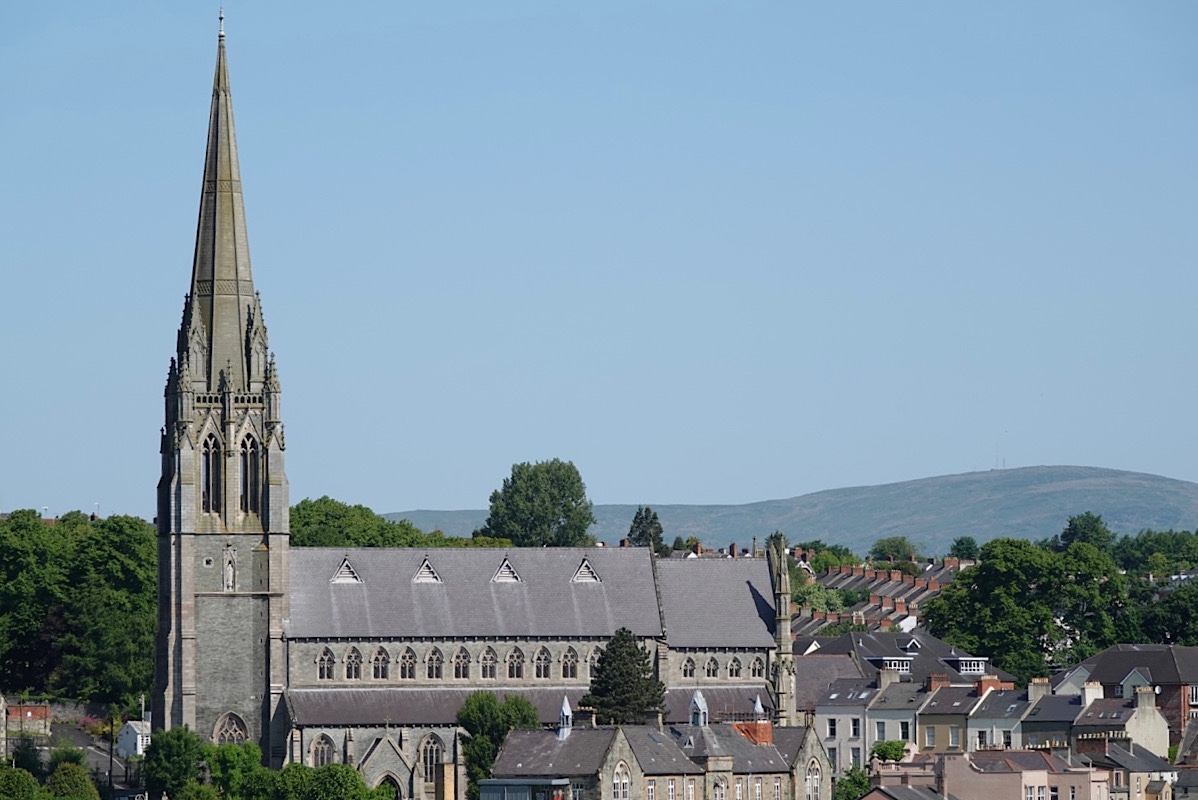
Although we didn’t tour it because there were Sunday services taking place, we did get a glimpse of St.Eugene’s Cathedral, the Mother Church of the Roman Catholic Diocese of Derry.
We also walked past St Columba’s Church, Long Tower in the heart of the city.

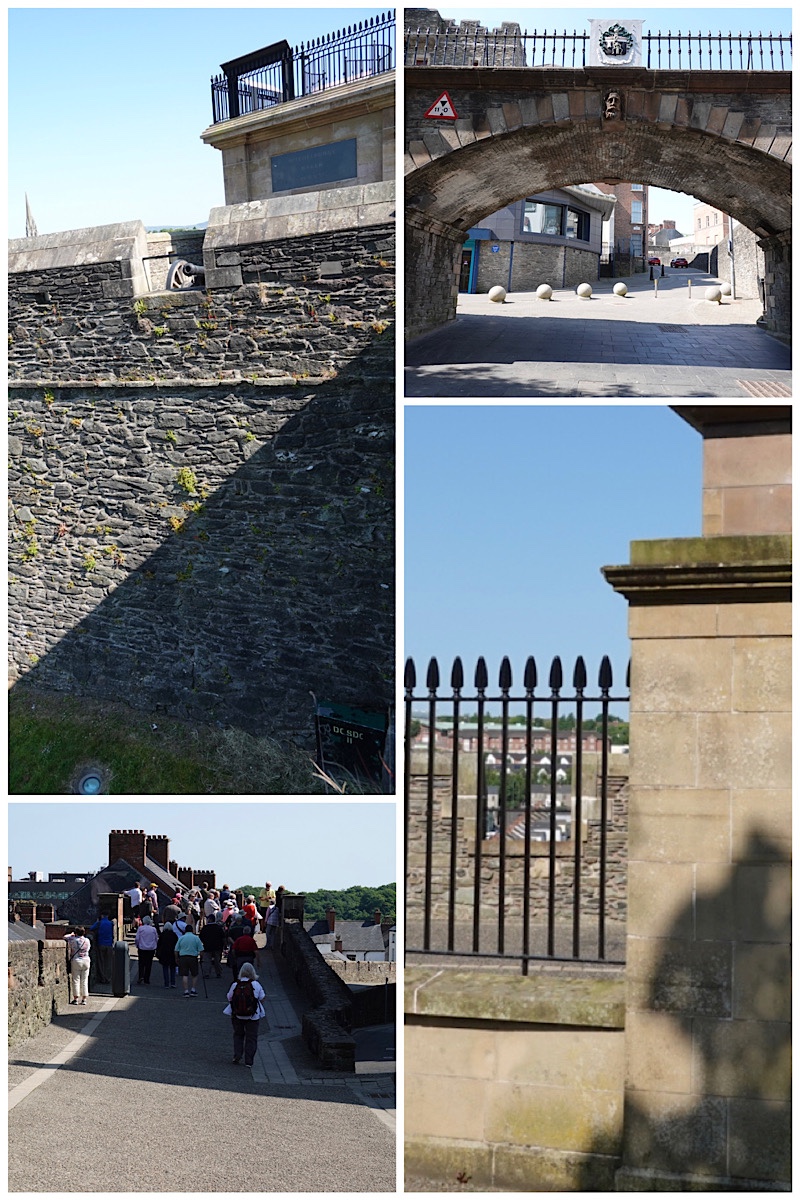
Derry is a walled city, and our guided tour took us along a stretch of the wall, walking over Butcher’s Gate. At the wall level we saw the locations of cannons that could have been used to repel the Jacobites in 1689, preventing the reinstatement of Catholic King James Stuart as king of Ireland.
There are still disturbing (to me, anyway) remnants of how deep divisions go in this city, in buildings and societies that seem to perpetuate those divisions. Back in 1689, thirteen young apprentices were credited with closing the city wall gates, effectively repelling the Roman Catholic Jacobites (“Jacobite = follower of King James). The Apprentice Boys Memorial Hall at the corners of Magazine and Society Streets, houses the all-male, all Protestant, Apprentice Boys of Derry fraternity, formed in 1814. It’s great to be proud of their role in defending their city, but over the years the society’s parades have come to be seen as symbols of intolerance, and our guide told us that even in 2023, new initiates swear to protect the city against Catholics.
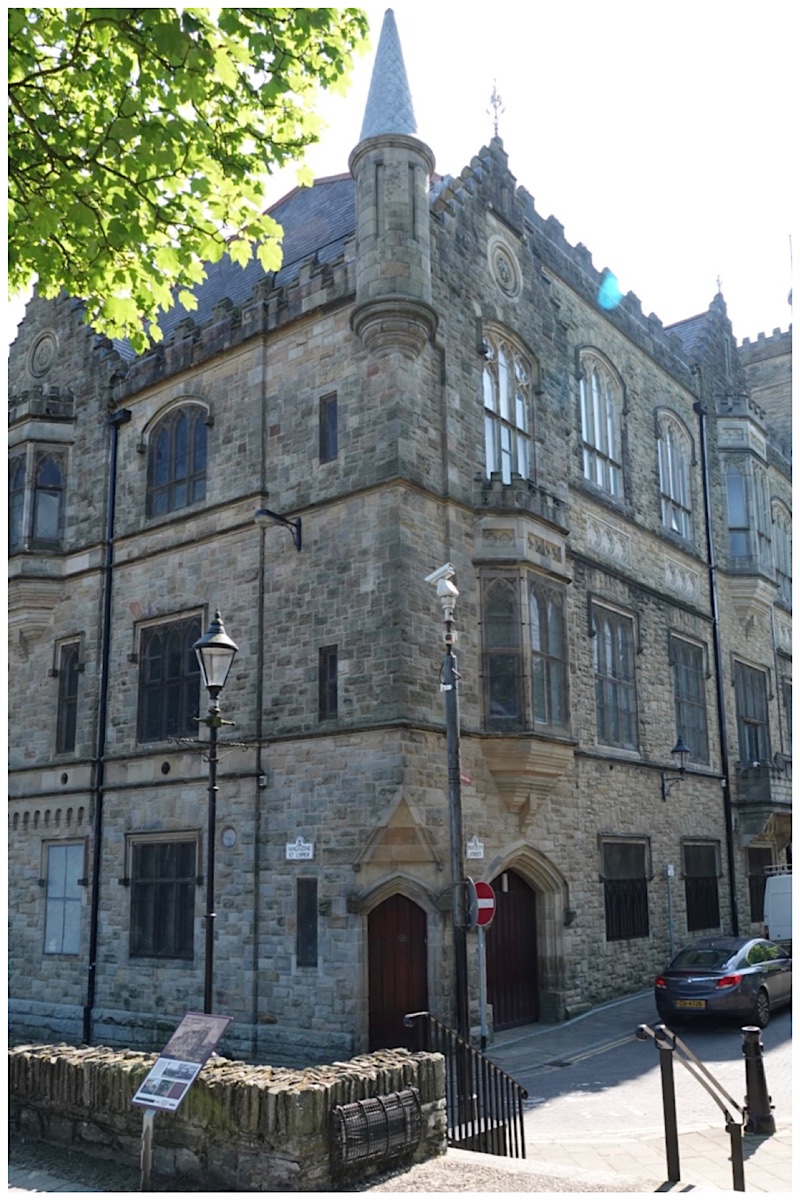
In 1690, William of Orange (and his Queen, Mary) successfully secured the crown after the Battle of the Boyne. It was largely due to Queen Mary’s insistence that the First Derry Presbyterian Church was built on Magazine Street. Neither the Roman Catholics nor the Protestants (Church of England/Ireland) of the time approved of the Presbyterian “reformers”, but Mary insisted that they deserved a reward in recognition of their role in the battle.
The church, without a spire, cross, or stained glass, looks more like a bank. The only visible religious symbolism is the carving of the burning bush above the entrance.

Looking far more like a church is the city’s Guildhall, below, completed in 1887 in the neo-gothic style.

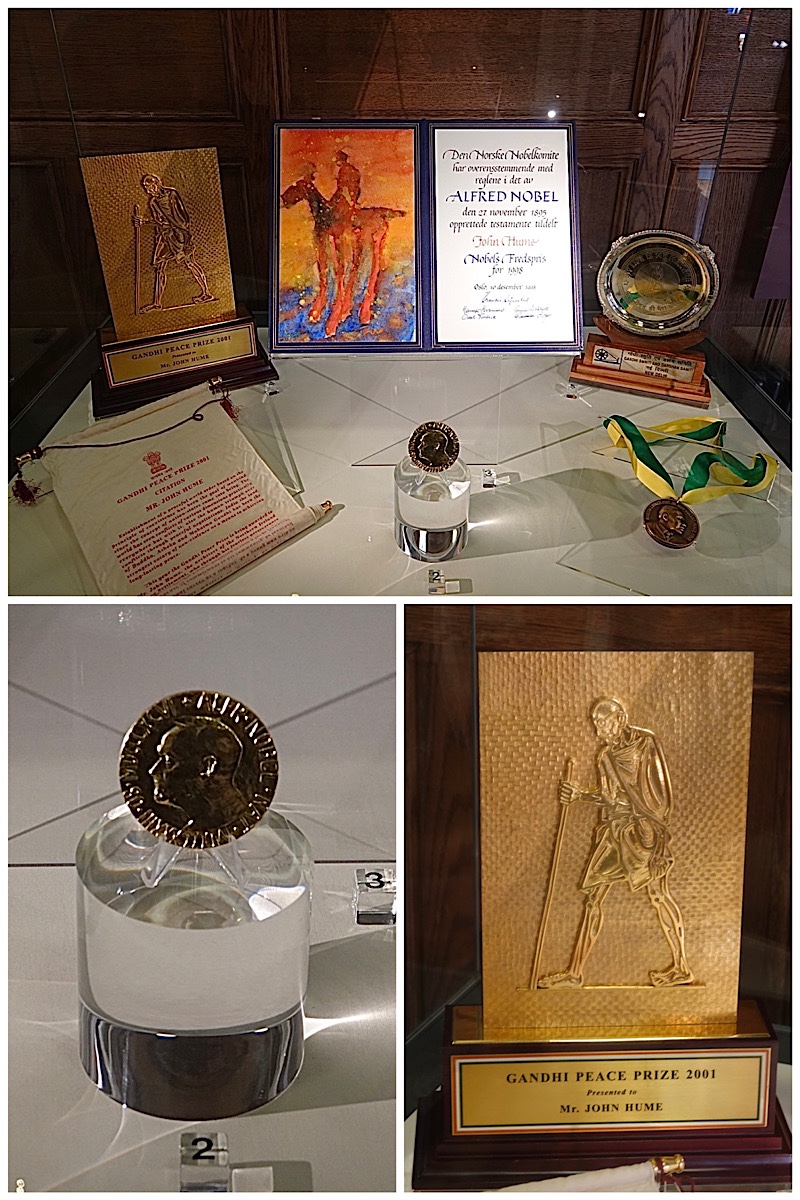
There was a huge children’s cheerleading competition going on inside the hall, but we were still able to see a few of the stained glass windows, and the display of John Hume’s peace awards: the Nobel Prize for Peace (1998), the Martin Luther King Jr. Nonviolent Peace Prize (1999), and the Ghandi Peace Prize (2002) – all three awarded in 2001 for his role as one of the architects of the Northern Ireland peace process. He is the only person to have received all 3 peace awards.
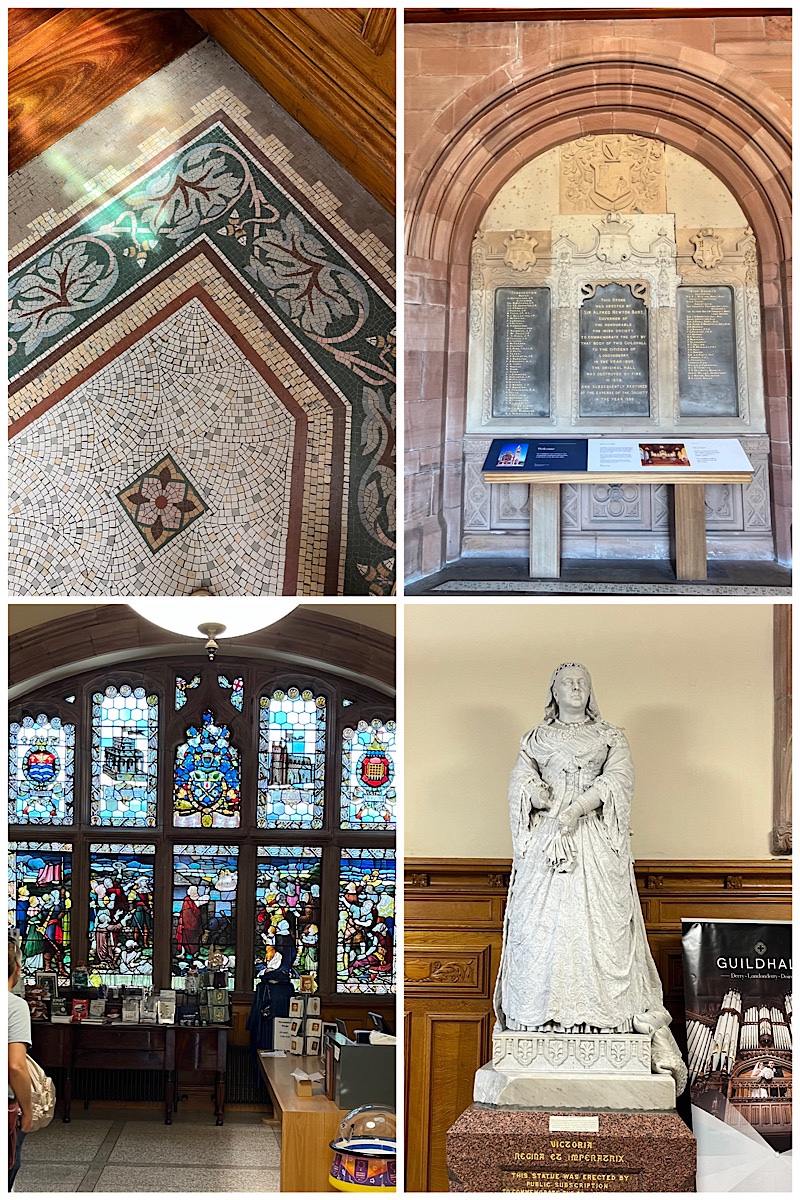
Bottom left: a segment of the stained glass windows depicting various guilds. Bottom right: marble statue of Queen Victoria missing a hand – that was the only damage to the statue when the hall was bombed.
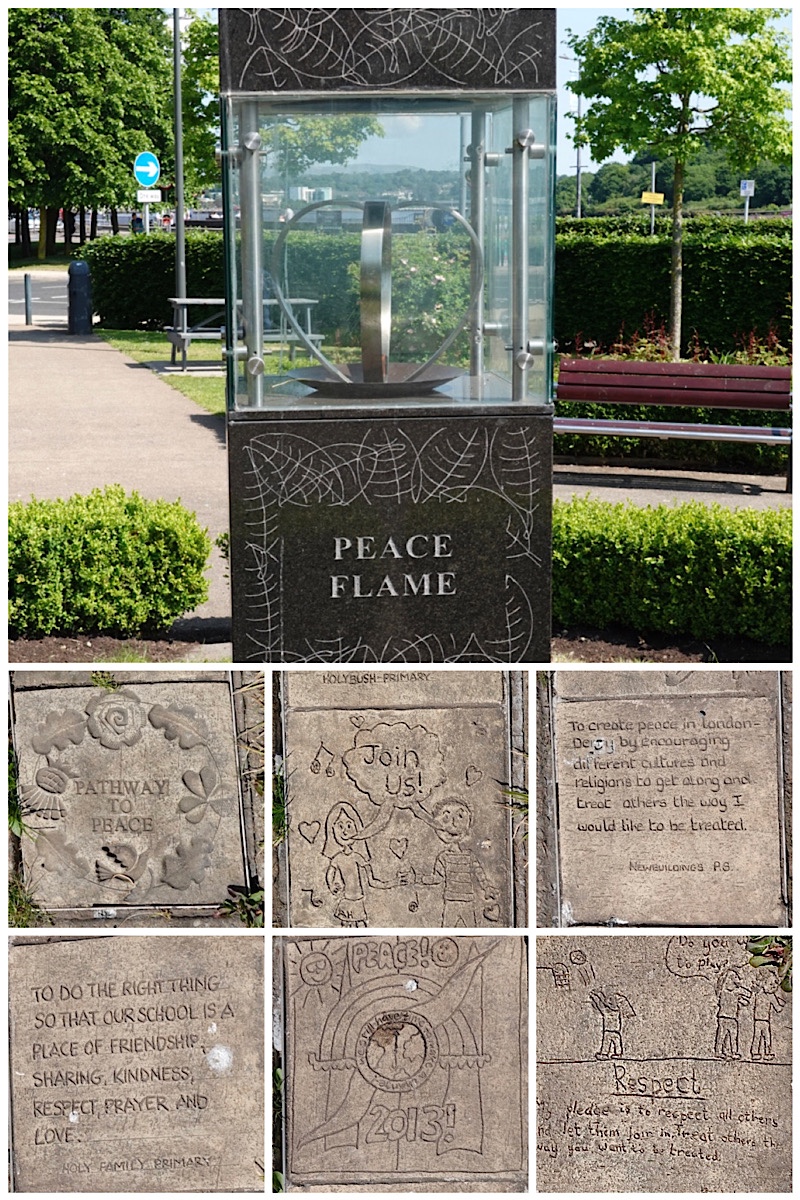
While I was still inside the Guildhall, Ted walked across to the Peace Flame Garden, which since 2013 has housed an eternal flame lit by Martin Luther King III. On the ground surrounding the flame are paving stones engraved with wishes for peace by Derry schoolchildren. Our guide Tony told us about an early 2000s initiative that saw Roman Catholic and Protestant children, educated in separate schools since the age of 4, sent to Boston through an exchange program. In Tony’s paraphrased words, the children left Derry on a bus spitting and cursing at each other, and returned saying “we breathe together, we bleed together, so the grownups better wise up”.
Ted and I were quite fascinated by Derry, and both felt we had far too little time here. We can certainly see returning for a longer visit.
In the afternoon, we were back in the Republic, visiting Glenveagh Castle in Glenveagh National Park in Donegal County. The park is an incredible 16000 hectares, or almost 40000 acres, of mountain, bogs, lake and woods.
The Glenveagh estate and its castle, while both imposing and beautiful, is another example of how even rich Irish abused the Irish poor. The huge estate was created in 1857-59 by John George Adair, a Scots-Irish businessman and landowner, and financier of JA Ranch in the Texas Panhandle. Adair had made his fortune in Ireland buying up estates bankrupted after the great Irish potato famine. He became infamous for evicting 244 Irish tenants from his newly purchased estate in the cold April of 1861. Many of the dispossessed ended up in Australia, while others were forced into the Workhouse.
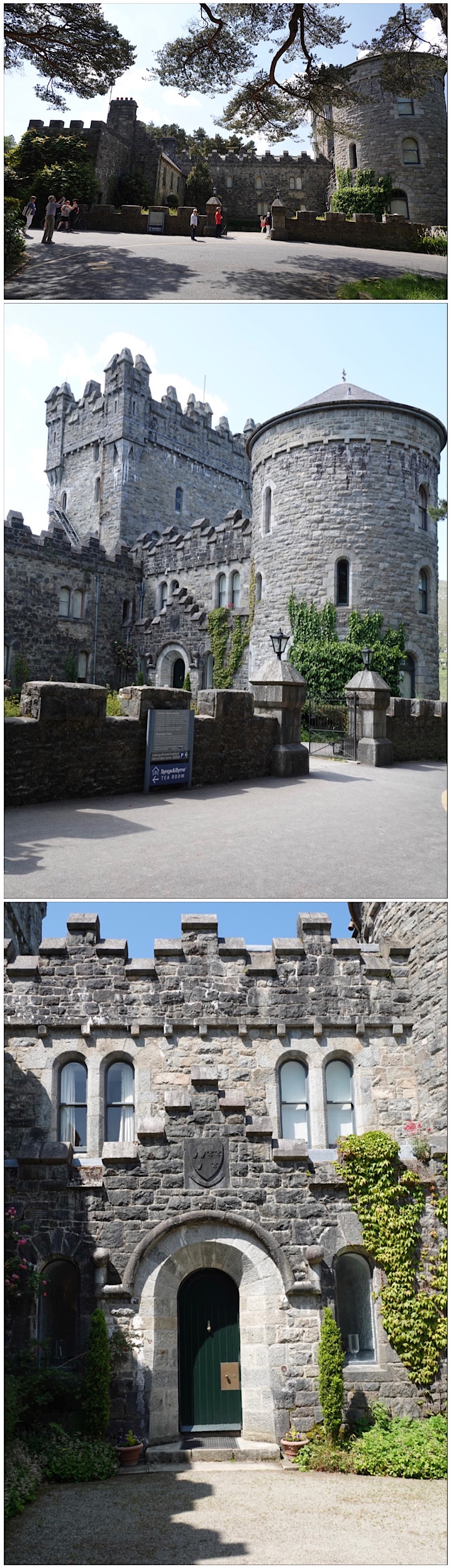
Adair died in 1885 and was survived by a wife who was apparently a kind and generous person. After her death in 1921, the estate was occupied first by the IRA and then by the Free State Army, and fell into decline until it was purchased by a Harvard professor, who mysteriously disappeared 4 years later.
The castle as we saw it today reflects the furnishings of and renovations made by its last owner: Philadelphia philanthropist, museum curator, and socialite Henry McIlhenney, who bought it in 1937 and kept it until selling the lands to the State in 1975, and donating the castle and gardens in 1981.
McIlhenney’s wealth was especially visible in the eclectic decors he chose, pairing intricately woven rugs with exactly matching upholstery, and covering walls in Indian silk.

He also demonstrated a few idiosyncrasies. Apparently he was quite obsessed with The Sound of Music, and bought the deer-themed china displayed in the dining room in Salzburg, along with dirndls for his maids to wear when serving dinner.
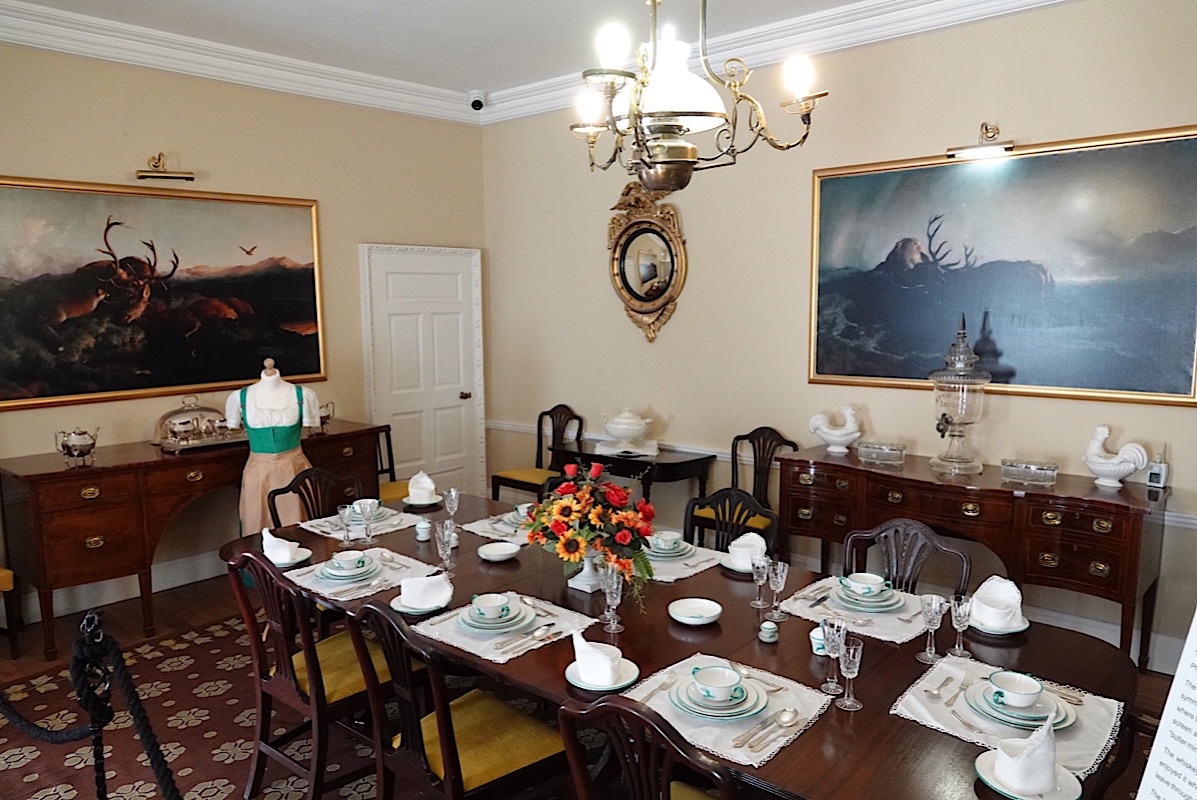
Famous American movie stars and socialites were entertained in lavish style. Greta Garbo stayed in this guest bedroom.

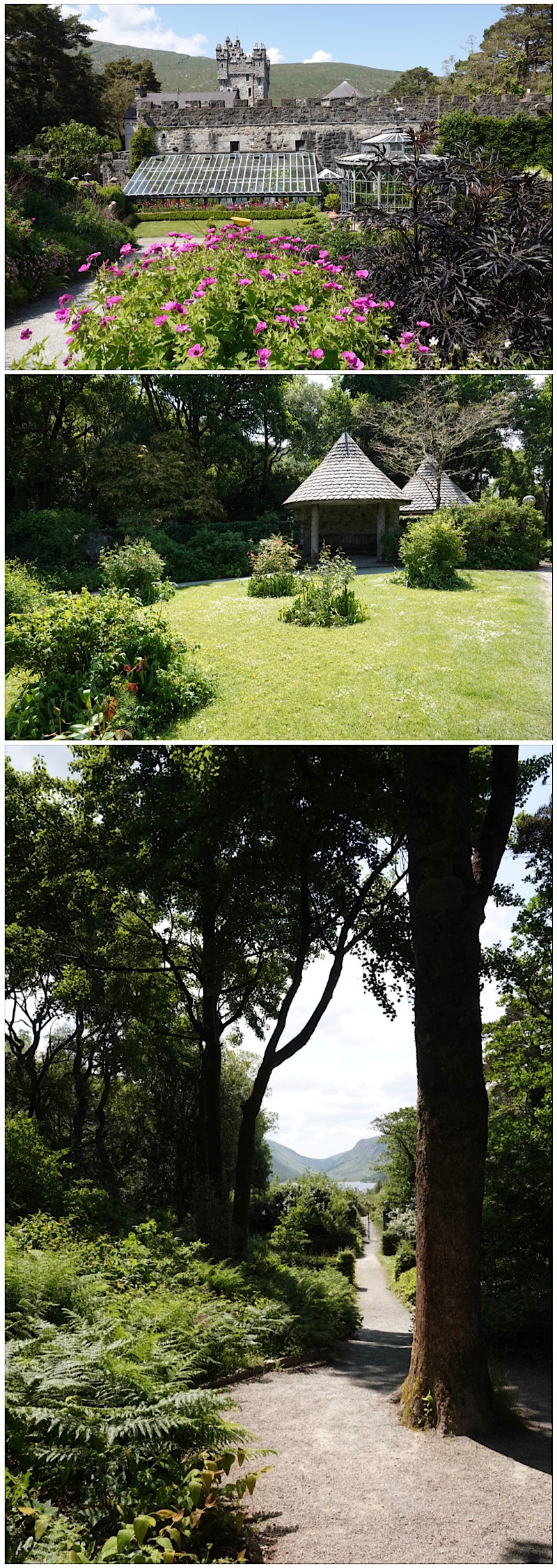
We had just enough time at Glenveagh to walk through the Victorian and kitchen gardens and hike up the trail to the viewpoint high above the castle, where we got a bird’s eye (or drone’s) view of the estate from one of its high elevations.

Back at our hotel, we had yet another dinner that favoured quantity over quality, which sadly has been the pattern for this trip. We know there are inventive chefs and restaurants in Ireland, but nothing included in our itinerary has served to dispel the stereotype of heavy, overcooked meals served in overly large portions.
Tomorrow: the Giant’s Causeway and Bushmills Whiskey Distillery. Maybe they’ll serve large portions too!
 Rose and Ted’s Excellent Adventure