Both my parents were ethnic German, something that always confused me as a child because I knew that my father’s family had lived in Poland for many generations, and my mother’s in Hungary…. so how were they Germans?
In history and geography classes in high school, I came to understand that Poland as I knew it had not always existed, and that when my paternal ancestors settled there it was Prussian. Nothing I learned explained why mom was German instead of Hungarian though. Still, all the stories she and my grandmother told were of a town with a German name – Gross Säckel – and an almost 100% German population, most of whom were somehow related to us.
It wasn’t until after mom died that I found a website called Swabian Trek, dedicated to the history of Swabians from the Danube River and their settlement in Nagyszekely Hungary from the 18th century through to their expulsion in 1948 by the Russians (Nagy = Gross = Large; Szekel = Säckel phonetically = bag or seat; it was the county seat of Tolna). The website was a revelation, answering SO many questions. Apparently my mom’s family had been refugees once before, in the mid 1700’s, when Protestants like them were made unwelcome in Catholic Swabia. It also suddenly “clicked” as to why my mom’s male cousins reverted to the Swabian dialect after a few beers and shots (beer followed by a brandy chaser – chug and repeat – being the libation of choice among the men). There in black and white on a web page were dozens of familiar family names; most of them had been represented in our living room at one time or another.
So, I’m “German” on both sides of the family, but I’m going to begin with my mom’s side. I’ll preface it with the fact that this side of the family was, for a couple of generations, mostly through necessity, a matriarchy: hence it is the story of Katharinas. There were no stories told (in my hearing, anyway) about the men. Maybe they were reserved to be told to their sons, but there were no sons.
In 1700’s Hungary, the German families were originally serfs, but by the mid 1800’s they were independent farmers and landholders. My mother’s family had a vineyard, inherited through the maternal side of the family, but I never heard of them making wine – only growing the grapes. They must have done fairly well, because my great-grandparents, Katharina (Braubach) and Heinrich Schott, travelled to the United States in 1904. There was some thought that they might settle there – until news arrived that my great-grandfather’s younger brother was planning to take over the vineyards. The couple booked passage back to Hungary and stayed there to reclaim the inheritance and run the vineyard. Until I was 8 years old, my great-grandmother lived with us – in fact, she’s the main reason I spoke German first, since she spoke no English except the one mispronounced expression she retained from her time in America: “goombye Chicago”.
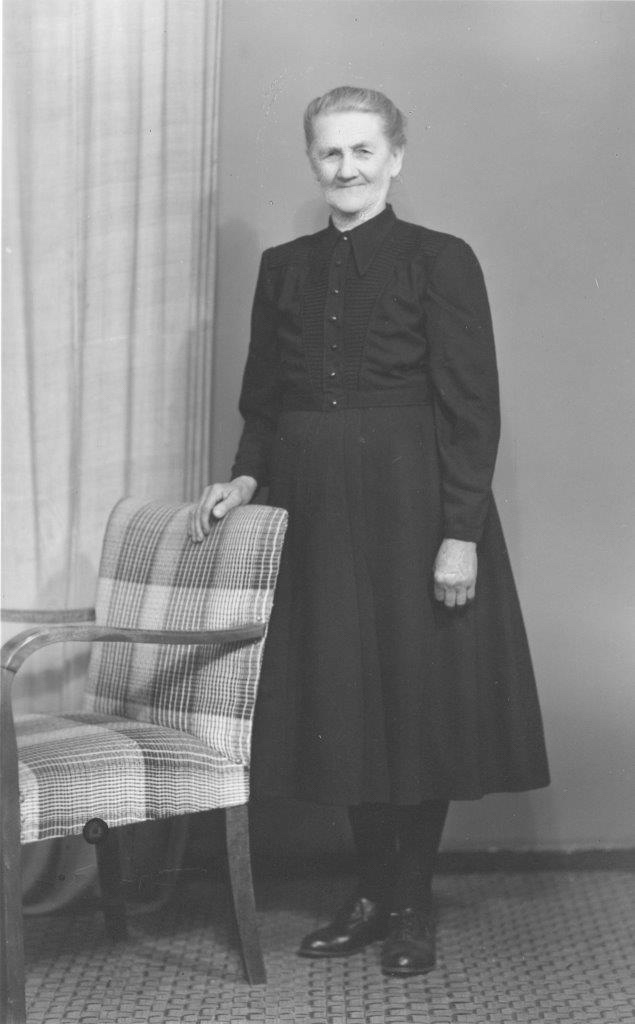
My maternal grandmother was born in the family home on January 24, 1906 and christened Katharina just like her mother. Despite the fact that her parents both came from fairly large families, she was their only child.
My grandmother never spoke about her childhood, so I’d have to assume it was uneventful – and yet she would have been a young teenager during the first world war. I know that her father, along with all the other able-bodied men in the town, was gone during those years; the first of many times that the vineyard was left in the hands of the “womenfolk”. My great-grandmother was a stern presence, and my own mother viewed her grandmother as critical and somewhat scary, so perhaps taking charge of the vineyards workers and finances took its toll. I can’t say that I ever witnessed much outward affection between my grandmother and great-grandmother, but there was no obvious animosity either – I think my grandmother felt that she owed her mother a debt for her role in raising my mom. By all accounts, my great-grandfather was the gentle presence in their relationship. He came back from the war unharmed – due, he said, to the fact God had watched over him because he refused to kill any of “the enemy”. While my mother was scared of her grandmother, she adored him. He died in 1934, when she was just 7 years old, and she was inconsolable. She often talked about the days after his death, while he was laid out in their home as was the custom, and how she sat perched on the coffin and stroked his hair just the way he had always allowed her to do when he was alive. In the last few years before her own death, mom often said that her grandfather was the only man who had ever really loved her.
I don’t know how my grandmother and my grandfather, Johann Neidert, met, but Nagyszekely was a small town where everyone went to the same school, so it’s inevitable that their paths would have crossed. They married in 1924, aged 18 and 19. That was fairly young for their community, but I think my grandmother was pregnant with their first child, who she miscarried – a fact put down to how tightly she was corsetting herself to prevent her pregnancy from showing. I later realized how silly that was of her, since marriage and birth records in the town show that a majority of first children were born far less than 9 months after their parents’ marriages. My mom, the third Katharina in a row, was born 3 years later on February 27, 1927, a tiny baby about a month premature. My grandmother always said they fed my mom thin cream of wheat and cabbage broth since she didn’t nurse well, but…. really? The only thing I know for sure is that my grandmother assigned cabbage almost supernatural qualities, whether in her soup, strudel, cabbage rolls, or mixed with potatoes or egg noodles into a dish to nourish everyone from children to young mothers to elderly relatives.
Mom was given a delicate pair of pearl and turquoise earrings as a christening gift, and my grandmother pierced her baby’s ears with a sterilized sewing needle and a sliver of ice off one of the blocks in the icehouse. As an adult, mom was never without earrings, and I could hardly wait to have my own ears pierced (which I was finally allowed to have done – by our family doctor! – for my tenth birthday).

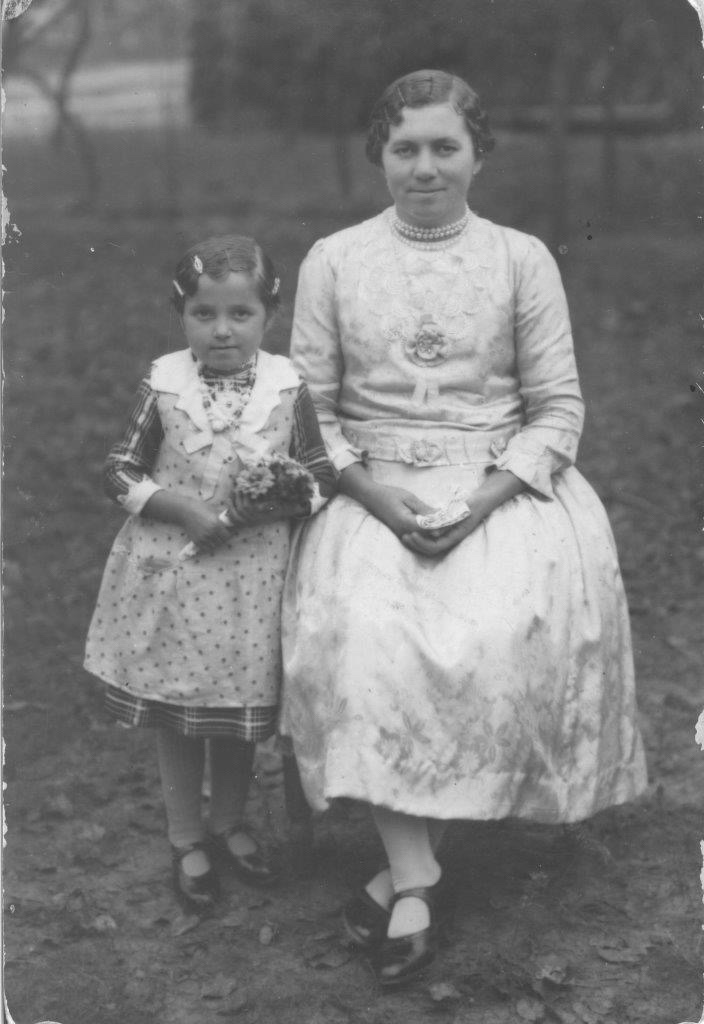
In 1929, frustrated with being dependent on a vineyard tied to his wife’s family, my grandfather set out for North America to claim his share of riches in Canada, a place where he’d heard that the streets were paved with gold. “The plan” was to get rich quickly and then send for his wife and infant daughter, but … 1929. His timing could not have been worse.
Instead of sending for his family, or returning home “in disgrace”, my grandfather simply made himself disappear. No letters home, which also meant no money sent home, but no death certificate either – just no communication at all.
My mother and grandmother continued to live with my great-grandparents. As long as my great-grandfather was there running the vineyard, everything was fine. My grandfather was not the only absent spouse; some had died during the war, and others like my grandfather were in Canada or the U.S. My mom was spoiled by her grandfather, and managed to be “cute” even when she was being mischievous. My favourite story involved a furry caterpillar. Mom apparently found one in the vineyard and was playing with it. My grandmother wanted her to get rid of it, but mom resisted. When grandma reached to take it away from her, mom “protected” it… by popping it into her mouth! Apparently only her grandfather thought it was adorable. As a child I loved that story, and fuzzy caterpillars, although I would never have put one in my mouth.
After my great-grandfather’s death, the house contained only women: my 56 year old great-grandmother, 28 year old grandmother, and 7 year old mom. The vineyard workers must have thought they’d have free reign, and I don’t honestly know how things were kept running, except that my great-grandmother was strong-willed enough to apparently scare more than just my mom, and there were men in town with their eye on grandma who were willing to act as foremen. My mom remembered that grandma had a “husband”, although two years later when 7 years had elapsed since my grandfather’s “disappearance” and he was declared legally dead, and grandma married someone else, a local farmer with land of his own. Mom never mentioned him living with them, or that she lived on his farm, so it’s possible this is when mom started her first period of being raised by her grandmother.

By the time World War 2 broke out, my grandmother was no longer married. I never overheard anyone talk about exactly what happened, except for a veiled comment from a relative that her husband was not interested in raising another man’s child, and my grandmother would not forsake my mom.

Unfortunately, without a husband to oversee the vineyard, a foreman was needed, which meant there had to be money to pay them. My grandmother was too old to go out to work, and my mother too young, so my grandmother left them both again to work as a maid in a wealthy residence in Budapest, which was about 140 km away.
From all accounts, my mom hated living with her grandmother. The “old woman” was strict and critical. Once my mom hit puberty, things got even more tense. Mom was considered quite pretty, and my great-grandmother was sure she’d become a “Schlampe” (trollop). Mom’s two great pleasures were school, and the pretty hand-me-down clothes my grandmother would send to her from the city. Mom always claimed that wearing the fancy shoes grandma sent, which were a size too small for her feet (but “SOOOOO beautiful”), were the reason she developed such terrible bunions. It’s true that the shoes in the picture of her at 14 look smaller than the ones she wore in the picture of her at 12.

In 1942, at 15 years old and having finished school, mom began working as a kindergarten teacher – the equivalent of today’s ECE’s in daycare. That’s the job she was coming home from in 1944 on the day the group of girls she was with was chased down the street by a low-flying bomber. Every time she told that story, her eyes would fill with remembered terror.

Nagyszekely was a strange place to be during the war. Because it was a “German” town, when the Nazis occupied Hungary in 1944 they investigated everyone’s genealogy all the way back to the late 1600’s; “Germans” were left alone (the women) or conscripted (the men), but anyone they determined to be “gypsy” was evicted from the town. Fortunately, there were no men in mom’s household who would have had to decide between enlisting or running. Then in 1945 when the Russians expelled the German armies, all the ethnically German residents were “encouraged” to get out of the country.

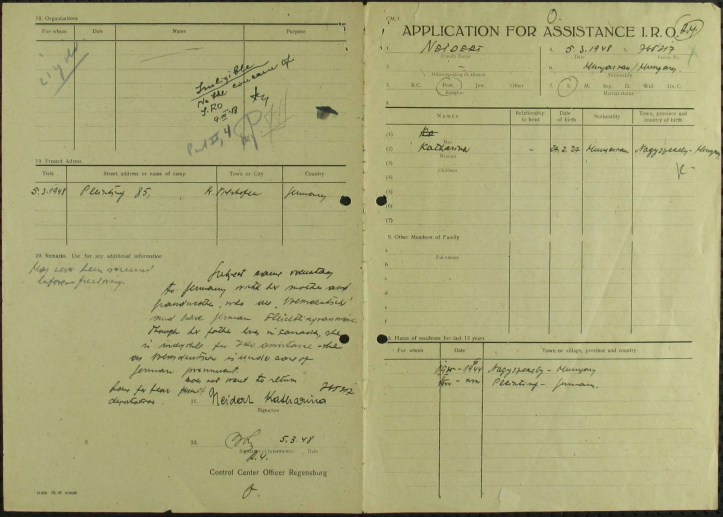
I don’t have exact dates as to when the three Katharinas left Nagyszekely for Germany. EDIT: After publishing this blog, a contact at the Croatian National Home in Hamilton, Ontario (where my parents’ wedding reception was held) found an on-line resource that had the original documentation for my mother’s claim for refugee assistance, showing their arrival in Vilshofen, Bavaria in 1944 (below).

What I do know is that they were one of the last families among their group of relations to leave; most of the relatives that I later got to know had recognized the signs of what was to come and emigrated voluntarily years earlier. Of those Germans who stayed on to live under Communist rule, many had married Hungarians and moved out of the “German” town.
I do know that my grandmother had lost her job in Budapest (Germans were no longer welcome there) and rejoined her mother and daughter in Nagyszekely , so the three generations of Katharinas travelled together.
Their arrival in Germany and eventual settlement in Canada is a separate set of stories.
 Rose and Ted’s Excellent Adventure
Thank you so much for telling your family’s story! I too have great grandparents from Nagyskeley. My family ended up in the Akron, Ohio, USA area. Anyone else have family in this area? Schilling is the family name, along with Stefan and Wahn. The Neidert name is also in my family tree.
LikeLike
My grandmother’s cousin Margaret married an Esterle, and they raised their family in Akron (sons Mike, John, Adam, Andy, and daughter Elizabeth). Have you done Ancestry DNA? You’d be a generation younger than me,I think, but…
LikeLike
My wife, who is 25 % “Donauschwaben”, also has roots in Nagyszékely (and Kötcse).
I have searched Tolna county (HU), Somogy county (HU) and Hessen (DE) archives and been able to find out more about Nagyszékely families like Reinhardt, Hilgert, Hinckel, Lehr, Deuchert, Freund, Los, Neuthert, Wegmann, Hildebrand, Fröhlich, Hörner and Biettner.
The focus has been on the Reinhardt family since my wife was born Reinhardt. This family left from Udenhain in Hessen in 1722 but the “Urvater” was an Otto Reinhardt von Storndorf who might have been lower nobility. Probably not but there is a slight possiblity.
You can read more here:
https://peetre.webnode.page/migrants/
LikeLike
Thank you!!! My mom always said that she came from “royalty” in Hessen!
LikeLike
My third great grandfather was a Reinhardt , Johan Henrik, born July 1, 1834 in Nagyszekeley, to Magdalene Wiand/Wandin and Henrics/Heinrich Reinhart .
Your wife and I may be distantly related!
LikeLike
Thanks for a very nice website, Rose.
I notice that the Mormons (familysearch.org) transcribed the birth record as Reinhardt but to me it seems like the father’s family name was really Neidert. Are you sure about Reinhardt?
LikeLike
I have a photo of the bible page, and I would read it as Neidert if it were me transcribing it!
LikeLike
But…. A very clear photo of his daughter’s birth record definitely reads Reinhart.
LikeLike
Neidert was one of the most.common family names.in.Nagyszékely. My ancestors.were.also.from that.family.
LikeLiked by 1 person
Yes, my wife is also a Neidert. I wrote Neuthert above but these seemingly were just two variants of the same name. So in some way we all seem related. In my case via my wife.
The Neuthert/Neidert family (like the Reinhardt one) also arrived in 1722. It’s a bit hard to see but I think that the oldest Neuthert/Neidert was a Johann Jorg/Jork Neuthert/Neidert (ca 1663-1733) who died in Nagyszékely on November 12, 1733. There are other possible transcriptions (like Jost, Jorl and Joel) but I lean towards Jorg/Jork since his probable (!) son, Johannes Heinrich Neuthert/Neidert (ca 1687-1752, married to an Ursula with unknown family name) had a son Georg (born ca 1709) possibly named after grandpa Jorg/Jork.
Magdalena Wiand in the 1830s was married (in 1833, I think) to a Johann Heinrich Neidert and they at least had Johann Heinrich (1834, called Janos in the Hungarian book), Barbara (1836) and Elisabeth (1839, called Örse in the Hungarian book).
It’s easy to go wrong since Johann Heinrich was a very common name combination and there often were two or more cousins named after a common grandparent. Maybe there therefore were two Magdalena Wiand in Nagyszékely in the 1830s. One married to a J H Neidert and another one married to a J H Reinhardt. I have found no proof of this after a quick search (just J H Neidert) but it’s not impossible.
LikeLiked by 1 person
If someone wants to investigate their Neuthert/Neidert roots further the family might be listed in the following directory including German hometowns:
https://www.cardamina.net/artikeldetails.php?aid=542
I suspect that the original name was actually Neidhardt and if so the family might have come from Hüttengesäss east of Frankfurt which makes sense since most (maybe 60 %) of the Germans in Nagyszékely had come from around Hanau or around the Vogelsberg. There were also some from just south of Frankfurt (maybe 20 %) and the rest (maybe 20 %) from elsewhere in Hessen or other German states.
By combining the following two documents Johann Jorg/Jork Neuthert/Neidert (ca 1663-1733) might have been identical with Georg Neidhart born in Hüttengesäss in 1658 who in 1690 (when his brother’s son was baptized in Hüttengesäss) was a tailor in Hanau. If correct the oldest ancestor seems to be Georg’s grandfather Claus Neidhart born ca 1605 in Engenroth in Hessen.
“Johann Jörg Neidhardt, Sohn des Stephan und Catharina, Gevatter ist Jörg Neidhardt, ein Schneider zu Hanau, des Kinds Vaters Bruder (Taufe 17.8.1690)”
Click to access Demografische%20Entwicklung%20H%C3%BCttenges%C3%A4%C3%9F%201690%20bis%201720.pdf
https://www.heritagepursuit.com/NeidhardtP99.htm
Please note that Hüttengesäss is uncertain. The directory (first link) might list the hometown of the Nagyszékely family so consult that one if the German hometown is of interest.
LikeLiked by 1 person
(Rose. Please neglect the comment sent earlier today and just add the below. Then I think that I have commented enough about this family.)
I am now almost certain that the Neidert/Neuthert family of Nagyszékely left from Hüttengesäss in Hessen but that the “Urvater” Claus Neidhardt (born ca 1605) was from Engenrod/Engenroth in Hessen (possibly Vogelsbergkreis). Many derived years in my wife’s tree can be verified in the following documents and wife Ursula appears both in Hüttengesäss and Nagyszékely.
If so the oldest Neidhardt in Nagyszékely wasn’t a Jorg/Jork/Georg but a Jost Heinrich Neidhardt (1670-1733) who married a Catharina Jacob in 1690 and had Johann Heinrich Neidhardt (1692-1752) two years later. Jost was, as stated above, one of my alternatives if Jork was incorrect.
Johann Heinrich Neidhardt (1692-1752) married Ursula (unknown family name) in 1712 and had Johann Justus/Jost Neidhardt (1713-1715) one year later.
My wife stems from the younger son Philipp Neidhardt (1716-1780) who in Nagyszékely married Catharina Elisabetha Hilgert (born ca 1722) from Villingen (Hungen). Maybe more of you stem from this couple.
I have just added various Hessian hometowns to the English Wikipedia page for Nagyszékely so that future genealogists won’t have to repeat my work.
Valuable links about the Neidhardt family:
Click to access Demografische%20Entwicklung%20H%C3%BCttenges%C3%A4%C3%9F%201690%20bis%201720.pdf
https://www.heritagepursuit.com/NeidhardtP99.htm
https://en.wikipedia.org/wiki/Nagysz%C3%A9kely
LikeLiked by 1 person
Fantastic research! ❤
LikeLike
Your comments are so interesting, never enough…!
LikeLike
If so, I take the opportunity to correct the Neidhardt “Urheim” if someone in the future wants to visit.
It was probably not Engenrod but Engelrod (by Lautertal). The document in the first link (probably by mistake) mentions both spellings.
I have also found other families that emigrated (possibly two decades later) from Hüttengesäss to Tolna county like the Kühn and Götz families who settled in Vársad about 10 km (6 miles) from Nagyszékely.
There might also have been other families than the Neidhardt family emigrating from Hüttengesäss to Nagyszékely in 1722/1723.
I have for example seen that the widower Johannes Büttner/Bittner (ca 1657-1737) who remarried in Nagyszékely in 1724 had a double in Hüttengesäss. The double was a “Zimmermann” whose wife Magdalena (ca 1647-1715) died in Hüttengesäss in 1715. Possibly the same man.
Some other possible travel companions.
A Claus Deichert married a Magdalena in Hüttengesäss in 1700 and in Nagyszékely there was a Nicklas Deuchert (with u) whose wife was also a Magdalena (ca 1680-1738). Their daughters were witnesses at baptisms in Nagyszékely in 1724 (Susanna Catharina, not Christina) and 1726 (Anna Christina) and might have been identical with Christina born in Hüttengesäss in 1712. I have before seen Susanna sometimes becoming Anna and Catharina instead of Christina could be a mistake from the minister.
My wife has another Deuchert (Philipp, ca 1711-1783) in her tree and even if he maybe wasn’t related to Nicklas (I however suspect nephew) I think that it’s of interest to understand if a family left alone or in a group so I have contacted a member of the Ronneburg history association to see if he knows or has an interest to investigate.
LikeLike
For.example.Heimbuch family also emigrated.from Hüttengesass.to Nagyszékely.
LikeLike
Dear Rose, Reading your story was a great pleasure to me. Let me add some comments to it. Nagyszékely was always a village, never a town. Germans in Nagyszékely originate not from Swabia, but from Hessen. People of the village lived from their fields and not from their vineyards. Everybody had a vineyard to produce wine for himself. Around 1904 people travelled to USA not because they were fairly well, but because they had not enough field to live from and had no money to buy extra fields. They left to make money. Marriages were arranged according to the financial backgrounds of the families, paths of the young people crossed so. After the 2nd world war people left Nagyszékely three ways: 1; with the German soldiers leaving Hungary 2; with the relocation (they had to leave their property and were transported to Germany) 3; they left their property and escaped to the neighbourhood Hungarian villages. My mother’s family chose the third version. That’s why I live in Hungary. My mother’s name is Elsabetha Neidert, her father was Heinrich Neidert (wife: Elisabetha Heimbuch) and her grandfather was also Heinrich Neidert (wife: Annamaria Knoch). She was born in 1937 in Nagyszékely. She died in 2023. She married a Hungarian men, my father and was afraid to speak in German in the rest of her life, because she was afraid of the consequences. Her first cousin, Philip Neidert left Hungary by the first version and still lives in Canada, Cambridge. There are Neidert descendants in Germany, whose ancestors left Nagyszékely by the first version.
LikeLiked by 1 person
Thank you for all the extra information! My mom’s family left via the second option you mentioned. My mother did talk about ancestry in Hessen, but then due to their migration path they ended up in Swabia. My older relatives all spoke the Swabian dialect. https://www.swabiantrek.com/introducing
Somewhere along the Neidert line we must be cousins!
LikeLike
My old relatives also all spoke the hessisch dialect, but I could listen to it only on funerals, when they gathered or when my realtives came from Germany. Otherwise they did not speak it when I was present. I spent all of my school holidays with my German grandparents and still knew my great grandfather. Germans from Nagyszékely had a close connection in the village they escaped to (Sárszentlőrinc). My great grandfather, Heinrich Neidert was the eldest child in the family so he inherited the Neidert house in Nagyszékely. From this line I have realtives in Canada. (Philip Neidert in Cambridge – who stil speaks the original hessisch dialect and his 2 sons). My great grandfather’s brother moved to Tengelic, in a village nearby as he could buy fields there. I still have the connection with his descendent, who lives in Hungary. His mother, Katharina Berg corresponded with relatives in Canada. Maybe it is your family?
LikeLike
It could be. With all the duplicate names it is really hard to tell. My godmother was also a Katharina Berg, born Katharina Holzapfel in 1909.
I don’t have much history on my Neidert side. My grandfather was Johann Neidert, born February 22 1905 to Heinrich Neidert (1873)and Dorothea Becker (1880). He had a younger brother Heinrich born in 1915. You can see how confusing it is!
LikeLike
Yes, they lived in the same village for centuries and mixed with each other. I think we are all realtives somehow. Building a family tree would be the only solution. I plan to build it when I will not be active. I still work and have limited energy…
LikeLiked by 1 person
I have a partial family tree built and will email it to you.
LikeLiked by 1 person
I should add that as a child, we used to visit Philip Neidert in Cambridge!
LikeLiked by 1 person
I read this comment just now. Is Philip your relative as well? It would be nice of you to visit him, listen to the original dialect and write his memories about Nagyszékely and the Neiderts. I am sure he would like it. We have a regular phone connection. He met my parents personally, unfortunally I was not here.
LikeLike
Philip was a cousin of my mother’s. Unfortunately we no longer live in the same part of Canada (4000 km apart!). For me, my mother and grandmorher’s memories are enough.
LikeLike
If Philip is your mother’s cousin then we are relatives. It is a pity that you live so far away from each other. For me these distances are unbelievable…I think Philip is the last person speaking the old dialect and remembering the old stories. Think over to visit him during your worldwide trips…If you plan to visit Hungary I would be happy to meet you. I live in Budapest.
LikeLiked by 1 person
How wonderful that would be! I do hope someday to get back to beautiful Budapest.
LikeLiked by 1 person
Dr Barocsai – I am Amy Neidert Iverson from an earlier thread in Roses post (see below). I have discovered on myheritage that I am distantly related to Kornel Faludi whom I’m guessing you too are related. Is this possible? If so, please contact me.
amyiverson@msn.com
LikeLiked by 2 people
How fun to be part of making connections! I’m glad that the break in our travels during Covid inspired me to do a bit pf family history.
LikeLiked by 1 person
Örülök, hogy egyre több Nagyszékelyből elvándorolt, kiűzött érdeklődik ősei szülőfaluja iránt. Magam (feleségem révén) kapcsolódom a Heimbuch, Lohmann Neider, Kiltau, Berg, Reinhardt stb családokhoz. A nagyszékelyiek szinte valamennyien rokonságban álltak egymássa.l.
LikeLiked by 1 person
köszönöm, hogy időt szakítottál a hozzászólásra. Mindig örülök, ha a blogunk eljut valakihez az óceánon túl!
LikeLike
My mom’s side of the family all were from Nagyszékely, they were kicked out during the war and immigrated to Canada. As far as I can trace back, my great grand mother was Neidert before she married. She was Katharina Neidert and married Fillip Schilling. They had one child Katharina, she married Janos Tippel, and they eventually changed their last name I think before they came to Canada, to Tolnai. They came to Ontario Canada with quite a few others from the same town, and many settled near the Delhi ont area and were farmers.
LikeLiked by 1 person
We knew them!! I can remember as a young child visiting the Tippel/Tolnai family on their farm. There is definitely a family connection on the Neidert side!
LikeLike
unfortunately they passed away, as most of the original people moved to the area. It interestingbto see all the photos of the Hungarian town. Maybe one day I’ll get a chance to visit. My dad was from Germany, so it would ge nice to see it all in one trip. Not sure I could find the exact property or see their old vineyard and press house. The property details in the town that I’ve seen so far don’t have the info.
LikeLike
My grandmother went back to visit in the 1970s, and the house was still occupied, although the vineyards were long gone. Ted and I debated trying to find it based on Google map pictures when we visited Budapest, but we were on a tour and it was too far away for us to do in our free time.
My dad was from a German settlement in Poland, now almost completely gone except for a cemetery, but just yesterday I heard from a Polish history buff who knew more than I did! It seems it was family day for the blog!
LikeLike
My maiden name was Neidert. The family lived in Nagyszekely up until the late 1870’s. at which time they moved to Budapest. My Ggranfather Kristof (Anna need Misek); GGgreat Fulop and kata (nee nagel); other ancestors: Werner/Phillip/ Heinrich/ Johann Neidert; Anna Margaret’s Schneider, Netta Weghman, Magdalena Koch, Anna Maria Ackerman.
To the best of my knowledge, my grandfather, Gyula, was the only Neidert to emigrate to America (specifically Detroit, MI).
I would love to connect with any possible “family” and explore how we may be related.
Amyiverson@msn.com
LikeLiked by 1 person
I’ve emailed you!
LikeLike
According to information my mother gathered regarding her ancestry, we have relatives from Nagyszekebly that immigrated from Germany. According to her we have a Johann Neidert in our family but she didn’t know much about him. My mother’s maiden name was Neidert and she and her family were from Rochester NY. loved your family story, maybe we are related 😃
LikeLike
We probably are related! Each Neidert family seemed to have a John/Johann, so if our grandfathers were cousins, we’d be third cousins!
LikeLike
It feels like looking back into my families history! I have a picture of my dad in his coffin in our living room. Mom was holding me and others were in the picture.
Cabbage – my grandmother made cabbage strudel (yum) and kraut frekerle. Squares of dough with fried cabbage. (Again – yum)
>
LikeLike